
Translated material
Easter Island, America and Genetics
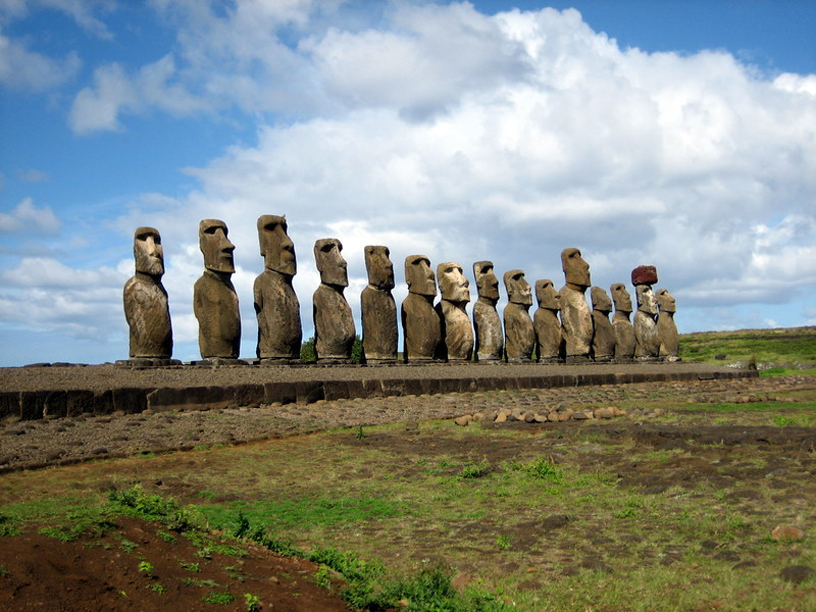
Paleogenetic Lars Fehren-Schmitz from the University of California at Santa Cruz and his colleagues published a study of the genomes of the inhabitants of Easter, who lived before the opening of the island of Europeans. The results refute the hypothesis about the possibility of contacts of the ancient inhabitants of South America with the island of Easter in the Derusive era.
The idea of the possibility of traveling ancient inhabitants of South America to the islands of Polynesia arose among different scientists repeatedly. In a radical form, it sounded like a hypothesis about the American origin of the Polynesians. In moderate - as a hypothesis about the ancient cultural contacts of these two regions. In any case, the island of Easter was usually in the focus of attention - the extreme eastern point of a huge imaginary triangle, which contains polynesia. The distance between the island and the South American coast is 3514 kilometers.
The radical hypothesis has never been taken particularly seriously. The evidence was too great that the settlement of Oceania came from Asia, and not from America. In favor of this, archaeological finds and ethnographic data said. Now historians are mainly discussing the sequence of migrations of future oceans by the islands and their chronology, not doubting that they came from Asia.
The linguistic study of the languages of Oceania also confirmed the Asian origin of the Oceanians. All languages of Polynesia demonstrate a rather clear relationship and enter the huge Austronesian language family. The ancestral home of this family was very likely to be on the island of Taiwan. There are no exceptions to the Rapanui language - the language of the natives of the island of Easter. It is part of the Polynesian group of the Austronesian family of languages, and the mangarean language used on the island of Mangarev in the eastern part of the Tuamota archipelago is closest to it. Almost 80 % of the dictionary coincides in these languages. The Rapanuans and native speakers of other Polynesian languages are well understood: Thaitansky, Tonsky, Hawaiian, Maori. When James Cook visited the island in 1756, who was on his ship, the Polynesian Hitikhiti, originally from the island of Bora Bor, could communicate with the locals.
But for the moderate version of the hypothesis about the ancient American-Polynesian connections, the enthusiasts always had any confirming facts, which did not allow us to reset this version completely. Their most significant argument was the battal - an edible plant, which was widely used by the Polynesians before the appearance of European sailors in their region. Radiocarbon dating of the remains of the battles found on Cook Islands showed that it grew up to 1000. Since the homeland of the battal is South America, it should be at some point brought to the island of Easter, either the South American peoples who made a long journey, or the Polynesians themselves, who reached South America, and then returned back.
Another observation was made in 2008 in the study of one Peruvian mummy. It turned out that the wood resin used for embalming belongs to a variety of araucaria, common in Oceania and New Guinea. The dating of the resin and the mummy itself showed that they have the same age and dates back to about 1200.
They also recall the small island of Sala-i-Gome, lying 3220 kilometers west of the American coast and 391 kilometers east of Easter Island. The Polynesian name of this island of Manu-Moto-Motiro-Khiva is translated as a “bird island halfway to the ground”, which indicates that South America was known to the Polynesians. In addition, they also called their legendary ancestral home the word Khiva.
The most known to the general public the journey of the Kon-Tiki team in 1947 from the Peruvian port of Callao to the Atoll Rrois in the Tuamot archipelago. The organizer of this swimming tour Heyerdal was an enthusiast of the US-Polynesian hypothesis in its most radical version. The journey of Kon-Tiki confirmed the possibility of achieving the Polynesian islands by residents of South America in antiquity, but could not prove that this really happened. Adherents of the opposite hypothesis also arranged voyages on reconstructed ancient courts. For example, in 1999, the Hawaiian canoe “Hokulea” overcame the path from the island of Mangarev to the island of Easter in 19 days.
They are trying to see another trace of American influence in the legends of the island of Easter, which said that two people of Hanau Eep lived on the island, which translated as “long-eared” or “thick”, and Khanau-Momoko “short-eared” or “skinny”. There was a war between them, in which Hanau-Momoko became the winners. The tour Heyerdal believed that Hanau Eep was the first settlers on the island and arrived from South America, and Hanau-Momoko appeared there later, belonged to the Polyneisian peoples, and occurred, according to Heyerdal, from the Pacific coast of North America. Modern researchers see in Hanau-Eep and Hanau-Momoko or two different groups of Polynesians who arrived on Easter Island independently, or representatives of two clans, or two social groups of the local population, or consider this story to be a myth that did not have a real historical basis.
In some of the scenarios of ancient American-Polynesian contacts, the main role is not the island of Easter. So, according to one version, the inhabitants of the Hawaiian Islands and Chumashi - the Indian people from Southern California met with each other. The version is based on the similarity of the design of tomolo - traditional boats in the Chumash - with canoeing, used in Hawaii. Even the Tomolo's Chumash word, denoting these boats, turned out to be similar to the Hawaiian term Kumula'Au, denoting logs that go to the manufacture of boards for lining canoe. However, most historians deny the possibility of such influence, indicating that the development of the tradition of building tomolo is well traced through archaeological data.
In 2007, scientists talked about finding in Chile in a territory inhabited by the people of Mapuche, chicken bones dated 1304 - 1424, that is, before the arrival of the Spaniards in South America. A genetic study then showed the similarity of the DNA of these chickens with chickens, which was bred by the inhabitants of the islands of Samoa and Tong. However, a year later in a new study, this conclusion was refuted . Hens hit the south of Chile through Latin America and, ultimately, from Europe.
Dutch linguists Willem Adelaar and Peter Muysken suggested that two words could indicate the contacts of Polynesians and South American. One of them is the name of the already mentioned battal. In the languages of Kechua and Aimara, one of his names - K'UMAR or K'UMARA, may be associated with the Polynesian word *kumala, which was reflected in the Rapanuisky Kumara, Hawaiian ʻuala and the Maorian kumāra. Another word means a stone ax. On Rapanuysky and in the language of Maori, it is called toki, also this word sounds in the language of makuche in Chile. At the same time, Adelar and Moysken emphasize that their finds can only indicate brief contacts between peoples, and not of any resettlement.
Since the 2000s, genetic studies of possible ties between the peoples of Oceania and South America began. But their results were contradictory. In 2004, a group of researchers did not discover the connections between the Rapanuans and the South American Indians either in mitochondrial DNA, or in the Y chromosome, but found South American alleles at the genes of the main complex of histosion of the Rapanuans. In the work of 2010, genetic data confirmed the origin of the peoples of Oceania from East Asia.
In 2014, an article was published in Current Biology, which analyzed the genomes of 27 modern Rapanuians for more than 650 thousand one -bloodleotid polymorphisms. The authors of the study came to the conclusion that about 8 % of the DNA of the Rapanuans were received from the South American Indians. At the same time, the DNA chains of South American origin were relatively small length, which spoke of long contacts. The calculations showed that the meeting of the Rapanuans and Indians was supposed to happen 19 generations ago, between 1280 and 1495.
Another study of 2016, where, along with modern genomes, the ancient DNA of three residents of the Vanuatu archipelago (age 3100-2700 years) and one resident of Tonsu (about 2700-2300 years) confirmed that the settlement of Polynesia was begun from the region of New Guinea and the surrounding islands.
In the current study, also published in Current Biology, samples of ancient DNA were used from the remains of the inhabitants of Easter Island, which were found by archaeologists in the 1980s. Of these, three lived in 1445-1624, and two in the years 1815-1945, that is, after contacts with Europeans. Lars Feren-Shmitz and his colleagues analyzed both mitochondrial and nuclear genome. In both cases of traces of the South American genes, the ancient Rapanuians could not be found. The genes of the first three Rapanuans testify to their connections with the inhabitants of East Asia and to a lesser extent - with the Papuan peoples of the New Guinea. But the genes of those who lived in the 19th and 20th century reflect the connection with Europeans and South American, but this is not at all what the supporters of the hypothesis of early contacts would like to hear.
The geneticist Anna-Sappho Malaspinas (Anna-Sapfo Malaspinas) from the University of Lausanne, which headed the 2014 study, confirmed the possibility of contacts, proposed its explanation of new results. In her opinion, people whose remains were investigated by Lars Feren-Schmitz lived when South American genes have not yet spread among the population of the island. And a larger study of the ancient remains should reveal traces of the South American genetic heritage.
Lars Feren-Schmitz considers it differently. According to his explanation, the short chains of South American DNA came to the inhabitants of the island no earlier than the XVIII or even the XIX century, when slave traders from South America began to regularly visit the island of Easter. Since on the continent of the mixing of descendants of Europeans with the indigenous population it began in the 16th century, after three centuries, the South American trace in the DNA just took the form discovered in the 2014 study.