
Translated material
Unfinished path
“Foreign intrigue”, “a bunch of young people rained”, “unsteady rams” - so the authorities and conservative publicists characterized the first political rally in Russia, which happened 140 years ago. And the first large demonstration of protest in Russia was arranged in 1861 by students of St. Petersburg University. History of protest in the Fatherland - Article second
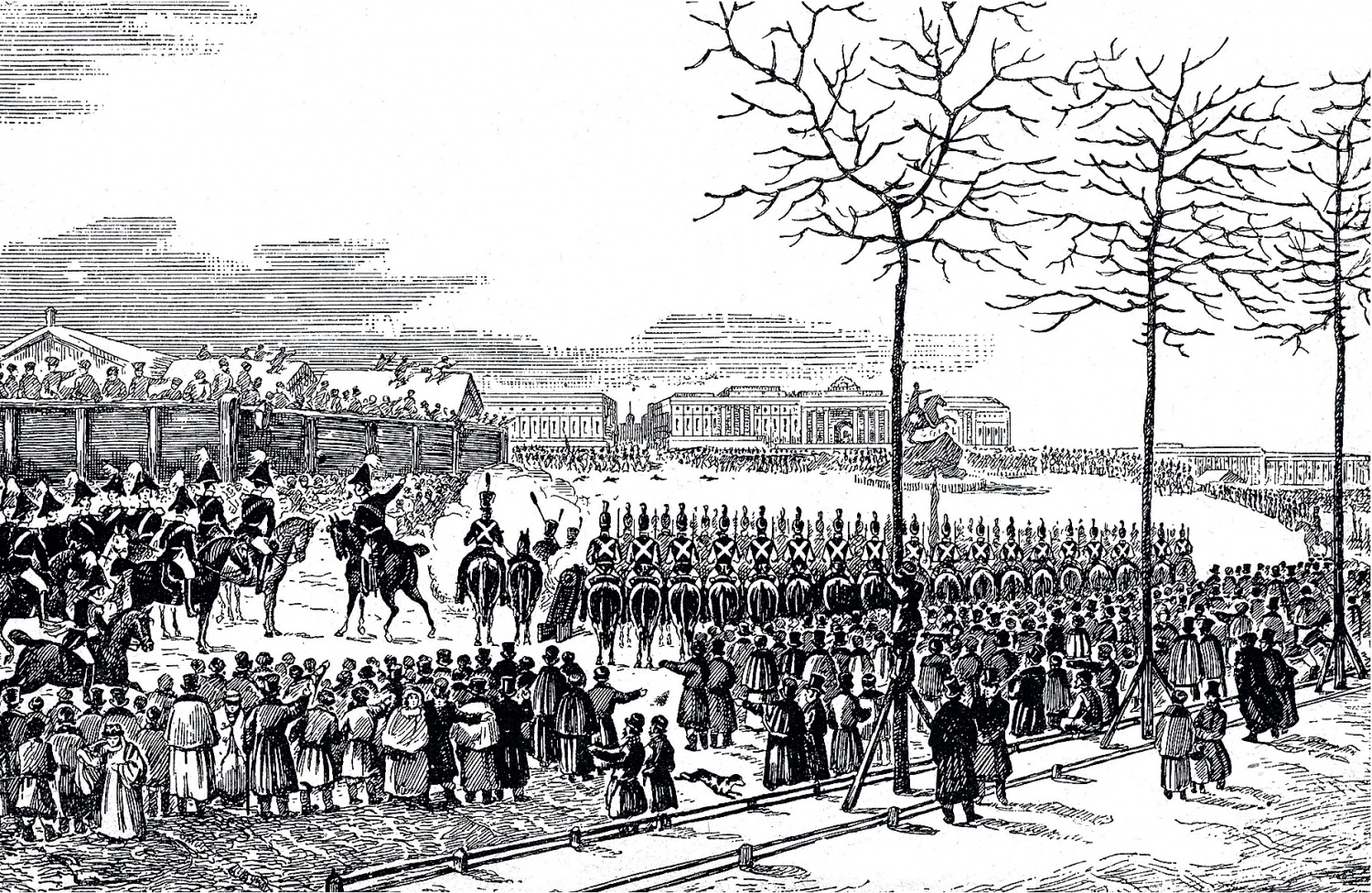
Karl Kolman (1786–1846). "The Decembrist uprising on Senate Square in St. Petersburg, December 14, 1812"
The emergence of political demonstrations and rallies, peaceful and not very, is customary to attribute to the era of the Great French Revolution of 1789. In Russia, opposition processions and rallies began almost a century later than in France and America.
First December
The “new Decembrists” are sometimes called participants in peaceful protests in Moscow and other Russian cities in December 2011. Meanwhile, it is quite difficult to call a rally or demonstration an attempt by a political coup, undertaken by real Decembrists - officers of the Russian Army on December 14, 1825. Armed people who refused to take the oath to Nicholas I after the death of Emperor Alexander I reached Senate Square. The actions of the Decembrists were passive, but not peaceful: the Decembrist Kakhovsky mortally wounded the hero of 1812 General Miloradovich, sent for negotiations with the rebels and who called to disperse them.
Around three thousand soldiers and several dozen officers on Senate Square, a crowd of onlookers quickly gathered. Its number, according to historians, amounted to 20-30 thousand people. At first they thought that the exercises were going on, but, having figured out, many began to support the Decembrists. Stones and even logs flew into a police cordon and government parliamentarians. As one of the eyewitnesses recalled, "three thousand soldiers and ten years more people were ready for everything according to the man’s wave." The air clearly smelled of a Russian rebellion. Apparently, the Decembrists, who did not seek to indulge the “ink” instincts, also understood this - this is how the townspeople gathered in the square were called in the documents of that time. It is significant that the first battlefield on that day was given not on the rebellious regiments, but just on the onioned on the neighboring roofs. During the suppression of the uprising “terribly distant from the people”, the conspirators most of all died precisely “ink” - 903 out of 1271 people, according to the calculations of the official of the Ministry of Justice of Korsakov. As a result of the shooting of the crankcase, among the killed, 79 women and 150 minors who obviously were not directly related to people in their form were among the dead.
OCCUPY bell
The first large demonstration of protest in Russia was arranged in 1861 by students of St. Petersburg University. On September 25, the very year when Tsar Alexander II canceled serfdom in Rus', his young subjects arranged a march along Nevsky Prospekt. The final point of this splash of “Walking” was house No. 2 on the bell lane, where the head of the St. Petersburg training district of Filipson lived. Students intended to receive explanations from him about the new “temporary rules” of university life accepted in the summer. The first “thaw” in the history of Russia was gaining strength, and the Ministry of Education suddenly decided to prohibit informal student gatherings, concerts and public lectures that have already become familiar. It was impossible to make lithographic copies of lectures - officials were afraid that, under the guise of copying in the student environment, samizdat would blossom. The cash desks of mutual assistance were closed, and at the same time the mandatory fee for attending lectures was introduced. The latter was very much hit by poor students from the families of a raznochintsy.
The youth action occurred so unexpectedly that the authorities were not immediately oriented. Grigory Filpson, a general who, in the recent past, commanded the Cossack army, although he was furious by the impudence of the Yunts not trained combat training, nevertheless even deigned to accept student activists at home. The troops called to the rescue did not particularly touch anyone, but the next day the arrests began. Many young people fell into the Peter and Paul Fortress, most soon released, but several dozen people were expelled from the university. In support of the students, the professor spoke: lawyer Cavelin and historian Kostomarov demanded the abolition of police rules. Two days later, 600 students and citizens joined the streets of the capital, students of Moscow and Kazan arranged manifestations. All, of course, were dispersed. The riots caused a resonance in Europe. Youth protests so frightened by the guards that at the insistence of the Admiral of the Minister of Education Putyatin for some time, Petersburg and Kazan universities were closed. But the times, fortunately, were "not the same." Soon, Putyatina with Filipson himself had to resign. Great reforms were just beginning.
The flag on Kazan
He did not give the Constitution or the right to rally the right to rally the country to the country. Among the youth and intelligentsia, radical moods grew. The revolutionary organization “Earth and the will” created in the second half of the 1870s demanded the “impossible”-the transfer of the whole land to the peasants, complete self-government, and freedom of religion. On December 6, 1876, they organized the first political rally in the country's history. Students, careers gathered in Kazan Square in St. Petersburg, and up to 400 people - to support political prisoners. It all started with the real prayer for the health of the writer Nikolai Chernyshevsky, who was in the Vilyui exile of the idol of the idol. The ghost of communism already wandered around Europe with might and main and managed to get to Russia: the rally was noted that one of its participants, the worker, raised the red banner. The Russian Marxist, and in those years, was just a student of the mining institute Georgy Plekhanov debuted as a speaker - called young people to fight despotism. He himself later called this event "the first large fruit of the convergence of the Narodniks with the St. Petersburg proletariat." As the St. Petersburg mayor Trepov put it, “a bunch of young people attended and wore in the arms of some boy who waved a banner with the inscription“ Earth and will ”.
The famous conservative Mikhail Katkov in the leading of the Moscow Vedomosti explained the rally on the Kazan “foreign intrigue” in order to scare Russia with a revolution and weaken its international positions
Seeing the flag, the city whistled. To help them, to disperse “gentlemen and girls in shawls”, cabbages and clerks from neighboring expensive stores arrived. One merchant, walking with his wife and children along Nevsky, also got into a fight on the side of the authorities and then regretted that he managed to “give along the neck” only two. Meanwhile, they grabbed and beat everyone indiscriminately, including random people, even gendarme bonds fell under a hot hand. Many organizers, including Plekhanov, managed to hide.
After a month of accelerated investigation, 21 people appeared before the court. The government has not yet distinguished a rebellion from political protest: the participants in the peaceful action were charged with the preparation of the uprising against the supreme power. One of this was the revolver found at the venue of the rally. The publicists loyal to the authorities went even further. The famous conservative Mikhail Katkov, in the leading of the Moscow Vedomosti, explained everything with a “foreign intrigue” in order to scare Russia with a revolution and weaken its international positions. And he called the protesting oppositionists with “non -strate rams”. As the outstanding Russian lawyer Anatoly Koni recalled, the assistant Minister of Justice Frish suggested hanging troubles, but in the end a more moderate point of view prevailed. The defense of the defense was achieved for three, five were given from 5 to 15 years of hard labor, and the rest were sent to exile. One of the convicts went crazy and died in a prison hospital. He personally beat the other “for impudent behavior”, sent to a punishment cell, after which he ordered the mayor of Treov to carve. This caused the famous attempt on him the revolutionary of Vera Zasulich. Having signed up for an appointment with the mayor, she is hard, but not mortally injured Trepova in the chest.
Pluting demonstrators!
After the murder in 1881, Alexander II, the authorities limited the already small opportunities to express public discontent even more. But “twisting of the nuts” gave only a short result. Since the 1890s, protest activity began to grow again. On April 15, 1891, the funeral of the famous democrat Nikolai Shelgunov turned out to be a seven-thousandth demonstration on April 15, 1891, and two weeks later the first Mayevka took place in St. Petersburg. On February 19, 1901, an action was held on Kazan Square against the draft of students in the army.
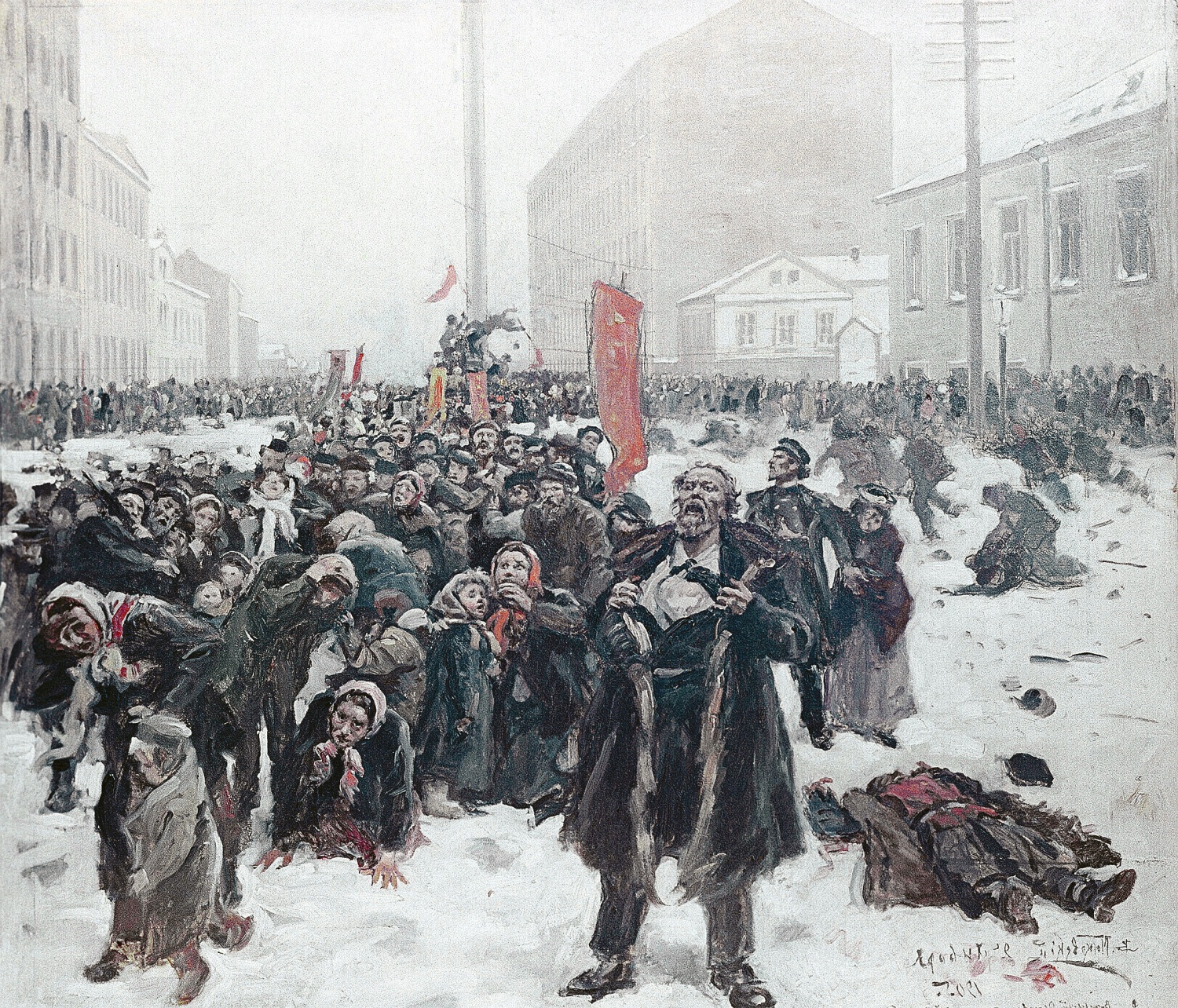
Vladimir Makovsky (1846–1920). "January 9, 1905"
The most famous pre-revolutionary mass action, which became an impetus for the revolution, is the “bloody Sunday” on January 9, 1905, when the troops shot a 140 thousandth and generally loyal procession of St. Petersburg workers. Meanwhile, the execution of the demonstrators was by that time already ordinary practice. The bloody scene in Odessa from the film "Bainstock Potemkin", although it was the directorial fiction of Eisenstein, turned out to be consonant with the memory of contemporaries. Only in 1903, shooting at protesters in Kyiv, Yekaterinburg and Zlatoust claimed dozens of lives. Soon after January 9, executions followed in Riga and Lodz. In the 1905 revolution, the Cossacks began to throw against the demonstrators. During one of the protests, the future activist of the Cadet Party and the Soviet academician Tarle received the Cossack checker in the head on the head. The executions did not stop even after the adoption of the manifesto on October 17, 1905, which granted the freedom of assembly, among other democratic rights. Literally the very next day in one part of the then Russian capital was a permitted highway, and at the same time at the other end of the city, they fell from rifles on working demonstrators. In February 1917, the troops, as we recall, refused to shoot at the people-there was a democratic revolution. But already on July 4 of the same year, the new democratic authorities opened fire on a rather aggressive, in fairness it should be noted, the procession of anarchists and socialists. "Sweep, tyrants!" - Such a slogan was carried by Moscow students on October 15, 1917 on Red Square. Which of them then guessed what tyranny was prepared by the country?
A hopeless business
The last time in the advice of the opposition (though only intra-party) was allowed to go outside on the 10th anniversary of the Bolshevik Revolution-November 7, 1927. The Left Blade demanded to fulfill the will of Lenin. But since Ilyich’s only heir proclaimed himself, Comrade Stalin personally proclaimed himself to the very Khrushchev “thaw” in any protest activity in the USSR. All those years from the cellars of Lubyanka and from Kolyma was blowing with deadly cold. After Stalin’s “oprichnina”, a new “rebellious age” followed: Krasnodar, Murom, Aleksandrov, Biysk ... The most tragic page then became the Novocherkassk execution on June 2, 1962. Around the same time, the manuscript leaflet of anti -government content for the first time in many years appeared on Gorky Street in Moscow, and in Vyborg, one worker tried to walk around the city with the poster "Down with new prices!" - Against the next rise in price of meat with a common and familiar Soviet shortage of products.
Until the Khrushchev’s “thaw”, there was no need to talk about any protest activity in the USSR. All those years from the cellars of Lubyanka and from Kolyma was blowing with deadly cold
The dissidents, who continued the traditions of Russian revolutionary democrats, all started almost from scratch. The first action on December 5, 1965 on Pushkinskaya Square in Moscow is very reminiscent of the Kazan Miting of 1876. "Respect the Soviet Constitution!" - Here is the requirement of the “impossible” in those years. Then there was a “demonstration of seven” on August 25, 1968 on Red Square against the introduction of Soviet troops into Czechoslovakia. A little less than 20 years later, on August 21, 1988, the police on Pushkinskaya blocked the rally attempt, undertaken by the Democratic Union - the first non -Soviet political party in the USSR.
The violence apparatus continued to operate even in the midst of Gorbachev’s perestroika: on April 9, 1989, the bloody acceleration of the opposition rally in Tbilisi took place. A little more than a month passed, and on May 21, on the occasion of the opening of the Congress of People's Deputies, the first major rally of democrats gathered in Luzhniki. In 1990-1991, hundreds of thousands of Muscovites gathered democratic rallies. The top of this wave was the three August days of the putsch: the Soviet government fell through the efforts of several dozen, and then hundreds of thousands of White House defenders on the Krasnopresnenskaya embankment of Moscow.
Alas, after more than twenty -odd years it is obvious that this victory was far from final. A difficult, full of steep turns the path to freedom continues to this day.
Protest chronicle in the USSR
On November 7, 1927, representatives of the anti-Stalinist opposition within the CPSU (b) came out in the column of demonstrators on the occasion of the 10th anniversary of the October Revolution. Representatives of the “left slope” went under the slogans “We will fulfill the will of Lenin!” And "For genuine working democracy!" This was the last legal performance of the opposition after the 1917 revolution.
On January 15–16, 1961 , mass riots in Krasnodar, an attempt to storm the military commandant’s office, anti -Soviet slogans, the defeat of the regional committee of the CPSU, the head of the city committee of the party were thrown by stones. The crowd was scattered by the KGB forces, according to the results of the riots, the authorities executed two instigators, active participants in the riots received long prison terms.
On June 30, 1961, a riot in Murom during the funeral of a worker who died due to the negligence of the police authorities. The rally of the local ATS ended with a pogrom and arson. Three were sentenced to death. In July, in Aleksandrov, a riot under the slogan "We will arrange, as in Murom." The authorities executed four, five more received 15 years each.
On June 1-2, 1962, the strike and a rally of workers in Novocherkassk, the authorities used tanks, at least 24 people died as a result of the execution of the demonstrators and at least 87 was injured. Dissatisfaction was caused by the next increase in meat and oil prices. In early June, anti -government leaflets for the first time in many years appeared in Moscow on the street. Gorky.
On December 5, 1965, a political action of protest was held on Pushkinskaya Square in Moscow. The organizers are Alexander Yesenin-Volpin, Valery Nikolsky, Yuri Titov and Elena Stroeva. They demanded the publicity of the process over Andrei Sinyavsky and Julius Daniel. The main slogan: "Respect the Soviet Constitution!" The rally was attended by 200 people.
On August 25, 1968, Konstantin Babitsky, Tatyana Baeva, Larisa Bogoraz, Natalya Gorbanevskaya, Vadim Delone, Vladimir Dremlyuga, Pavel Litvinov and Viktor Finberg arranged an action on Red Square against the input of Soviet troops into Czechoslovakia. Participants were convicted of different terms of links and camps, and Natalya Gorbanevskaya was determined by the special psychic hospital.
On November 22, 1987, one of the first protests permitted by the USSR authorities was held in Irkutsk-a rally of “Baikal’s movement in defense” against the construction of a pipe for discharge of wastewater in the Baikal pulp and paper plant into the Irkut River.
On August 21, 1988, an attempt of an unauthorized rally on Pushkinskaya Square, undertaken by a democratic union, dedicated to the 20th anniversary of the input of Soviet troops into Czechoslovakia. The slogans of the rally: “Down with the Warsaw Treaty!”, “To withdraw Soviet troops from Eastern Europe!” After the rally in the USSR, police police were created (riot police).
On April 9, 1989, the night acceleration “sapper shovels” of the 10,000th rally in Tbilisi at the Government House with the slogans of Georgia's exit from the USSR. The organizers of the rally were Zviad Gamsakhurdia, Merab Kostava and Irakli Tsereteli. 19 dead, about 4 thousand victims.
On May 21, 1989, the “All -Union” rally in Luzhniki, organized by democratic forces on the occasion of the opening of the I Congress of People's Deputies of the USSR. The declared number of participants (50 thousand people) was exceeded at least three times.
On February 4, 1990, the procession from the Crimean bridge to Manezhnaya Square in Moscow with a demand for the abolition of the 6th article of the Constitution of the USSR “On the leading and guiding role of the CPSU”. Over 200 thousand people took part in the action. On February 25, on Zubovskaya Square, a rally in support of the democrats in the elections to the Supreme Soviet of the USSR gathered 600 thousand people.
On January 14, 1991, the rally of the Democratic Russia movement on Manezhnaya Square in solidarity with the struggle for the independence of Lithuania and in support of Boris Yeltsin. The number of participants reached 100-500 thousand people. On March 28, a rally on Manezhnaya Square in support of Boris Yeltsin and for the resignation of Mikhail Gorbachev gathered 200-500 thousand people.
On August 19–21, 1991, rallies in Moscow against the GKChP, the action of the White House defenders on the Krasnopresnenskaya embankment, where the Supreme Council of the RSFSR was located. The total number of participants in street shares amounted to several tens of thousands on the first day to 200-400 thousand people for all days of the August coup.
First published in NT No. 28 (255) of September 10, 2012 .
The first article is in NT No. 25 of August 20, 2012 .