
Translated material
Vunderekur
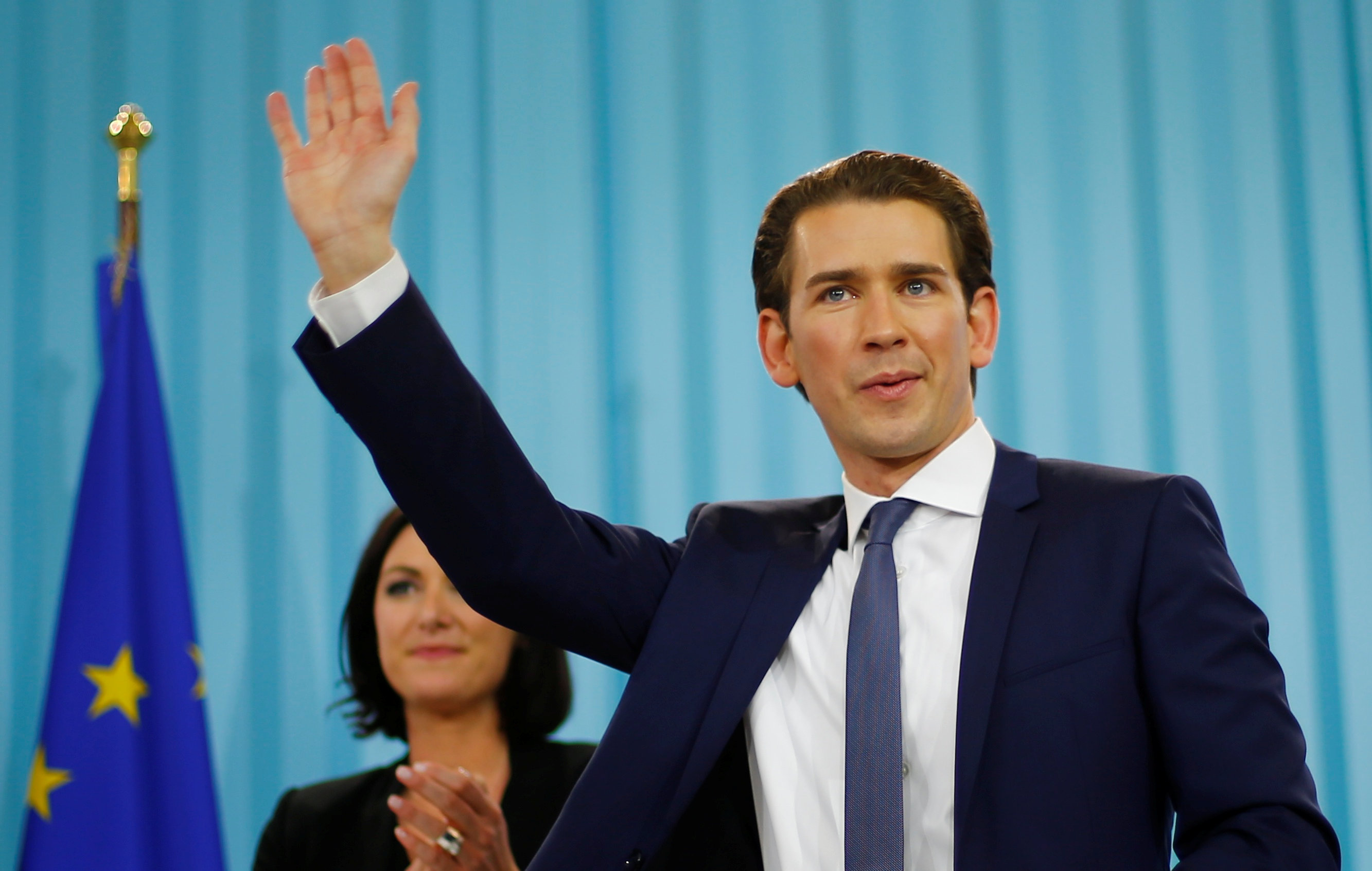
Large pistachio letters, folding into the German word Danke - "thank you" - in the hands of a merrily bouncing young people behind the back of another young man with a microphone. This was the scene in the campaign headquarters of the Conservative Austrian People's Party (abbreviated övp) after the announcement of the preliminary results of Sunday parliamentary elections. A nice young man with a microphone is the most likely future chancellor of the Republic of Austrian, 31-year-old övp leader Sebastian Kurtz. If he really becomes a chancellor, he will be the youngest head of government in Europe, and possibly in the world.
Austria%27s Foreign minister declares Victory in Elemention, Set to Become Europe%27S YOUNGest Leader https://t.co/6zgyf5pjou
- Fox News (@foxnews) October 15, 2017
According to preliminary data, the People’s Party, led by Kurtz, gained about 32 percent of the vote, but in second place there is a fierce struggle between the Social Democrats of the current Chancellor Christian Kern and the Liberty Right Party-both more than 26 percent of votes. The balance of power will be determined by the ballots sent by mail (their counting should end by evening of Monday). Sebastian Kurtz himself reacted modestly to his victory, thanking voters for trust and calling what happened "not a triumph of rivals, but a chance of changes":
Vielen, Vielen Dank Für Das Vertrauen. Der heutige tag ist Keiner des triumphs über andere, Sondern Eine Chance Für Veränderung. 1/2
- Sebastian Kurz (@sebastiankurz) October 15, 2017
Until now, Kurtz, who is often called the "political child prodigy", served as the Minister of Foreign Affairs of Austria - and also the youngest in the world (he entered this position when he was 27). As Deutsche Welle notes , the political career of Sebastian Kurtz, a native of the Vienna district of Maidling and a native of the most ordinary family (father - engineer, mother - teacher), began, even when he studied at school. In the youth wing övp, Kurtz quickly acquired a reputation as the genius of election campaigns, noticeably strengthening the position of conservatives in his native Vienna, where the majority traditionally votes for the Social Democrats. The actor and patron of Sebastian Kurtz in big politics was considered an influential conservative, the former vice-chancellor of Austria Michael Spindlegger -it was his Vienna Political Wunderkind in 2013 as Minister of Foreign Affairs. At the same time, at that time, the young minister was an unfinished student who postponed his classes at the Law Faculty of Vienna University-the case in European politics is again unique. Sebastian Kurtz Holost, his friend Suzanne Tyr is an employee of the Austrian Ministry of Finance.
The youth of the most likely new Chancellor of Austria cannot be considered a synonym for inexperience, political analysts emphasize. He has more than one year of political work, and, as the Austrian political scientist Peter Filzmeier notes , Kurtz himself sees himself "a kind of conservative macron or treud", but is unlikely to the Austrian analogue of Donald Trump or Victor Orban. In favor of the fact that Kurtz, despite the “gentle” age, a skilled politician, says the fact that in a matter of months he transformed the People’s Party, weakening traditionally strong regional organizations, introducing several popular personalities that were previously not related to politicians to the pre -election campaign with traditional conservatives to Pistashkaya, to the lists of candidates instead of party bureaucrats.
Kurtz, despite youth, quickly became a completely independent and popular political figure. Being-before becoming the head of the diplomatic department-a state secretary on integration, he "saddled" the topic of migrants, who, after the crisis of 2015, became one of the most burning in the Austrian political debate. Kurtz supported the "Law on Islam", in particular, prohibiting financing from abroad of new mosques in Austria. He advocated reducing benefits to persons who received asylum in the country, and more active measures to integrate them - in particular, a mandatory attending German language courses. Kurtz actively advocated the closure of the "Balkan path", along which hundreds of thousands of migrants moved to central and Western Europe in 2015-16, and strengthening the external borders of the European Union.
At the same time, the young minister manages to say all this, without sliding down to hysterically, Xenophobic rhetoric and frank euroskepticism, characteristic of the right-dressing party of freedom. The left subjected Kurtz to criticize, stating that under him the People’s Party became the "Freedom-Light" party. The leader of the “free” Hinz-Cristian Straha himself said that Kurtz actually stole “their” political slogans from the ultra-right, only a little softening them. The word vordenker appeared on the pre -election posters of the stance, which can be translated as a “forerunner” or “spiritual father”. Supporters of Kurtz-he himself is distinguished by the ability to conduct polemics extremely correctly and diplomatically-responded with ironic attacks to Strach: Denker denotes the “thinker”, and with this, they hinted at the fan club of Kurtz, the leader of the Freedom Party is somehow not very good.
This skirmish, however, is unlikely to prevent the cooperation of two right -wing parties in the framework of the new ruling coalition. More traditional for Austria is the Union of the People’s Party and Social Democrats, but Sebastian Kurtz ruined this coalition, becoming the leader of övp in May of this year. The calculation was a success: the rating of conservatives from the moment Kurtz headed the party increased by 10 percent, and the election results speak for themselves. Chancellor Kristian Kern has already stated that the Chancellor was not against negotiations with the winners, but noted that the programs of conservatives and “free” intersect too many points, and it would be easier for them to agree among themselves. Many Austrian voters do not like this: the collection of signatures under the petition of protest against the possible entry of Hinz-Christian Straha and his one-party people to the government began:
The Austrian writer Robert Menasse, in an interview with the Italian newspaper, La Repubblica even called Kurz the "puppet Straha." The Freedom Party actively criticizes the European Union, primarily in the field of security and migration policy, acts with anti -Islamic and pro -Kremlin positions. (On this collage, Hinz-Christian Strache rites the EU flag):
Strache has repeatedly expressed in the spirit that sanctions against Russia should be canceled as soon as possible, and the Freedom Party itself concluded an agreement on cooperation with United Russia last year. Representatives of the Austrian ultra -right have repeatedly visited Moscow and even in Grozny . It is difficult to say whether it will be respectable and at first glance unambiguously pro -European Sebastian Kurtz to resist the pressure of the most probable coalition partners. This will be one of the main issues of Austrian policy in the coming months.