
Translated material
Biochemistry of depression
Confidence that nothing can be changed - the strongest provocateur of fear and depression
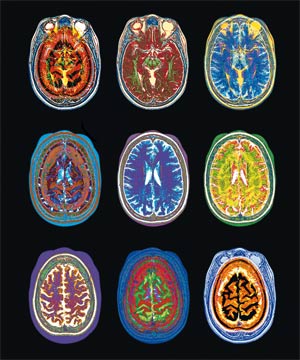
What is fear? The question is by no means trivial from the point of view of scientists studying the work of our brain. There are at least two types of fear. One is rational, which arises when a person sees a completely real source of danger, such as a snake. Another (in English is called anxiety) - this is an irrational fear, emotion, a state of anxiety, when a person cannot understand either a source or the degree of threat. Rational fear is necessary for a person to protect against dangers: he encourages action. The fear of irrational, on the contrary, paralyzes, reduces a person’s ability to think, make decisions and defend himself. The biochemical mechanisms of the brain responsible for these two phenomena are very different.
Brand-defender
When a person sees a snake, the brain department, in which information from the senses is collected*, directs the resulting image of danger at the same time in two different centers - to the center of emotional memory and the center of conscious memory (hippocampus).
* This section of the brain is called "Talamus."
** It is located in the cerebral core, in temporal shares.
The center of emotional memory ** stores in its “Archive” a whole collection of dangers (memory of attacks, accidents), as, indeed, emotions associated with great victories. At the same time, there are dangers, such as the snake that the brain “remembers”, even if a person has never seen snakes before. This is one of the few innate fears, as well as congenital, for example, the fear of falling or fear of loud sounds. Most other fears are laid in this “archive” as a result of a life experience acquired by a person.
Having recognized the danger, the center of emotional memory immediately activates the “conductor” of the hormonal system, and he, in turn, gives the command to the glands of internal secretion to secrete hormones that order the body to increase the pulse and blood pressure, expand the pupils in order to better see, increase the level of glucose in the blood, that is, give a charge of energy, tenses muscles. In other words, the brain creates the conditions necessary for a person to defend or run.
At the same time, the image of danger - snakes - processes the brain department, responsible for conscious memory. This center decides, a poisonous snake or it is just to ignore the danger or escape.
Two centers sometimes conflict with each other: emotions are faster than consciousness. And that is why the reaction is mixed - at first a person will squeeze out with horror, and then he will breathe a sigh of relief: it was only.
Brain-destroyer
Unlike rational, irrational fear - anxious anxiety - often does not help, but on the contrary, it prevents a person from protecting himself from danger and can even lead to suicide. A person, paralyzed by this type of fear, cannot concentrate, make decisions, behaves inappropriately in relation to others, he has headaches and weakness, sleep disturbance and appetite. Neurophysiologist Daniel Amen, who studied patients suffering from obsessive fears, argues that in 80% of cases such fears are associated with depression.
The philistine point of view: Depression is nothing more than the inability of a person to control himself. Meanwhile, studies conducted by scientists of the Harvard Medical School, as well as the University of John Hopkins in Washington, showed that depression is quite material than the stomach ulcer, and is associated with a change in a number of biochemical processes in the brain.
Biochemistry of depression
The biochemistry of depression can be schematically imagined. Imagine that the brain is a building in which there are many rooms (neurons), connected to each other doors (synapses) through which postmen with various kinds of information (nerve impulses) pass. In order to open the doors of these rooms, you need keys - neurotransmitters, that is, the substance responsible for transmitting the signal from one nerve cell to another. When there are too few or too many keys-neurotransmitters, postmen-nerve impulses cannot walk along normal routes and problems begin in the brain.
So, depression causes too low the content of neurotransmitter serotonin. For the same reason, people have different phobias, obsessive fears, bizarre disorders, when a person, for example, begins to check ten times whether he closed the door to his apartment, although he knows exactly what he closed.
In order to compensate for the lack of serotonin, psychotherapists prescribe drugs to patients that make up for this deficiency, such as Proseak, Selection, Zolaf and so on. If you use the same analogy with the keys, these medicines do not allow to put the key under the rug, guaranteeing that it will always stay in the keyhole.
The disadvantage of another neurotransmitter - dopamine - is associated with another group of disorders, when people are afraid that it does not exist and cannot exist. Such people, for example, think that the whole world set out to harm them (paranoia), or begin to see hallucinations and be afraid of monsters.
I must admit that the lack of serotonin does not explain everything, and scientists still do not understand much in the mechanism of depression. Firstly, dozens of keys are neurotransmitters, and in different and numerous parts of the brain they work differently. A large -scale study of various types of fears and depression was carried out in the Daniel Amen clinic in Newport (California) using special computed tomography - photography of activity.
It turned out, for example, that the state of “pure” anxiety is associated with excessive activity in the subcortical nodes of the brain, where a general tone of brain activity is set. When this department is too active, people experience anxiety, when too passive - lethargy and low motivation. Dr. Amen claims that this department is excessively active in some very efficient people. If they stop working, then they begin to experience fears.
There are many reasons that launch the mechanism of fears, phobias and depression. Genetics also plays a role: studies show that if one of the parents suffers from this or that phobia, then with a probability of 50% and children will be predisposed to violations associated with fears and depression, if something is wrong with mom and dad, then the probability of 75–85%. But social factors play a significant role.
"Learned helplessness"
Back in the mid -sixties, scientist Martin Seligman from the University of Pennsylvania discovered the so -called “learned helplessness” effect, which becomes a source of depression and fears.
In one of the experiments, two groups of dogs were subjected to electric shock. Next to each dog from the first group was a lever that could turn off the electricity, which the dogs learned quite quickly and did not experience any problems. There was also a lever next to the dogs from the second group, but it did not work - no matter what the dog does, it still received an electric shock. As a result of such “upbringing”, two -thirds of the dogs from the second group not only received depression, but also lost their will: they did not try to avoid electric shock, even when they were given the opportunity to run away, jumping over a low barrier.
Is this not reminiscent of the realities of the Soviet era when the idea of the impossibility of changing the existing order of things was cultivated, when people were accustomed to the idea that all resistance is useless, even if heroism is not required to solve the problem, but a simple everyday action is needed? And is it not one of the reasons for the low social activity of people and in the post -Soviet period? The authorities will still do as he wants, because, a person says such learned helplessness, there is no point in trying to get out of the aviary. Even if the doors of the aviary have long been open.
First published in NT No. 32 of September 17, 2007 .