
Translated material
Their fears
NT resembles the agenda of the previous (2016) Valdai Forum, as well as other topics discussed by international experts at annual meetings
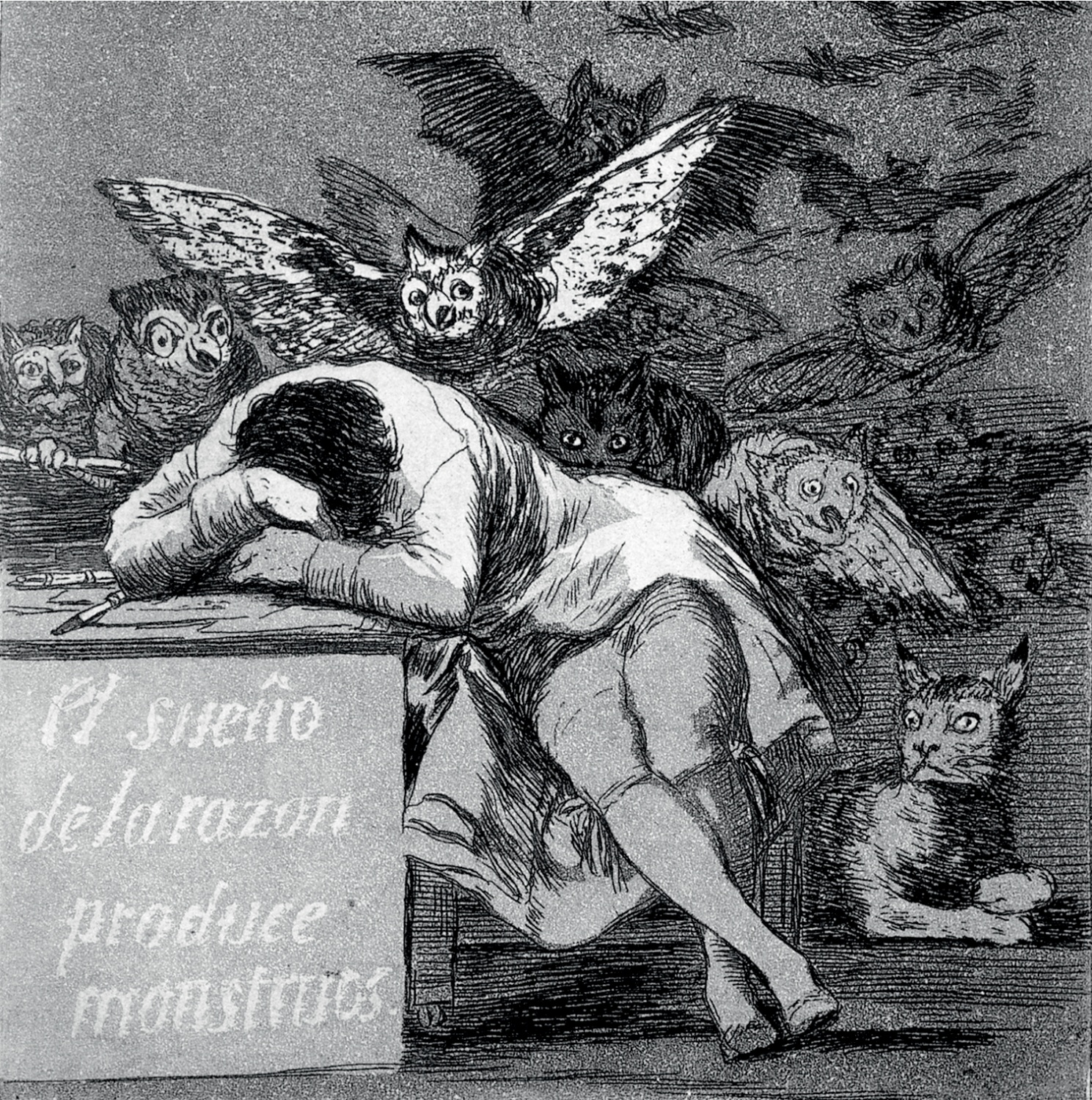
“The dream of the mind gives rise to monsters”, the engraving by Francisco Goya from the Kaprichos series, which could serve as an illustration for many Russian estimates of foreign policy realities
The Russian authorities, tormented by adolescence complexes, have not been experiencing a difficult period of foreign policy concern for a year now. The confrontation of civilizations, the struggle of superpower, the intrigues of European and overseas enemies-these are, it turns out, topics that are more important for television talk shows and final analytical programs than the events within the country. Russians, for example, were aware of the US election in more detail than the elections to the State Duma of the Russian Federation. But all these are products, which offers rather a poetic image of defending at the same time both its sovereignty and peace worldwide than the presentation of a intelligible and consistent doctrine.
Assembly point
However, a systemic presentation of the Russian authorities about the global world order and its place in it still exists, and there is not even the need to reconstruct it by the cries of Vladimir Zhirinovsky or the jokes of the TV presenter Vladimir Solovyov. At least one of the options for such a system presentation is annually offered to discuss the participants of the Valdai club.
Putin in his speech sets out the same theses. Just more intelligibly
The club itself is a ball of contradictions. It is called "Valdai", but which has been taking place in Sochi for a year. It seems to be an unofficial flower of leading experts-political scientists from around the world, but always with the obligatory participation of the first persons of the Russian state and the president itself. Actually, the performance of Vladimir Putin and answers to the questions of the guests are the key event of the forum. It is discussed, it is pulled out for quotes, on the text, as on coffee grounds, they are wondering what actions in the world arena to wait from Russia in the near future. But the forum is not only a meeting of world intellectuals with the President of the Russian Federation and “other officials”: this year, for example, Deputy Prime Minister Igor Shuvalov and the Speaker of the State Duma Vyacheslav Volodin, then the head of the presidential administration Sergey Ivanov and Minister of Foreign Affairs Sergey Lavrov, went to Valdai. The forum is four days of experts, panel discussions and reports. As well as the installation report proposed by foreign guests for discussion, a set of global problems and challenges, which the forum organizers consider the most important at the moment.
The report is a bicoline, like everything on Valdai. Rather, a journalistic than a scientific text prepared by a group of experts, but at the same time marked “not for distribution”. The view of the authors is the position of power. For example, because Putin in his speech sets out the same theses. Just more intelligibly.
Semi -secret document
This year, the reporting report by Timofei Bordachev (the program director of the Valdai Club), Fedor Lukyanov (director of Valdai for scientific work), Dmitry Suslov (HSE), Andrei Sushentsov (another program director Valdai) and Ivan Timofeev (also a software director) is called the Global Bunt and Global Order: The revolutionary situation is in the world and what to do with it. ” The text not intended for the distribution of the document is at the disposal of the NT editor.
The report, like the whole “Valdai”, in addition to others, solves the PR-ditch: showing world intellectuals not evil and terrible, but smart and reasonable Russia and convey to them, but through them to Western elites its own point of view on the processes taking place in the world. It is characteristic that on the Russian side participants in the discussions are not loud regulars of the current show, but university specialists from MGIMO and HSE, scientists, and not necessarily pro-government. The only exception is the writer Alexander Prokhanov.
But, in addition, the report, like any speech, including Putin’s “Valdai” speech, is a way to speak out, tell, sometimes not wanting that, about his own fears and achieve a psychotherapeutic effect. It is from this point of view that we propose to look at the document about the revolutionary situation, which the demograph Anatoly Vishnevsky, one of the participants in Valdai -2016, called the “symbol of faith”, common for Putin, and for serving intellectual personnel. We will understand what they scare - and we will see what they themselves are afraid of. “Paranoya can become a factor in survival if you have a real enemy. And they believe that they are surrounded by enemies, ”says NT political scientist Gleb Pavlovsky.
Fear No. 1: People
The authors describe the revolutionary situation with reference to the “prominent practice of socio-political transformations” by Vladimir Lenin: “The tops cannot, but the lower classes do not want.” The world is included in the phase of the "One World Jar", predicted back in 1992 by American political scientist Ken Jovit. “The tops” are the elites of Western countries that “cannot rule the way”, the lower classes are the Western society, which is afraid of threats of globalization - migrants, Islamic terror and a fall in the standard of living. A certificate of discontent of the lower classes - Brexit, the violation of Europe (and Donald Trump’s victory in the United States - could add the authors of the report, but at the time of its writing in victory no one believed this). Plus-the leading powers of the "non-west" require the "new rules of the game." The transformation of the global device is inevitable, the authors of the report believe, and the only question is whether it will pass peacefully or "the bottom will try to overthrow the tops."
It can be assumed that this is the transfer of outside fashionable talk about stability as the main achievement of Putin. But this is an erroneous path (especially if, reading the text for external use, to remember what propagandists from TV inside Russia say). Any sign of instability in the West from the point of view of propaganda is almost the victory of Russia. At least evidence of the wisdom of her leadership, which foresaw and warned the frivolous “partners”.
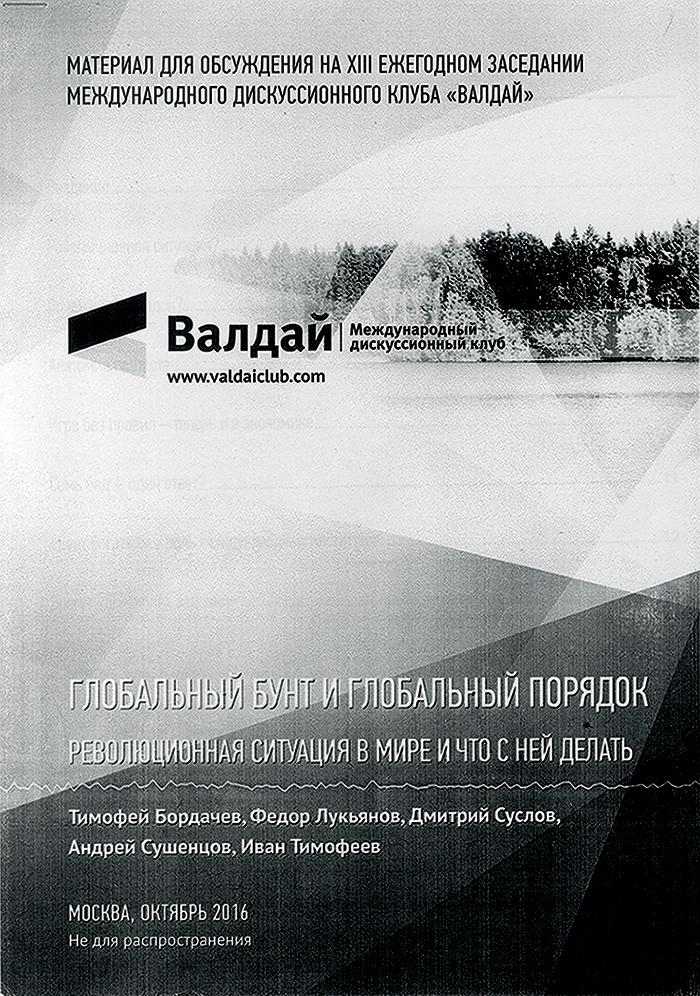
The cover of the very closed report intended for the experts of the “Valdai” cover of the very closed report intended for “Valdai” experts
All more interesting - this is the key saying: "The atmosphere of the crisis and the legality of the ruling class stimulate the activity of the masses and contribute to their involvement in the political struggle." Do not immediately realize that “crisis and incapacity” are not about Russia, but about Western countries. And the possible “involvement of the masses in the political struggle” is the main horror of the Russian government. It is quite inner fear: a couple of weeks after the publication of the report, Russian propaganda will applaud the wise choice of the American people. The democratic dialogue of the people with power there does not scare. Scares - if this happens here. From here, if you distract from the text of the report, and the importance of "popular support" of the initiatives of the Russian government, which was also mentioned at the forum. “According to their (authors of the report) of the opinion, the achievements of the authorities received support, which means what to argue about. The dialogue is not assumed in principle, ”Anatoly Vishnevsky reconstructs this view at the request of NT. The expert is ironic: "Questions can only be from unreasonable forum participants, who patiently explain how everything is actually." Concluding Valdai, it was this “actually” for several hours that the president of the Russian Federation personally explained to the intellectual but “unreasonable” guests.
Fear No. 2: Status
From politics, the authors of the report are moving to the economy, of course, of course, the trouble: “In the last one and a half to two years, the“ game without rules ”has spread to the world economy.” This is even a italics in the text is highlighted to emphasize the importance of the thesis. It is immediately explained what, in fact, the question: “The interdependence and freedom of trade and economic ties <...> today are used to weaken rivals and the information of geopolitical accounts.” And the expected: "The transformation of unilateral sanctions <...> into ordinary practice means that the" liberal order "has ended."
Everything is transparent, although the players are not called by names: introducing sanctions, the West destroys the system, which he himself built, aggravating the “revolutionary situation”.
But there is a deeper fear: according to the authors of the report (by the way, exactly the same was said at the last year’s forum), “the exit from the riots created can be the crystallization of two giant transcontinental communities” - “the spaces of two oceans” (around the United States) and the “spaces of Big Eurasia”. Guests are scared again with instability? No! This is the image of the coveted bipolar world. Alas, from further reasoning about the economic confrontation between China and the United States, it becomes clear that the status of Russia at this feast of powers is modest. Which, perhaps, is not even scary, but still insulting taking into account the officially declared claims. It even turns out that Russia is not a player, but a problem: “Preservation of tension along the Russia -NATO line, especially in the case of a probable new escalation of the Ukrainian crisis, will stimulate the demarcation between the EAEU and the European Union” ... Last year, Sergei Ivanov was happy that the forum participants “almost did not ask about Ukraine - only about Syria”. But even the authors of the main Valdai report cannot forget about Ukraine.
Fear No. 3: Efficiency
And yet - where is the place of Russia in a drawn scheme? Talking about the “degradation of the European Security System” and the loss of NATO “Binding to the real context” by the NATO block, the authors, just in case, twice, note: “The priority attention is paid to one task - the deterrence of Russia”. That is, Russia still has an unenviable role of a “potential enemy”.
But this is not the fear of the prospects of a military conflict with the “most powerful military-political union in the history of mankind” (we recall, later Putin spoke of the inconceivability of such a conflict). This is a fear of their own inefficiency: for the thirteenth time the forum is held, “unreasonable guests” are chewed, as everything is actually, they are welcomed, feed and entertained (in the Valdai program - not only discussions, but also excursions, as well as a concert), and they will still not bring to the elites in their own countries an easy thought: Russia does not need to be restrained. We must agree with Russia.
“The ruling and intellectual circles of the West basically continue to insist on the inviolability of the principles adopted as a result of the Cold War, ignoring the results of their implementation,” the authors of the report state their bitterness, apparently, who apparently appeal to representatives of the intellectual circles of the West.
Fear No. 4: powerlessness
Having shown how the world changes from their point of view and how old views on the world lose their adequacy, the authors of the report turn to the assessment of international institutions, primarily the UN. It would be logical to wait for crushing criticism: the institutions are also a product of the old order. But no: it turns out that international institutions are “the only thing that formally connects us with the relatively legal nature of relations in the world community.” The most important thing is to preserve the “hierarchy of member countries” of the UN and the right of veto for those who have it. That is (we read between the lines) - for Russia. “It is important to achieve unconditional respect for such a rule and guarantee the preservation of this unique right.”
Hope for the exit, at least temporary, from the world of his foreign policy fears gives official Russia the victory of Trump
The fear of losing the right of veto is so strong that the report here loses its science and switches to the language of propaganda journalism. The chapter is full of calls and references to the critics of the veto law, and also reported that attempts to limit universal international organizations are “direct attempt on democracy”.
STRAW
Hope for the exit, at least temporary, from the world of his foreign policy fears gives official Russia the victory of Trump. Fedor Lukyanov, one of the authors of the report, confirmed the assumption NT that the formation of “giant communities” could now slow down. “The mood in the USA, which was expressed in the election results, is as follows: it is necessary to turn global leadership and focus on national interests,” the expert says. And he adds: "Everything that was previously perceived as an instrument of strengthening the position of the United States in a global sense will lose its significance."
Political scientist Gleb Pavlovsky is optimistic in assessing the intellectual abilities of the inhabitants of the Kremlin, but not the prospects for friendship with Trump: "I hope they are not able to madness and do not expect Trump to serve their interests."
But even if Trump lets down, the Valdai club will still remain and its financing will not go anywhere, despite the crisis: simply because Putin clearly likes to meet and talk with Western intellectuals. Popures of the slightly known aphorism of Vyacheslav Volodin, who was born just at the Valdai Club in 2014, say: “There is Putin - there is a“ waldai ”.
First published in NT No. 38 of November 21, 2016 .
For the Valdai forum, see also: “Moscow is the West: the sanctions were damaged, but we continue to put on Trump” , “Eternal Halloween ” , “The Committee for the Protection of Good” , “The Late of the World War II ” .
Photo: wikipedia.org