
Translated material
The wind leaves no chance of the Mongolian hydroelectric power station
Windle and solar stations already occupy 10% of the total electricity production in Mongolia, while the hydropower in this country has a miserable 2%. This is stated in the article “wind stations are developing acceleratedly in Mongolia, which leaves no chance for large dams”, published on the resource of the international environmental coalition “rivers without borders”.
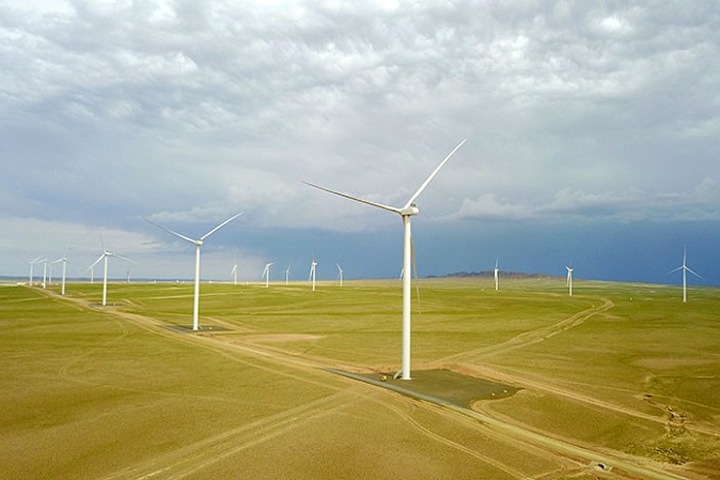
According to the coalition, the joint venture of the Newcom group and the Japanese SoftBank Energy (part of the SoftBank group) - Clean Energy Asia - launched the TSETSII wind park with a capacity of 50 MW in UMNUGOVI province. 25 Vestas V90 turbines were mounted three months earlier than the planned period (earlier they planned to launch the wind farm in December). According to the head of SoftBank Group, Masayshi Sona, “the commercial launch of the TSETSII VES is the first SoftBank Step to build renewable energy sources in Mongolia as part of the Super-GRID Asian project, in addition to India and Japan.”
In January , a large SES with a capacity of 10 MW in Darkhan , which was built by the Mongolian company Solar Power Int. (Design), together with Japanese Sharm and Shigemitsu Shoji. Another windmill with a capacity of 50 MW should earn the next year in Sainshand. According to “rivers without borders”, in October 2017, the structure of the energy generation of Mongolia was as follows: 1020 MW - the volume of production of traditional coal thermal power plants, 28 MW - the release of small hydroelectric power stations, at least 15 MW - SES, 105 MW - VES. About 25 MW - on diesel and other small installations.
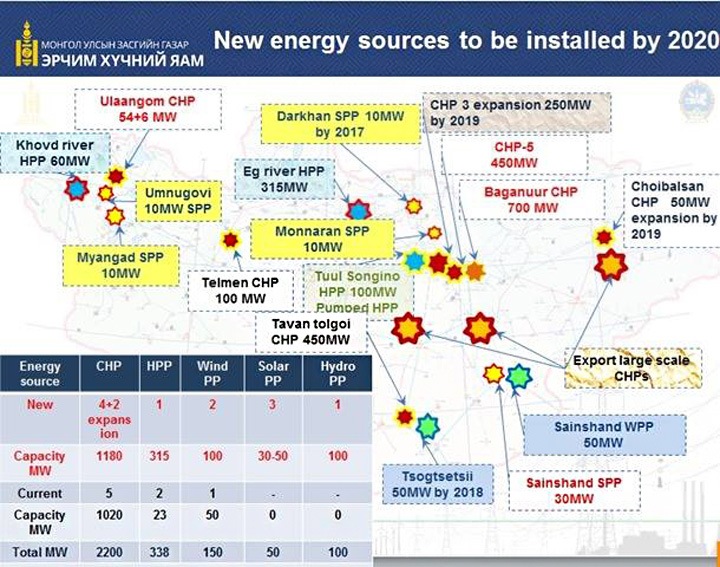
“Wipes and solar panels already make up 10% of the total electricity production, and hydropower is scanty 2%. And the reasons for such a difference are crystal clear, ”says Yevgeny Simonov, international coordinator of coordinator of the coalition. -As expected, all large hydropower projects, declared during the last decade (for example, the Hydroelectric Power Power Power Power Plant, Sharen on the Selenga River, Orchon-Gobi, Erdeneburen on the Hovd River), stalled due to the lack of funding, low-quality technical and social risks, non-disclosure of the conditions of international Conventions, as well as disputes with neighboring countries. Some of the projects, for example, the “Egine-Gol” hydroelectric power station, turned into corruption and ineffective spending of budget funds. These are general problems of hydropower in developing countries. ”
According to Simonov, "none of the large dams in Mongolia will be built (and, most likely, will not even begin to be built) until 2020." Therefore, the coalition expects that the development plans of energy until 2020, voiced by the Ministry of Energy in May 2017, will be adjusted in favor of “True VIE”. Moreover, earlier Mongolia voiced the goal (which, incidentally, is prescribed in the obligations of the country as part of the Paris Climate Agreement) to increase the share of renewable stations in the generation structure to 20% by 2020 and up to 30% by 2030.
“If the government of Mongolia is seriously configured to doubling the share of renewable sources by 2020, then it can achieve this only by accelerated construction of wind and solar power plants. It is possible that the pumping drives (accumulating stations), as well as a radical shift as networks control, can also be needed to ensure maneuvering, ”Simonov is sure.