
Translated material
Great family
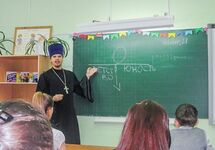
The Russian Orthodox Church invited the Ministry of Education and Science to include the Moral Foundation of Family Life in the mandatory school curriculum, Kommersant reports . The idea was supported by the Association of Parental Committee and Communities, the department also reacted positively to it.
A few years ago, this course was developed by the Yekaterinburg priest Dmitry Moiseev and the nun of the Middle Ural Convent (Krygina). The course should introduce high school students to "basic family values inherent in domestic culture", as well as prepare adolescents for "creating a strong large happy family."
According to the head of the Association Olga Poykova, at her meeting with the Deputy Minister of Education and Science Tatyana Sinyugina, an agreement was reached that the issue of entering the course into the program will be considered in November. At one of the closest meetings of the educational and methodological association under general education at the Russian Academy of Education, experts will decide which subject should include the course and how many hours it is necessary to study it.
In May 2015, the Russian Orthodox Church already proposed to introduce the course "Moral Fundamentals of Family Life" into a compulsory school curriculum . “We need to try to change the moral state of our society by all available means,” said Archpriest Dimitri Smirnov, chairman of the Patriarchal Commission on family and childhood. “School education is a certain crutch that is given to parents with which they could expand the possibilities of children and prepare them for adulthood.” The course was tested in a number of regions, but the past leadership of the Ministry of Education and Science refused to make it mandatory.
In November last year, the head of the Synodal Department of Religious Education and Catechization Deacon German Demidov said that the course “Fundamentals of religious cultures and secular ethics” included in the program must be expanded . According to him, until the subject is adequately represented in the clock, "it will not be a serious attitude to it, there will be no high -quality training of textbooks and professional teachers."
"Now the task of compulsory teaching from 1st to 11th grades is not worth. During the period of testing of the Orksa course, there were many proposals about the prospects for its expansion, and in particular about teaching, for example, in the 4th, 8th and 10th grades, in order to talk about some basics in elementary school, then at the main stage about the main content of the Orthodox tradition and discuss some worldview issues in high school," - said the deacon.