
Translated material
The area of captivity = 0.33 sq.m.
The Gulagovsky standard for the transportation of prisoners was approved by the police chief Andrei Nechaev. He was detained right at the Avtozakov exhibition. Now he learned how close the framework of the law
On October 18, 2017, the Basmanny District Court of Moscow sent under the arrest of the acting head of the Scientific and Production Association “Special Technique and Communications” (NGO “SES”) of the Ministry of Internal Affairs of Russia Andrei Nechaev, suspected of corruption crimes. A day earlier, according to Kommersant, Nechaev was detained by the FSB officers at the opening of the XXI International Exhibition of Safety of the State of Interpoltek -2017, the invariable part of the exposition of which is the police carriers. Those same auto -zaks, the inquisitive standard of which, which is leaving with its roots in the era of the Stalin Gulag, Andrei Nechaev as the head of the NGO “SHIS” approved - by irony, it turns out that for himself personally - in August 2016.
Travel to the Gulag and back

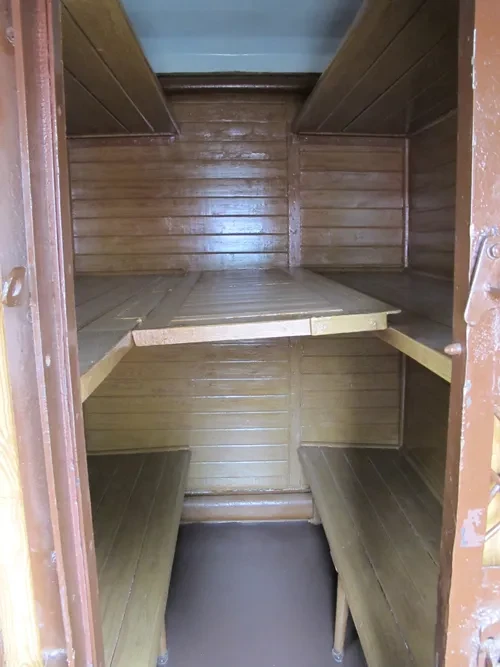
Bagonzak from the collection of the Museum of the History of the Latvian Railway in Riga is the only special vehicle that has been preserved in the world, transporting prisoners of the Stalinist concentration camps. In the spring of 1940, it was in such prison wagons made in Leningrad at the Egorov caring plant, the NKVD officers sent to the places of mass executions of Polish prisoners of war. According to the information received by me from the museum directorate, the cells for prisoners in the Riga carriage have an area of about 3.6 square meters. m (170 cm in width and from 213 to 215 cm in depth). When placing 11 prisoners in the prison coupe (about such an official norm of its maximum filling, Alexander Solzhenitsyn wrote in the Gulag Archipelago), about 0.33 square meters will account for each prisoner. M personal space, which approximately corresponds to the area of five sheets of A4 format.
Many penitentiary escort services, which were in the post -socialist countries at the time of their accession to the Council of Europe, were also based on the Gulag standard “0.3 square meters. m for one prisoner. " This is evidenced by the earliest reports on visiting such countries by the delegations of the European Committee on the prevention of torture and inhuman or humiliating human dignity or punishment (ECPP).
Thus, the ECPP delegation, which visited Poland in 1996, discovered a prison car produced in the Polish People’s Republic in the Warsaw-Balolenza pre-trial detention center based on the Star truck, each of the two cameras of 3.8 square meters. m and was designed for transportation up to 12 people. In his report, published on September 24, 1998, ECPP came to the conclusion that such a car is unsuitable for long -term transportation of 24 prisoners. According to the results of this visit, the Committee also pointed out the inadmissibility of using poorly lit and insufficiently ventilated single chambers with an area of 0.5 square meters for transportation on roads. m.
The Russian Federation became a member of the Council of Europe on February 28, 1996. On May 5, 1998, the European Convention on Human Rights (ECHF) was mandatory for our country, Article 3 of which prohibits torture and other forms of humiliation of human dignity.
However, the values of a democratic society, which are guarded by the ECCH, turned out to be alien to the NGO “SHIS” group. As a profile developer of the relevant technical standards, the unification is consistently on guard of the Gulag idea that the “crook” in the autozak is enough 0.33 square meters. M personal space.

"Glass" for two
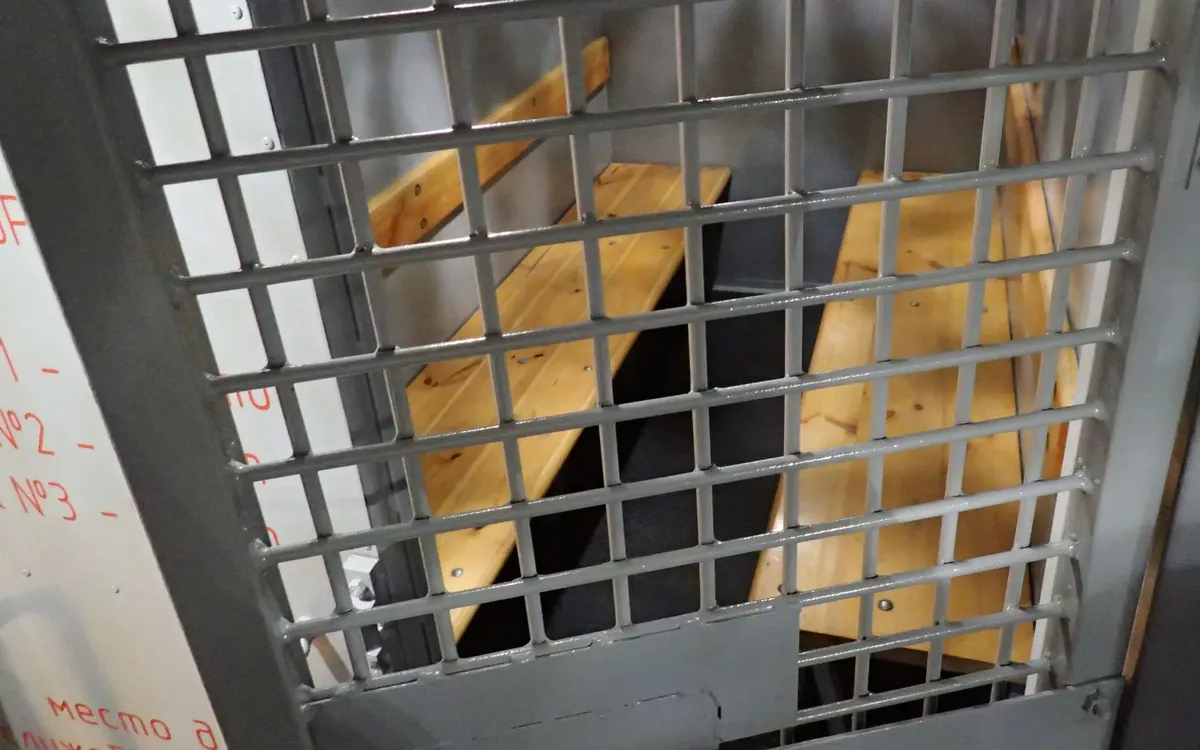
The most common type of auto -zaks in the system of the Russian Ministry of Internal Affairs is a truck with a van body, equipped with two common cameras (each has two hard shops mounted at the long opposite walls of the camera), as well as one or more (up to four in one of the cars shown at the Interpoltech -2017 exhibition), which are called at Russian prison slang, which are called in Russian prison slang "Glasses." In the latter, prisoners usually fall, who, according to formal or informal safety requirements, should be separated from their main mass, in particular, women, minors, former law enforcement officers, “activists” and “offended”.
For the convenience of perception, the technical requirements of the STIT NGOs related to the conditions for transporting prisoners in the chambers of autosaks of a similar design will be described further.
So, in 1999, the NGO “SES” developed, and the First Deputy Minister of Internal Affairs of the Russian Federation Vladimir Strashko approved the Standard of the OST industry 78.01,0002–99 “Cars operational-service for the transport of convicts, suspects and accused of committing crimes. Special technical requirements. Test methods. "
Clause 5.4.2 of this departmental remained the following minimum sizes of the chambers of auto -zaks of the police:

Thus, OST, in fact, allowed the operation of single chambers of prison cars with an area of 0.3 square meters. m (in 2009, I myself, as a member of the Public Supervisory Commission of the Komi Republic, discovered a “glass” precisely such an area in the Avtosak of the IVS of the Cortekes district of the Komi Republic), as well as common cameras, in which each prisoner will account for 0.26 square meters. m of personal space (which approximately corresponds to the area of the Novaya Gazeta turn).
At the same time, on November 8, 2005, having examined the case of “Ricky against Russia” (complaint No. 6847/02), the European Court of Human Rights (ECHR) for the first time in its practice analyzed in detail the conditions for the transportation of prisoners by road.
From February 16, 2000 to May 28, 2004, Donier Martorov was detained in the Vladimir Central pre -trial detention center. During this time, he was released 205 times from the insulator to the Vladimir Regional Court. Judging by the description of the facts of the case, for this, the police auto -zats were used, which were once produced on the chassis of the KAVZ -3976 bus.
Judging by the documents available to me (including those submitted to the ECHR, the Ministry of Justice of Russia when considering another case), which describes the autozaks on the Cavz-3976 chassis from the Komi Republic, as well as the Ivanovo and Murmansk regions (in 2013, one of them was used to transport the "pirates"-Greeks captured by Russian border guards in the Pechora Sea), each such machine has such a machine) A common camera with an area of about 1.5 square meters. m, designed for transportation up to 5 prisoners, and six "glasses" with an approximate area of 0.4 square meters. m everyone.
It cannot but shock the fact that Varierov, as follows from the resolution of the ECHR, experienced several hundred trips to Vladimir in conditions when another prisoner was located with him in the formally single “glass”. At the same time, as the applicant himself indicated, "due to the lack of space, one prisoner sat on a bench, and the second-on his knees." However, the ECHR could not give an appropriate assessment to this circumstance, since the Party of Martorov mistakenly informed the court that the area of the single chambers in which he was transported was about 1 square. m. The Russian government, in turn, prudently preferred not to correct this mistake, limiting himself to a statement, that Varierov was transported in special vehicles “responding to the established standards” (presumably, osu 78.000–99).
As a result, the ECHR, having established a violation of the ban on inhuman circulation, pointed out the following: “In the present case, individual compartments in a prison van area of 1 square. m complying with ECPP standards, if we assume that their design capacity was not exceeded and that they were covered, ventilated, heated and equipped with a seat and special devices that help prisoners to maintain their balance during movement ... However, the applicant had to divide the individual compartment with another prisoner, with which he had to sit on each other's knees ... ECPP The situation is unacceptable. The court also believes that the transportation of two prisoners in a compartment with an area of 1 square. m, equipped with only one seat, was unacceptable. The government claimed that the trip took only 30 minutes, but, according to the applicant, the car traveled to other institutions along the way. Since the arrested remained all this time inside the car, it would be more true to base the assessment on the approval of the applicant that the trip lasted an average of one hour. In any case, the court finds such conditions of transportation unacceptable, regardless of their duration. ”

Take in the toilet
The conclusions of the ECHR, which in Strasbourg continue to adhere to today (so, last April there were awarded 5,000 euros to the resident of Komi Anna Lozinskaya, who in 2013-2014 transferred 15 trips with a total duration of about 35 hours in a “glasses” with an area of 0.34 sq. M and a height of 130 cm), did not affect the position of NGO “SES”.
In 2010, in return, the association was developed in return on 78.01.000–99, and the Deputy Minister of Internal Affairs of the Russian Federation Sergey Gerasimov (subsequently transferred to the Ministry of Justice of Russia to combat “foreign agents”) approved the standardization rules for PR 78.0024–2010 “Speaking and service cars for the transport of suspects and accused of committing crimes. Technical requirements ".
Clause 5.4.4 of these rules increased the minimum sizes of single chambers of prison cars from 0.30 to as much as 0.33 square meters. m (due to an increase in the minimum width of the "glass" from 50 to 55 cm). At the same time, the minimum area of personal space, allocated for one prisoner in common cells with two shops, remained at the same level - 0.26 square meters. m.
After 6 years, the NGO "SHIS" again supported the "good old" Gulag standard. On August 2, 2016, Andrei Nechaev signed a substantially redesigned edition of the above standardization rules, which received the number PR 78.01.0024–2016, which was approved after six days by the Deputy Minister of Internal Affairs of the Russian Federation, Alexander Makhonov. Despite the fact that the volume of paragraph 5.4.4 of the rules increased ten times, its main idea has not changed at all. The minimum area of single chambers of prison cars remained at 0.33 square meters. m, and the minimum area of personal space, allocated for one prisoner in common cells with two shops, was preserved at 0.26 square meters. m.
At the same time, if OST 1999 and PR 2010 did not formally establish the maximum size of the area allocated in a car carrier per prisoner, in 2016 they first appeared - no more than 0.68 square meters. m for a "glass" of a standard design and not more than 0.46 square meters. m on a prisoner in a common cell with two shops. However, the manufacturers of autosaks still focus on the lower limit of the area. This, for example, is evidenced by a police car carrier on the chassis of the “Badn NEXT” truck C41R13, produced by JSC “Combine Autofurgons” from Chuvashia (the main Russian manufacturer of autosaks for the needs of the Ministry of Internal Affairs of Russia), which I examined at the Exhibition “Interpopolotech -2017”. This machine has two nine -seater common cameras with an area of 2.6 square meters. m, each (respectively, a 0.29 sq. M personal space contained in them) and one “glass” with an area of 0.33 square meters. m.

However, in PR 78.01.0024–2016 there is also a completely new norm, the misanthropy of which goes off scale (Lavrenty Beria, probably, would have handed Andrei Nechaev a reward pistol for her). The subparagraph 5.4.5.2 of the Rules allowed the operation of toilet cabins “combined with one of the single cameras for the special contingent” (“Zhulik” in this case, during transportation, will sit on the folding lid of the box in which the all -welnary guideline is mounted).
Civil car manufacturers are still embarrassed to sit prisoners in toilet cabins. What can not be said about the correctional colony of the IK -7 of the Federal Penitentiary Service of Russia in the Republic of Bashkortostan from the city of Meleuz (the main producer of prison cars for the needs of the Federal Penitentiary Service of Russia), which at the exhibition "Interpopolotech -2017" introduced two the latest carriers equipped with "glasses" with the function of the toilet. It remains to guess if Andrei Nechaev managed to inspect them before his detention.
Ernest Mesak,
Lawyer of the Public Verdict Foundation -
Especially for "new"