
Translated material
The grave of Lenin
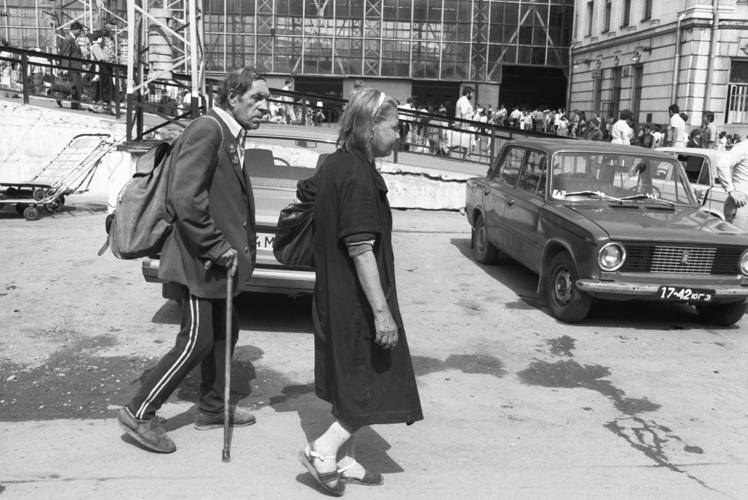
Poor people
There, in some smoky corner, in some raw Konura, which, out of need, is considered for the apartment, some kind of craftsman awakened; And in a dream, he, approximately saying, had a dream of boots all night ...
Fedor Dostoevsky, “Poor People” (1845)
In 1985, for the first time I got to Russia, I made an excursion in Moscow and the surroundings on the bus stuffed with British socialists. It was not the most successful company for a joint trip: they wore orthopedic shoes and raincoats that took shape in envelopes "fit in the palm of their hand." They obviously wanted to complain to someone about a nasty breakfast: cold porridge, poor coffee, inhospitable waiters. But they knew that they should not complain.
We settled in places, and the bus with a vile creak set off; We went north, to Zagorsk [1] , in the Trinity-Sergius Lavra. The guide spoke a clumsy official English, as a cinema spy undercover. She talked about the “unconditionally ideal” union of atheism with the freedom of religion, which is observed in the Soviet Union.
In particular, she said a mysterious phrase with a smile: "This is the personification of public and spiritual." The passengers had neither the strength nor the desire to ask about anything. It was a gray morning; The tourists wiped the foggy windows of the bus and watched Muscovites go to work. Somewhere on Mira Avenue, we stopped at a traffic light. I noticed a woman at the door of the building: she stood in a coat -shaped brown coat and asked for alms - held out a hand to pedestrians coming past her. I noticed that in her hand lay several five -cake coins, but judging by the fact that passers -by seemed to not notice her, she put them in her palm herself. The British, who was sitting behind me, raised her hand and asked how to understand this.
- Your state does not care about the poor, as in London?
“Usually this does not happen,” the guide answered, certifying a beggar with a quick look. - Most likely, the woman you see, a foreigner. Or a gypsy.
It turned out a little too much. The guide was embarrassed, and we all became embarrassed for her. We made the rest of the way to the Russian shrine silently.
These were the last days of the Soviet Mirage. Under Brezhnev, Andropov and Chernenko, the regime survived due to incredible income from oil sale. At the peak of the energy crisis and after its completion, the country squandered its huge oil reserves in Siberia, Azerbaijan and Kazakhstan, receiving funds to finance the huge military-industrial complex. The remaining areas of the economy were destroyed and functioned either by magic, or according to the laws of corruption. But while oil prices remained high, the Kremlin had nothing to do with this. The country could afford to import cheese of four varieties in stores, cheap winter shoes and vodka three rubles per bottle.
 © Corpus
When Gorbachev came to power in 1985, the oil boom remained in the past. The Himeric economy was dead. The Soviet Union entered the era of high technology in the complete absence of those: competition was not shining, it could hope only to survive. The state of affairs was well outlined by the joke: “The best microcomputers are produced in the Soviet Union! They are the largest in the world! " The West still did not understand that his great opponent in the Cold War was still dangerous, but ruined. “Upper Volta with missiles” - as the USSR called Xan Smilei from the Daily Telegraph [2] .
At first it was difficult to realize the scale of impoverishment. In 1988, there were much more articles about Stalin’s mental health than about homeless, child mortality and malnutrition. It seemed that the press agrees with the comments of Edmund Wilson [3] , who visited Moscow half a century ago: “You gradually understand that, although their clothes are monotonous, there is almost no genuine poverty; Although there are no fashionable areas in the city, there are no completely cramped areas. There are no unsightly scenes on the streets: you will not see tramps, sick, the elderly do not rummage in the garbage. I did not see a single slum, even not a single dirty quarter. ” But now, on the contrary, the traces of dilapidation were everywhere. Those signs of poverty that Wilson did not notice or did not want to notice, now it was impossible not to see. You stumbled upon poverty on every corner, in every city and village.
One winter evening, having left a small demonstration near the editorial office of Moscow News, I went into a bad cafe on Gorky Street. I was hungry and froze, ordered a plate of watery borsch and sat at one of the common tables.
- Do you need a spoon?
A woman was sitting next to me, she smiled, exposing the ranks of metal teeth. She handed me her spoon-bending, dirty, but still a spoon. The woman was called Elena. For the past eight years, she lived at stations and airports. In the summer I spent the night in deserted parks on the outskirts of Moscow. “Sometimes I get five rubles a day for the fact that my floors on trains that arrive in Moscow,” she said. - Now I'm without a penny. All I have, you see: my clothes. " According to Elena, some of her friends were driven out by husbands and lovers from apartments. They had nowhere to go. She herself wrote letters to all party authorities and never received an answer.
An Elena's friend was hooked on us - a homeless person named Leonid. “I wrote to Gorbachev, Gromyko, to everyone,” he said. “I am defending my right to work and a life guaranteed by the Constitution of the USSR.”
Elena nodded. “You know, there are thousands of us in the country. Thousands ".
“To tell you the truth, I will earn more money by handing over 20 kopecks per piece than at some construction site,” Vitya Karsokos told me, whose source of income was the garbage dumps. -My main problem is nowhere to sleep: it falls at stations or in a landfill, in some box. I would get a job, but it should be lucky. ”
For years, while state television, demonstrating the horrors of capitalism, showed documentaries about the homeless in New York, the Moscow police tried in vain to remove from the streets of the homeless. But they became more and more, and the police could not cope. Moscow homeless people (the abbreviation of the homeless means “without a specific place of residence”) spent the night in cemeteries, stations, construction sites, in basements. Favorite habitats were also attics of Moscow skyscrapers: they were well heated and ventilated. The bums were drunkards, abandoned children, mentally retarded - victims of the bureaucratic confusion, who lost the right to stand in line for housing. Sometimes homeless people got a job - when for money, when for a bottle of vodka. In the afternoon one could see how they unload the boxes at the wine store. They collected empty bottles in parks and landfills and handed them over for money. At airports and at the stations, homeless people helped taxi drivers lure passengers, for which they received a small percentage of revenue. In Moscow, they could stand in line for you; In Central Asia, they hired in the season to clean cotton.
At the Kazan station, a tramp named Alik promised me to tell anything for a bottle. I suggested that he go to the store with me and stand in line together. Laughing, Alik said: "Just give me a thirty." Having grabbed money from my hands, he quickly moved along the sidewalk. We managed to take a few steps, and Alik already found what I was looking for. An inconspicuous woman in a mouse -colored coat extracted the desired from his pocket, and the silent exchange was made. Almost running, we rushed to the institution with the sign of the "cafe". Inside, a meter from the entrance, Alik tore off the cork and in several grandiose sips devastated a liter bottle. “In the mornings, I like to eat potatoes with potatoes,” he admitted, and, singing, ran out into the street.
Alik was stunted and overgrown bristles. He kept a change of clothes in a ventilation pipe at the station. According to him, to collect bottles he was west. “Humilly, you understand. What am I, dog, or what? He told me. “I'll explain to you how I live.” When I need money, I just take it. Here you have rubles, but R-time-and they are not! " For theft, Alik spent most of his twenty -year -old pocket career in the camps and in the settlement. Going to freedom, he immediately returned to the "station life." He did not have a residence permit in the capital - “I am nobody in Moscow,” so he did not linger in hospitals and sovereigns. He did not want to make his life easier. He was a bitter drunkard. Sometimes he didn’t eat anything for three or four days: “He does not accept the stomach.” He easily fell into irritation and anger, but in the next instant he could become sentimental. This self -taught read by heart Pushkin and sang the songs of the famous bard Vladimir Vysotsky - shouting them in the face, like selected swearing.
“My father and mother worked from morning to night, so that we, boys, provide for us,” Alik told me when we sat down in some deserted courtyard. -My brother was killed in Hungary in the 56th, he was 19. I sometimes think that if he had been alive, I would not go along this path. I ran away from the house at 16 or 17, went to Kazakhstan. Hungry - stole the first wallet. Thus began my prison career. He received five years in a Tashkent camp for minors. Since then I have been wiping in all zones. You are sitting in the cell, for 20 minutes you gave the charging, then you are lying hungry on cold concrete. I started to hurt from this. We, homeless people, are at our points for 24 hours. We are always afraid that we will now flan down from the cops. We have nowhere to go. I tell you this on behalf of the Soviet homeless people, for life. We have no rights, no residence permits, nothing. When you leave prison, it’s very difficult. You are like a third -rate person, nobody needs it. ”
Sometimes Alik stopped talking and sang a Vysotsky’s song about a man who gets into prison and never again sees his beloved. Then he could break himself and, looking nowhere, sip from a new bottle.
“How to get out of this circle? I just don't know. One of my Koresh came to me here - yesterday, or what? “And he says that if I don’t quit drinking, he will fill my face.” And I told him: “You are a son of a son, I can’t leave. I can’t.”
I sometimes worked - in Uzbekistan, but not for long. I can't get along with the authorities. He also worked on the drill. And in Moscow he did not work for a day. Give me 300 rubles a month and an apartment - and I will live great. But I don't have them. And where should I go? Maybe you say? "
In 1989, about the mass Soviet poverty, about which only fiery Western propagandists had previously trumpeted, they began to write within the country. Even communist newspapers noted household devastation. “Komsomolskaya Pravda” scolded the system, indicating that until 1917 Russia was the seventh in the world for custody consumption, and now it has become the 77th-“after South Africa, but ahead of Romania”. “If we compare the quality of life in developed countries with ours,” the newspaper wrote, “then we have to admit that from the point of view of a civilized, developed society, the vast majority of the population of our country lives behind the poverty line.”
People themselves began to capture the connection between their deplorable position and the failure of the party leadership. In street conversations, the word “mafia” pronounced through the teeth was an explanation of any drawback, any injustice. Only a foreigner might have thought that this word refers exclusively to small criminals.
For some time, a monthly income of 78 rubles was recognized as an official threshold of poverty. For such an amount it was possible to feed the dog. No one, even the government itself, took this figure seriously. Most officials and scientists both in Moscow and the West believed that it should be doubled. But in this case, almost 131 million of 285 million Soviet citizens would be officially recognized as poor. “For decades, we tried to implement the idea of universal equality,” wrote economist Anatoly Deryabin in the journal “Young Communist”. - And what have we achieved in all these years? Only 2.3% of Soviet families can be called wealthy, and of which only 0.7% earned their income honestly. About 11.2% can be attributed to the middle class, to the wealthy people. The rest - 86.5% - are simply poor. What we have is equality in poverty. ”
Poverty in the Soviet Union was not the same as in Somalia or Sudan: no swollen stomachs and mass hunger, rather, the general state of need. Self -deception and isolation have reached such perfection that poverty was considered the norm. But even at the same time, almost no one, with the exception of the government elite, could turn a blind eye to popular disasters. “Even in the houses of the chairmen of collective farms-millionaires there are no hot water,” the Turkmen cotton told me. And Joseph Brodsky wrote: "Money ... has nothing to do with it, since in the totalitarian state the income of citizens are not too differentiated, speaking differently, everyone is equal in poverty."
Vorkuta miners lacked soap to wash off coal from their faces; Sakhalin mothers gave birth in rented rooms, because there was no hospital on the island; Belarusian peasants sold scrap and lard to buy their shoes. The numbers began to penetrate the printing that allowed the scale of the problem: the average Soviet citizen to buy a pound of meat needed to work ten times longer than an American; Burners in Tyumen, where oil reserves are larger than in Kuwait, lived in barracks and vans, although the temperature in winter drops to minus 40; Even officials recognized that in the USSR they lives from one and a half million homeless, that in one Uzbekistan there are more than a million unemployed, that children's mortality is 250% higher than in most Western countries, and at the same level with panama.
In addition, all the products that could be found were disgusting: plastic shoes, mineral water with a sulfur flavor. Apartment buildings threatened with collapse. The squalor of everyday life irritated both the eyes and the skin. The towel began to scratch after the first washing, the milk was sour in a day, the cars broke immediately after the purchase. The main reason for fires in the houses of the Soviet Union were suddenly exploding TVs. Because of all this, people were in a state of permanent stress.
The transition to publicity meant that all these facts would have to be recognized. Sometimes an honest article was published in some newspaper, sometimes the text was written with the characteristic Russian irony, which contrasted with Soviet pathos. An exhibition of achievements of the national economy-something like an EPCOT-center [4] -was near the Ostankino TV tower. For many years, the achievements of Soviet science, technology and astronautics in huge pavilions built in the neo -Greek style have been demonstrated here. Above the entrance to VDNH, the gigantic sculpture of Vera Mukhina “worker and collective farmer” (outstanding breasts and biceps, bulging eyes) rose: those who came to the exhibition had to feel like the same muscular proletarians, part of a new, socially and genetically bred breed. But in the era of the declared publicity, the modest Directors of VDNH staged an exposition under the amazingly honest title “Exhibition of poor -quality goods”.
A string of visitors slowly walked along an amazing collection of antidotions: rotten cabbage, holey shoes, rusty samovars, peeling pots, oolins without feathers, flattened fish canned food. The exhibition was a bottle of mineral water, in which a dead mouse floated. All this was bought in the surrounding stores. “It's time to start showing reality at VDNH,” one of the guides told me. The exhibition has become a merciless, mocking rethinking of socialist realism. In the clothing section, red arrows pointed to uneven sleeves, flooding the paint, cracks in the soles. On the label of one jewelry, it was directly written: "Monstrous." No one argued with this.
“I'll tell you a secret,” transporter Alexander Klebko told me when we passed rotten fruits. - This is not so bad. I have seen worse. Most stores have no such abundance. And then there is nothing at all. ”
Translated from the English Leo Oborin
David belt. The grave of Lenin. The last days of the Soviet Empire. Per. from English. L. Oborina. - M.: AST Publishing House: Corpus, 2017. 624 p.
[1] Now Sergiev Posad.
[2] The expression “upper volt with missiles” is often attributed to other authors-for example, the Chancellor of Germany Helmut Schmidt and the Prime Minister of Great Britain Margaret Thatcher. Upper Volta is the name of the state of Burkina-Faso until 1984.
[3] Edmund Wilson (1895-1972)-an American literary critic, came to the USSR in the 1930s.
[4] Epcot Center is one of the World Walt Disney World thematic parks (part of Walt Disney World ), including the future devices and technologies of the future; Initially thought as a "perfect city."