
Translated material
Learn from cars, see a thousand eyes
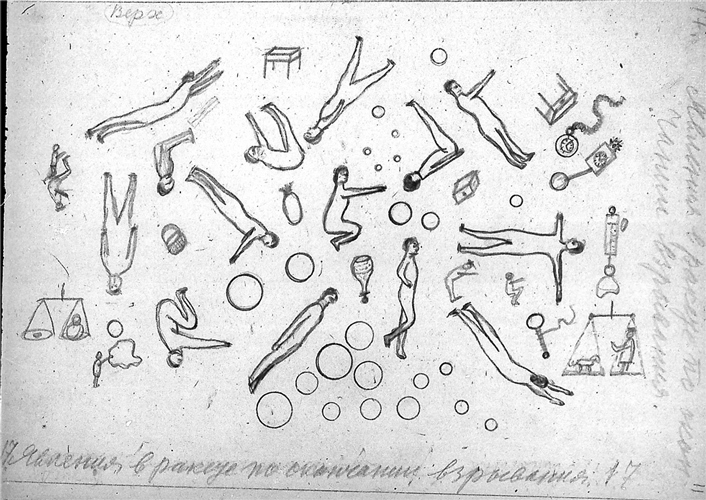
When acquainting with the ideas of theorists of Russian cosmism, slight irritation may occur. It will be due to the fact that the vast majority of representatives of this movement built their futuristic projects on the grounds under which today, after more than 150 years since the launch of these ideas, thoroughly blurred. First of all, we are talking about the ideas of religious Christianity with its strict ethical and gender position, divine fishing and linear time with an obligatory eschatological end. From this, the viewing point from the position of an unzipropocentrism and the so -called vertical standing that gave a person imaginary power over the planet logically follows from this. Finally, the pathos of the worldwide idea, global unity of peoples for the sake of victory over death, gravity, nature and life itself in its current understanding can finally force this acquaintance to the best, cosmic, times. Thanks to the above features, this movement itself begins not to be presented not by the rocket, directed into the interstellar Dali, but heavy to the incompatibility and ultimately quite irreversible phenomenon of Russian scientific and philosophical thought. In the same sense, the archive nature of the mushroom exhibitions dedicated to the topic of cosmism, like the recently passed Art Without Death: Russian Cosmism in the Berlin HKW, can also scare away.
The cosmist can be a deeply believers, an Orthodox person and at the same time develop the idea of complete equality between man and God, imputing the first in the duty of the creation of new creatures and worlds.
But, of course, not everything is so unambiguous. Justified irritation occurs where, bending down in three deaths, one of the dusty artifacts has to dig up one that can be interested, not being sure that it exists at all. Along with this, it is enough to take out all this pile out of the room (in our case, by brackets) to see how the remaining lies on the floor and with what benefit to understand the current moment it can be applied to us. Cosmic speculation, which is no longer constrained by the framework of religious ethics and the anthropocentric model of the world, freed from ballast, will be ready to start moving in the updated axis of coordinates. The way of thinking of the cosmists themselves contributes to this approach on our part. Reading the texts, it is difficult not to notice how close their authors, from Fedorov to Chizhevsky, feel within the framework of even those concepts on the basis of which they build their theories. The philosophy of cosmism is sufficiently crazy so that, affirming the global idea, at the same time look for ways to exit from its closed bubble. The cosmist can be a deeply believers, an Orthodox person and at the same time develop the idea of complete equality between man and God, imputing the first in the duty of the creation of new creatures and worlds. He can insist on the primacy of the human mind in the universe, at the same time, caring for the transformation of people into a semblance of advanced insects for better assimilation of the limits of the cosmos. The cosmist does not contradict himself, and when he ponds evidence of the complete scientific admissibility of the physical resurrection or immortality of people. The cosmist is closely in his modernity, for himself, first of all, he is only fertile pollen, abandoned at that, and not other times, and therefore, if we want to go the same way, then we should not follow the time, but rather time - after us.
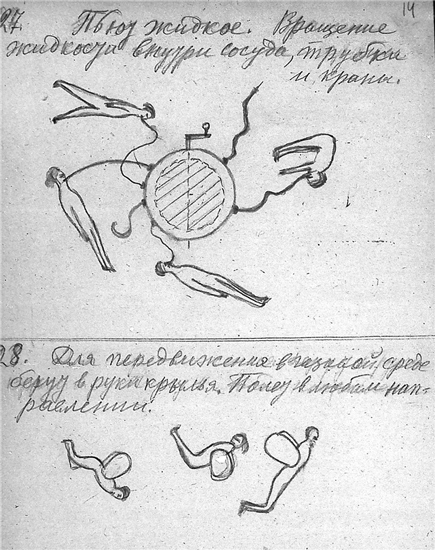 © drawings of Konstantin Tsiolkovsky
For us, this means to see in the discourse of cosmism a phenomenon that goes not inside time, but next to it, along its own spatio-temporal trajectory. This trajectory will not resemble a line, but rather a spring with a spiral with a variety of size and shape. Some of these turns grow and make a titanic test forward, some stretch and hooks over points in the distant past of human civilization, such as Adam or New Testament times. Due to the colossal unevenness of its parts, such a spring should be a rather ugly design, but at the same time exceptionally plastic. Its spirals are constantly stretched and compressed, expanding and decreasing in all directions, and all this in order to non -stoply capture the changes that are taking place and be able to respond to them. If we imagine that the cosmist, devoted to his futuristic ideas, suddenly turned out to be in the current moment, he would probably be the first to apply this property of spring plasticity in order to deform his ideas according to the intellectual movements of the time. Along with this, the arguments of the cosmists, balancing on the swaying sides of such spirals, now and then encountered obstacles, indestructible in their modernity. We, following the logic of the constant mobility of the spring, we can argue that, intersecting in some 1900s, the parties to the spirals no longer intersect at the same point in 2017. This means that where the thought of one of the cosmists stopped, ours can follow further, without meeting any obstacles in his path.
Despite the variety of currents inside cosmism, we can talk about the main project of the whole movement, related to thoughts about the extension of human life up to the achievement of physical immortality, as well as the idea of reasonable use of the entire energy of the human body in the conquest of the earthly and cosmic elements. The liberation of the mind from the shackles still in many ways of animal human nature should have played a key role. The man believed the cosmists-this is the only creature on Earth, endowed with the mind and the ability to set and achieve the goal, but he is still captured by lust and sexual instinct. Even having once accepted a vertical position, which allowed him to pick up his first instrument and put his eyes to the sky, a person did not free himself from the call of chthonic forces. Moreover, our body itself has not come to terms with this vertical aspiration. Nikolai Fedorov, one of the main and earliest representatives of the movement, in this matter refers, among other things, to the notes of the doctor Vikenty Veresaev, in which the latter claims: “The human organs and their placement have not yet adapted to a vertical position, and especially in women. The uterine displacement is a very common disease. Meanwhile, many of these displacements would have no place at all if women went on all fours. ” From this, Fedorov concludes that the process of biological birth was physically never characteristic of a person [1] .
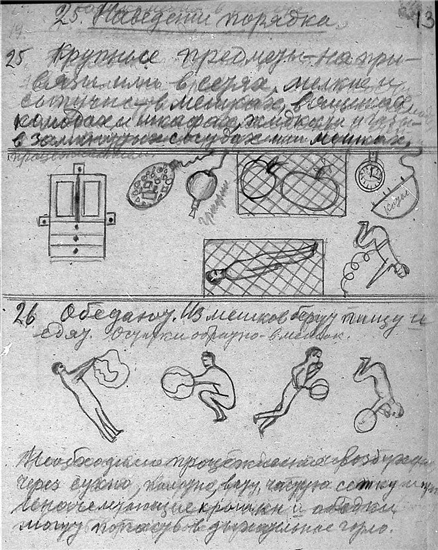 © drawings of Konstantin Tsiolkovsky
According to Fedorov, the horizontal is a synonym for all the dead, death itself, while the vertical directed up is a symbol of reason and spirit, “wakefulness, life, resurrection” [2] . A person may, and must admit the fact that his body still adheres to the not at all the goals that the mind directed upwards. A woman concerts and gives birth to children, taking a horizontal position: reproducing this circle over and over again, we are close to animals, not much different from them. Thus, biological life becomes equal to death, and the process of the birth of new generations - the bad infinity of the chilly existence.
A deadly, sleepy, voluptuous life - in such words, characterizes the world of living organisms surrounding a person, another representative of movement, Vladimir Solovyov. He experiences a genuine aversion to such forms such as mollusks and worms, these ideal personification of horizontality. The worms, as Soloviev writes, “feed on their whole being, the entire surface of their body through the endosmos (absorption) and then do not represent any organs except the sexual, and these latter with their strong development and complex structure are an amazing contrast with the extreme simplification of the rest of the organization” [3] . A worm, the entire outer cover of which consists of mucous tissue, as if entirely represents only a genital organ, driven by one reproduction, in which it has amazing virtuosity. Its non -stop, porous, slippery fabric is, in contrast to the shell that protects the missing mind from irritation, there is rather a perfectly designed membrane, designed to be in constant mutual exchange of organic compositions with the environment.
A person of the future in Gorsky is a form of an advanced, cosmic worm armed with reason, but regaining his abilities that had fallen in the process of evolution.
In contrast to the worm, a person was able to develop to a state in which the genitals, although they are able to influence his thoughts and behavior, are concentrated in one specific part of the body instead of a uniformly, slippery, vibrating mucus to cover the body, forcing this body without stopping to seek mating. It can be argued that both the external and internal genital organs of a person live so independent, excessive life that they can be completely separated from the body without prejudice to the life of the latter. For several centuries, this was proved by the Skoptsy - representatives of the religious movement arising in Russia in the XVIII century. With the help of well -known manipulations, the sods of both sexes deprived themselves of the external genitalia (for women, this also meant removing of both breasts). As we can judge from group photographs of the wraps, over time passing after the defense, both women and men acquired peculiar, common features for all, differed among other things with expressive calm. Turning to the experience of scraps, the cosmists still could not consider such a practice sufficient: when fully cutting off the instincts of reproduction, the skoptes, due to this, did not achieve immortality or even tangible longevity compared to ordinary people. Thus, their experience, although it was to a certain extent radical, could not satisfy the requirements of the complete, and not a partial victory of the immortal mind over the body.
Along with this, the fact that in a person the genitals are in only one specific part of the body was more likely to be a drawback than the dignity for the Nikolai Gorsky spacecraft. Gorsky, who repels from the ideas of Freud, largely took the opposite position, arguing about the female organism transfusing through the edge of the sexual redundancy. Gorsky associated such redundancy with the presence of a woman’s “larger section of the mucous membrane of the wet organs”, capable of a powerful “excretion of energy” [4] . While the genitals of a man have certain, clearly distinguishable outlines, which always allows us to talk about their failure, in a woman they are “deeply hidden inward” and constantly produce strong “radiations” indicating non -stop expansion and growth of the whole organism [5] . The possibility of such an increase for Gorsky seems to be a key factor in mastering his own body, and through this a more successful functioning of a person on Earth and subsequently in space. If such energy will be radiated not only by organs directly related to reproduction, but the entire surface of the human body, then, according to Gorsky, it will lead to the fact that the body will become entirely an erogenous zone, which means that its supra -sensitivity will be able to free from serving sex instinct and aim to intense interaction with the world. Thanks to such “extragenital sexuality”, the human body from the insulator will become a conductor of all kinds of energies and currents. Perhaps it will begin to talk about “skin-mesh and muscle erotica” [6] , emancipated from sexual instinct.
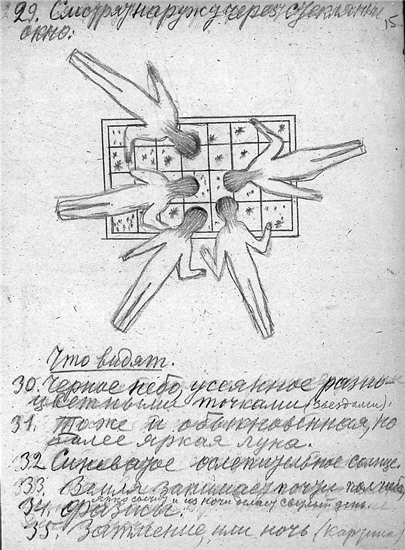 © drawings of Konstantin Tsiolkovsky
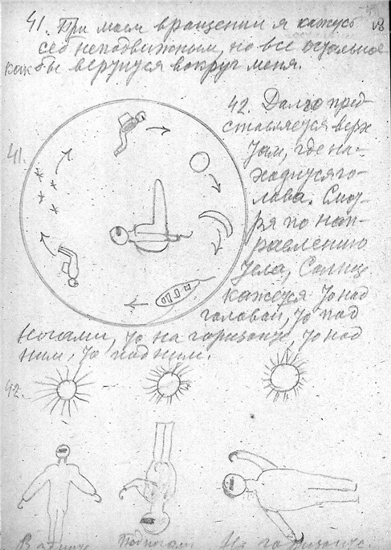
Such leather, this new mucous membrane, will become, according to Gorsky, photosensitive, returning to itself the opportunity to see the opportunity to see the entire surface of the body in the process of evolution. Referring to the experiments of the French writer Jules Romen, Gorsky speaks of the possibility of steam -optical vision, that is, such in which thousands of small eyes will open throughout the human body, while the usual vision for the poverty of his abilities will begin to inactive. The entire surface of the body, still filled with these rudimentary eyes, will be able to perceive and analyze the surrounding environment without a break for sleep or rest. Since “all the skin will become fully with an erogenous zone, the erection of the genitals will spread evenly to all others, they will all begin to perform (and already consciously, that is, coordinating, consistent with each other) the reproduction function - <...> processing <...> inorganic (unorganized) matter in organic:“ dead ”in“ living ” [7] . The external effect on the skin of any external stimuli and the instant response to the skin of not just nervous and muscle reactions, but a variety of “living” products will become the most important stage in the way to a new type of person, capable of mastering the atmosphere and, perhaps, an interplanetary space ” [8] .
In essence, a person of the future in Gorsky is a form of an advanced, cosmic worm armed with reason, but returning skills that had fallen up in the process of evolution. Gorsky, who lived and worked in the first half of the twentieth century, half a century after Fedorov and Solovyov, is already beginning to work on the “turn” of the vertical, its inclination towards the horizontal plane, where worms and all kinds of living mucus live. Along with this, intuition, reporting the permeability of the boundaries between the living and the dead, about the mutual and horizontal axes, is already manifested by Solovyov: “[O] Rganic bodies are only transformation, or transformation, inorganic matter in the same <...> sense, in which the Isaac Cathedral is the transformation of granite, and Venus Milosa - transformation - transformation - transformation marble ” [9] . Soloviev writes not without a hint of the need to inhale into the granite and marble of the spirit of their creator, but in this case, the installation expressed by Solovyov, on which even religious cosmists were based: living and dead bodies are organically identical, and therefore, fundamentally and completely mutually conventional. This opens the path of another cosmic speculation, the so -called organ projection - to grow new, more advanced organs on the human body with support at the same time on the experience of the functioning of inanimate matter.
 © drawings of Konstantin Tsiolkovsky
Compared to reptiles, birds and mammals, a person is a very young look on Earth, which means that his evolution, strictly speaking, has just begun. This point of view, in one form or another, separated by all cosmists, was expressed in specific projects for the acceleration of this evolution. If Gorsky’s ideas remain at a level close to abstraction, then Pavel Florensky and Konstantin Tsiolkovsky formulate specific steps on the path to bodily transformation. In 1919, Florensky wrote about the deep connection between the organs of the body and the tools that are created by people. If the gun is a continuation of the parts of our body, as the first stick used for reasonable purposes was a more effective continuation of the hand, then the opposite is true: already created and functioning devices can indicate to us the way to detect organs in our own bodies. “The guns,” writes Florensky, “are created by life in its depths , and not on the surface of specialization, and in our depths, each of us has potentially multi -result organs that are not detected in its body, and can, however, identify them in technical projections. <...> [g] Explosion can technically projection of a certain organ before it becomes an anatomical and physiologically known to us ” [10] . Inside our bodies in the embryonic or atrophied (thousands of eyes in Gorsky) are and sleep unknown to us, the organs that we can identify by our own cars are forgotten. In the limit, such a logic leads to the most complete merger of human and machine bodies, since for the most fruitful understanding of the work of the latter, a person needs to learn to think and live as a machine. An inanimate instrument is joined by a inhospitable man of Gorsky, designed to wake up skills still dormant in the end.
The fact of such a Falstart means that, probably, the cosmic spring was not caught entirely for the right points on the historical temporary axis.
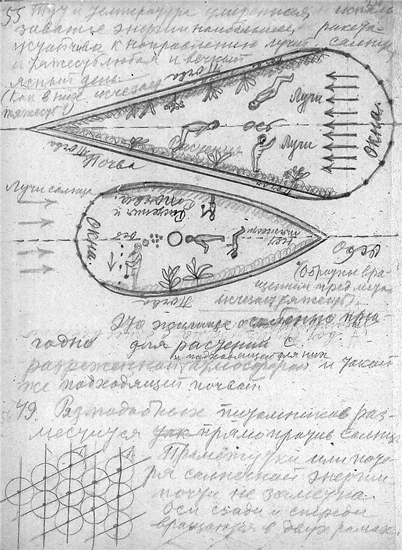
Finally, another representative of cosmism, Konstantin Tsiolkovsky, who called himself the purest materialist, was a supporter of, perhaps, the most radical changes in the human body. Where Soloviev only carefully hints at the permeability of the border between the living and the dead, Tsiolkovsky speaks directly: “The responsive part of the universe. <...> This is a continuous staircase. It does not end on the border of living matter, because this border is not. She is artificial, like all borders ” [11] . Циолковский крайне прагматичен в своих рассуждениях о трансформациях тела, необходимых для завоевания человеком территорий космоса. Путем «упражнения, подбора, скрещивания, операций и другими способами» [12] должно быть создано существо, идеально приспособленное для жизни на различных планетах и путешествий между ними. Оно будет способно питаться только солнечной энергией за счет обладания хлорофиллом, который позволяет растениям перерабатывать такую энергию в питающие их химические элементы. Образуемые в процессе распада вещества не будут выделяться из организма, а, совершая очередной круг переработки, полностью пойдут на его дальнейшее питание. Существо образуется из яйцеклетки, растет, затем «понемногу преобразуется (как гусеница в куколку и бабочку), теряет потовые железы, легкие, органы пищеварения, покрывается непроницаемой кожей. <…> Оно живет только солнечными лучами, не изменяется в массе, но продолжает мыслить и жить как смертное или бессмертное существо» [13] . Вся организация тела здесь призвана служить наиболее эффективным перемещениям в космосе: значительная продолжительность жизни, непроницаемая оболочка и необходимость одного только света звезд для питания позволят этому существу перемещаться на значительные расстояния и обживать далекие планеты и галактики.
Характерно, что Циолковский уже не называет такое создание человеком, однако наделяет его разумом более совершенным, чем человеческий. Вместе с этим он не указывает на принципиальную обособленность человека от этих усовершенствованных существ. Циолковский оставляет этот вопрос открытым — из его текстов невозможно понять, где закончится человек и начнется это бессмертное, питающее само себя панцирное существо. В этом месте проявляется затруднение, которое старались не замечать другие космисты: на каком основании мы можем быть уверены, что существа, описываемые ими, в конечном итоге останутся людьми? Мы больше не можем опираться на религиозный принцип вертикального движения, так как сам дискурс христианства претерпел значительные трансформации в течение ХХ века. Вертикаль больше не является направляющей к Богу с тех пор, как само место его пребывания представляется отдельной проблемой. Не можем мы говорить о характерно человеческом и в отношении обладания разумом и языком — и то, и другое на сегодня является человеческой прерогативой скорее в силу ограниченности наших знаний о мире, чем в силу неких объективных причин. Все «подлинно человеческое» растекается во всех направлениях, заставляя размышлять о глобальном повороте креста, на котором когда-то распяли богочеловека.
 © Рисунки Константина Циолковского
Движение космистов почти полностью прекратило свое существование к середине ХХ века, к моменту, когда характерный для них радикализм только начал набирать обороты в западной интеллектуальной культуре. К примеру, возникшие в этот период литературные герои Беккета были призваны расшатывать принципы, уже находящиеся к тому времени в критическом состоянии, и в определенном смысле олицетворяли своими действиями предпосылки космистов. Одни из них, уподобившись слепым червям, ползали по сырой, булькающей земле, подключая все свое тело к процессу интенсивного чувствования. Другие плотно и замысловато присоединяли себя к разнообразным орудиям вроде велосипедов и кресел, буквально сливаясь с ними, и благодаря такому соединению расширяли наружу свое тело и успешно изменяли состояние своего сознания. Третьи спутывали границы между жизнью и умиранием, создавая среду, в которой жизнь и смерть успешно проникали друг в друга. Постгуманизм Беккета более чем совпадал с настроениями послевоенного периода, в то время как космистский импульс оказался в конечном итоге обречен на драматичный фальстарт. Это среди прочих факторов повлекло за собой почти полное забвение идей космистов на целые десятилетия, и сегодня, когда концепты, сформулированные ими, не вызывают шока, а, скорее, кажутся более чем своевременными, космистский след в их развитии оказывается почти неразличим. Идеи радикального преобразования человеческого тела и едва уловимое сомнение самого космизма в человечности преобразованных существ спустя сто лет повсеместно отзываются эхом, в то время как исключительно творческий характер космистского движения замысловато кривится в зеркале спекулятивного характера современности.
Факт такого фальстарта означает, что, вероятно, космистская пружина зацепилась не совсем за верные точки на исторической временной оси. Одновременно скрываясь в глубоком прошлом и в до сих пор смутно различимом будущем, эта пружина слишком далеко отстает от этой оси в настоящем. В этом смысле архивный характер выставочных проектов, посвященных теме космизма, приобретает новое измерение в деле приближения частей пружины к текущему, улавливаемому нами времени. Эти проекты как будто стремятся сделать резкое торможение для того, чтобы тело космизма смогло по инерции вылететь вперед и таким образом догнать, а может быть, и перелететь настоящий момент. Такое торможение каждый раз заставляет те части пружины, которые зацеплены в прошлом, стремительно растягиваться, что при известном преодолении допустимого максимума растяжимости может заставить их рваться и создавать новые спиралевидные узоры и новые сцепления в непосредственной близости от нас. Вместе с этим вбрасывание космистского тела в сейчас , падение обрубленного разрывом спирального конца на нашу голову смогут стать действительно плодотворными, дающими новые, жизнеспособные, ростки, только оказавшись в связке с ростками спекулятивного настоящего, — подвижность пружины будет прекрасно способствовать гибридизации. В конечном итоге только таким гибридным образом постоянно мутирующий космистский проект сможет продолжить свое движение. Космистский червь с тысячью глаз наконец покажется из земли, чтобы поймать солнечный луч и отразить его своей блестящей кожей.
[1] Федоров Н.Ф. Горизонтальное положение и вертикальное / Федоров Н.Ф. // Сочинения / Общ. Ed. A.V. Гулыги. Вступ. статья, примеч. и сост. S.G. Семеновой. — М.: Мысль, 1982. С. 516.
[2] Там же, с. 520.
[3] Соловьев В.С. Красота в природе / Соловьев В.С. // Сочинения в 2 т. 2-е изд. Т. 2 / Общ. Ed. и сост. A.V. Гулыги, А.Ф. Лосева. Примеч. S.L. Кравца и др. — М.: Мысль, 1990. С. 378—379.
[4] Горский А.К. Огромный очерк / Горский А.К., Сетницкий Н.А. // Сочинения / Сост. E.N. Берковской (Сетницкой), А.Г. Гачевой. Вступ. статья и прим. A.G. Гачевой. — М.: Раритет, 1995 (Библиотека духовного возрождения). С. 212.
[5] Там же, с. 222.
[6] Там же, с. 238.
[7] Там же, с. 259.
[8] Там же, с. 259.
[9] Соловьев В.С. Красота в природе / Соловьев В.С. // Сочинения в 2 т. 2-е изд. Т. 2 / Общ. Ed. и сост. A.V. Гулыги, А.Ф. Лосева. Примеч. S.L. Кравца и др. — М.: Мысль, 1990. С. 371.
[10] Флоренский П.А. Органопроекция // Русский космизм: Антология философской мысли / Сост. S.G. Семеновой, А.Г. Гачевой. Вступ. Art. A.G. Гачевой. Approx. A.G. Гачевой. — М.: Педагогика-Пресс, 1993. С. 161.
[11] Циолковский К.Э. Монизм Вселенной // Русский космизм: Антология философской мысли / Сост. S.G. Семеновой, А.Г. Гачевой. Вступ. Art. A.G. Гачевой. Approx. A.G. Гачевой. — М.: Педагогика-Пресс, 1993. С. 265.
[12] Циолковский К.Э. Живые существа в космосе / Циолковский К.Э. // Путь к звездам / Общ. Ed. и сост. Б.Н. Vorobyova. — М.: Издательство Академии наук СССР, 1960. С. 302.
[13] Там же, с. 306.