
Translated material
Solovki
October 30 - Memorial Day of the victims of political repression. In the last days of October, in many cities of Russia the “Return of Names” will be held: in monuments, in places of burial or at the buildings of the former NKVD, citizens will read the names of the dead. For the first time, the “Return of Names” took place in Moscow ten years ago, on October 29, 2007. This year, Muscovites will gather on October 29 at Solovetsky Stone on Lyuban Square, Petersburgers - on October 30 at Solovetsky Stone on Troitskaya Square.
The dome of the Preobrazhensky Cathedral of the Solovetsky Monastery were destroyed by a fire at the end of May 1923 (Fig. 1). After the Solovki turned into a camp (the first batch arrived there on June 7, 1923) in the cathedral opened a dining room for prisoners. Above the turrets they made a tank roof from roofing material, although there was still a cross above the bell tower.

The star appeared after the next fire that destroyed the spire of the bell tower (Fig. 2). It was this condition that was displayed on the Russian banknote of 500 thousand rubles, which was circulated in 1997 (Fig. 3); It was preserved on five hundred -piece after denomination on January 1, 1998, which removed three zeros, and then on two more versions that were mainly improved by improved degrees of protection (Fig. 4).


In 1997, the press service of the State Bank said that it was so intended: “This is a kind of tribute to prisoners, victims of the Stalinist repressions” [1]. Apparently, the original drawing was a photograph of 1960-1970 [2].
In September 2011, the drawing on the back of the banknote was changed (Fig. 5) - now it depicts the Solovetsky monastery after restoration (Fig. 6). It was argued that the reason for this was the appeal of Patriarch Kirill to the then President Medvedev [3].


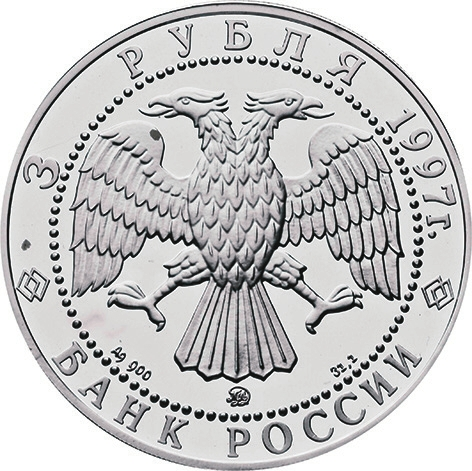
8. 3 rubles, Moscow Mint, 1997 ( rusnumismat.ru )
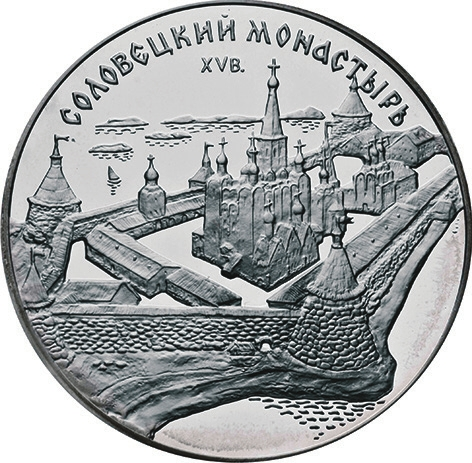
And the sailboat on the front side of the banknote (Fig. 9), behind the monument to Peter I work of Mark Antokolsky and against the background of the Arkhangelsk naval station, is the frigate of the Libertada Navy (Fig. 10). Former chief artist Goznak Igor Krylkov explained this: “In the photo with which I spent the port, there was a modern steamer. But at the last moment, the Central Bank said that with the general idea of the banknote the ship did not fit. I urgently found a photo with that sailboat and redrawn. How did I know that he did not go to Arkhangelsk? " [5].


There were unfair pickups. So, they wrote that the monument to Peter I was erected in Taganrog, and not in Arkhangelsk. In fact, in Taganrog there is a full -size option, and in Arkhangelsk there is a reduced copy, cast after the death of the sculptor, and, judging by the form of the pedestal (square, not round in terms), it is precisely she depicted on the banknote. By the way, a fragment of the same monument was also depicted on the five -hundred -piece banknote of 1898 (Fig. 11).

The elephant (the Solovetsky special purpose camp) was a micromyer with its own newspapers, the Solovetsky Island magazine, which was sent through the libraries of the whole country, museums, scientific laboratories, even party factions and the church "Cathedral of the Ulovets bishops" [6]. It also had its own money, which could be earned (5-6 rubles per month for re -completing the norm); Their main source was transfers from the mainland (up to 50 rubles): cash were not given to the prisoners to complicate the escape, but replaced them with calculated receipts (Fig. 12–15). On the bonas of special -purpose camps (i.e., Solovkov itself) put the date “1929”; And on the bones of the forced labor camps, the structure that grew up from Solovki and absorbed them (the Gulag was founded in 1930),-1932. The minimum denominations were 2 kopecks (Fig. 12), the maximum - 5 rubles. (Fig. 13); Catalogs mention the 1932 Bon with a face value of 10 rubles, but her image could not be found. For 5 rubles. You could buy 2 kg of sausages, a little less than 4 kg of herring, a little more than 8 kg of sugar, 27 English pins.
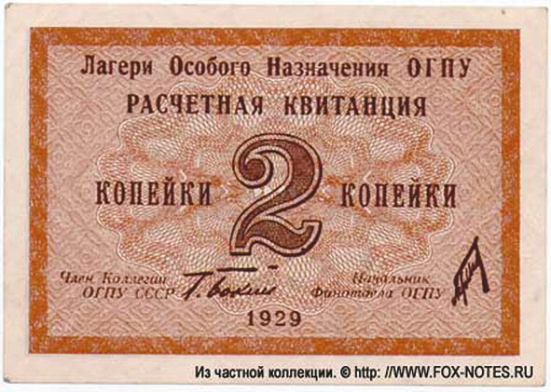
12. 2 kopecks., Lageri of special purpose, 1929, first release; Signature-"Boiste" ( Fox-notes.ru )
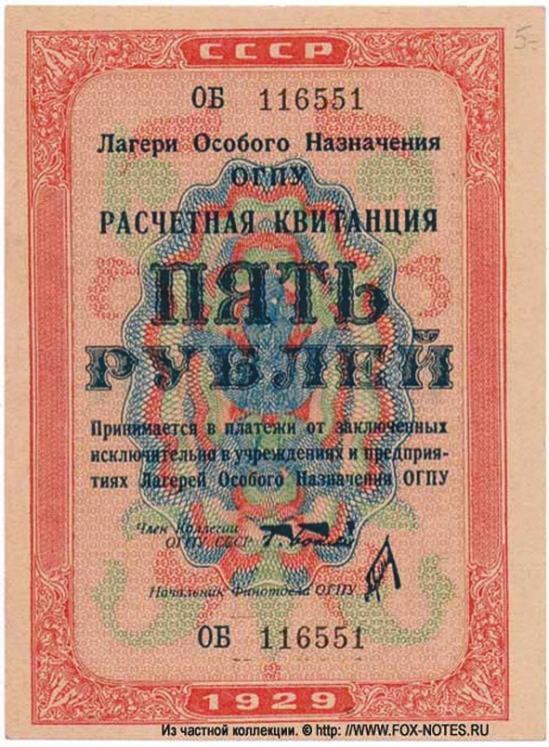
13. 5 rub., Lageri of special purpose, 1929, second release; Signature-"Boiste" ( Fox-notes.ru )
The bones were formalized according to all the rules, with the signatures of the collegium of the OGPU Gleb Bokia (the first two issues; Fig. 12 and 13) and the chiefs of UlaG OGPU Lazar Kogan (the third issue, 1929, the year, apparently, is indicated conditionally; Fig. 14) and Matvey Berman (1932; Fig. 15). Is it necessary to specifically mention that not one of the three survived the purges of the thirties? If necessary, then: Bokiy was arrested at the oral instructions of Yezhov and shot in 1937, Kogan was arrested in 1938 and shot on March 3, 1939, Berman was arrested in the office of Malenkov in 1938 and was executed at the Kommunarka training ground on March 7, 1939. All three were rehabilitated in 1956-1957.
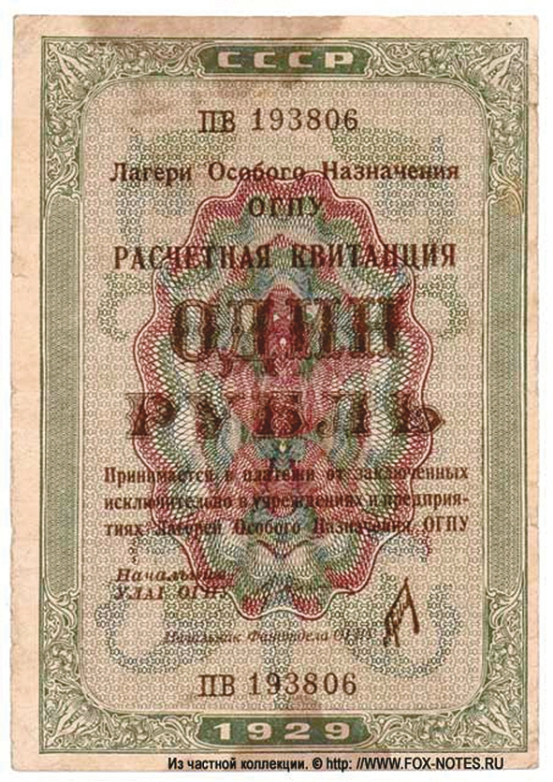
14. 1 rub., Lageri of special purpose, 1929, third issue; Signature-"Kogan" ( fox-notes.ru )
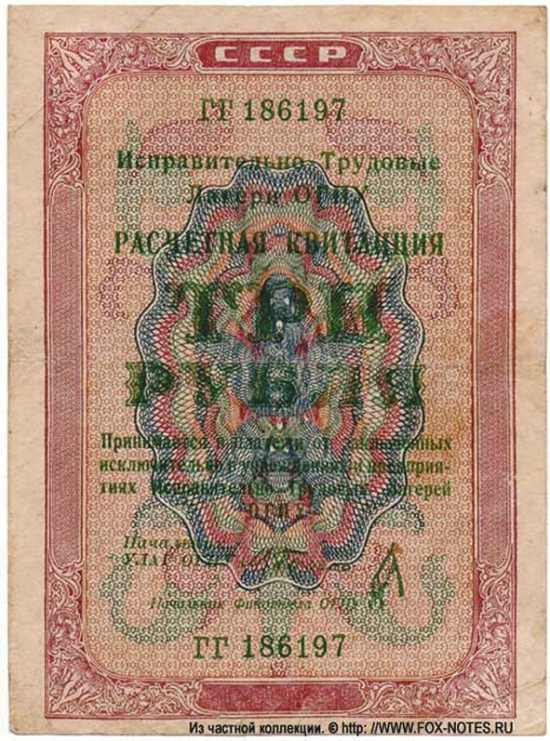
15. 3 rubles., Correctional labor camps, 1932, fourth release; Signature-Berman ( Fox-notes.ru )
Some sources mention earlier calculated receipts with a face value of 5 and 10 rubles. with the image of an elephant, but they are not in the catalogs. But at auctions there are photographs of the calculation signs of other camps (Fig. 16–19); Some, perhaps, are fantasies (Fig. 20: on Bon, the date “1935”; the elephant was disbanded in 1933, turning into a Belbaltlag branch, and in 1937-1939 a special special purpose prison (groan) worked on Solovki).


On the other hand, in 1931, the cooperatives of law enforcement officials issued a warrant for the distribution of the deficit (Fig. 21–25).


M. G.
1. Kulbitskaya S. Crosses-Noliki Gulag // Moscow Komsomolets. September 22, 1997.
2. “Few people know that a Solovetsky monastery is depicted on a modern 500-ruble bill. Look carefully at the bill. And let it be on the date: 1997 - do not believe it, it looked like the monastery in 1975 (I have documentary confirmation of this fact) (Mitin I.V. Solovki and physical factory. Http://upmsu.phys.mu.ru/solovki.htm ).
3. Www.interfax-religion.ru/orthodoxy/?act=news&div=42241
4. The share of S. Solovka is a monastery with 500 ruffs .
5. Gnedinskaya A. Artist from bills // Moscow Komsomolets. June 27, 2011.
6. Solovetsky special purpose camp // Tree, open Orthodox encyclopedia.