
Translated material
Statistics in the hands of the revisionist
Hand dexterity ... and Stalinist repressions become "insignificant"

Round dates always attract attention to the events of the past, and the 80th anniversary of the beginning of a large terror was no exception this year. But, unfortunately, not everyone can accept historical truth, preferring to embellish the past of their country.
Repressions have become one of these stumbling stones. The supporters of the Soviet system, to the fans of Stalin, and just “patriots” of various stripes are not easy to admit that the state machine was going around and completely pointlessly killed hundreds of thousands of citizens, and underwent millions of innocent punishments. This gave rise to a whole course that denies repression, in many features similar to revisionism - the denial of the Holocaust.
I will not discuss the opinions of the authors completely divorced from the reality, claiming that there were no repression at all, that all the information about mass executions and camps is the arrogant fiction of anti -Soviets. I will pay attention to those who, trying to preserve at least some visibility of scientificity, are forced to recognize the data published in sources and research.
Among them are quite a lot of famous and relatively popular public figures and pseudo -historians who use a number of techniques to be understood in the perception of listeners and readers of the scale of repression. Subsequently, these techniques from year to year are replicated in blogs and various publications [1, 2, 3]. For their debunking, I will not immerse myself deeply in the topic and use the most common and common summary data. The discussion about the exact number of repressed continues, and my goal is not to finish it, but to show the methods of manipulation, which make it possible to achieve the effect of "insignificance" of repression.
Consider some of them.
1. Understanding the relative number of repressed
The absolute number of convicts under political articles, according to various figures (depending on the calculation methodology, the selected period and categories of convicts, which are included in the list of victims of political repression), is from 3.5 to 5.5 million. If you add to them dispossessed, forcibly resettled, affected in rights, then the number of repressed increases to 10-15 million (again, depending on the calculation methodology). The number of those sentenced to higher fluctuates, according to various sources, from 700 thousand to a million [4, 5].
In order for these terrible numbers to be so frightening, some authors try to make them down, translating them from absolute to relative ones. The following technique is often used: the number of those who lived in the USSR for the period from 1922 to 1953 is calculated (as a rule, according to an unknown methodology) - for example, 400 million people are obtained; As a result, it is concluded that the number of repressed during this period is 2.5–3.0% of the population. It seems like a little.
Sometimes after this another conclusion is made: out of 10 million repressed, only about 700 thousand people were shot, that is, not more than 0.25% of the country's population - that is, a little, percentage. To obtain this effect, several ways to serve.
Firstly, the mechanism of counting all citizens who lived in the USSR in a certain period is not justified. The total population is invented based on the author’s desire.
Secondly, this method is used only to reduce the relative number of repressed against the general background. If you follow it to the end, then, for example, it is necessary to exclude from the total hypothetical number of children who did not fall into the lists of the repressed ones - and the minors in those years in the USSR made up about 45% of the population. This will immediately double the percentage of repressed. But, I repeat, in fact, this is a meaningless comparison, which does not mean anything. The destroyed Jews or the Red Army soldiers also made up the insignificant share of the population of the Third Reich, but can this serve as a sign of the insignificance of the crime?
Another reason associated with this is to take the initially high number of victims of repressions, for example, 60 million dead, called A. I. Solzhenitsyn in one of the interviews, and triumphantly debunk, proved by support to the sources that for 1921–1953 the “total” of 799,455 people were sentenced to the highest degree of punishment. After that, correspondence opponents are accused of lies and sheltered.
As a result, all these reasoning is lost that the absolute numbers - 10-15 million exposed repressions and 800 thousand of the executed - are quite indicative and terrible in themselves.
2. Comparison with modernity
The next way to underestimate the scale of repression in people's perception is a comparison with the demographic losses of Russia in the period after 1991. Usually they try to illustrate this with a simple thesis: under Stalin, the population of the USSR grew by almost 50 million people, and from 1991 to 2010 the population of the Russian Federation decreased by 4.5 million people. Say, therefore, the most terrible revelry of mortality right now and completely different persons should claim the title of bloody tyrant.
This is a classic technique - a comparison of incomparable: they are trying to purely visually compare the numbers and trends that describe completely different demographic situations. The fast -growing population of the demographic explosion period, with a larger share of the rural population, high birth rate, which is rapidly decreasing as a result of the introduction of medicine and hygiene by mortality, and society in a state of demographic transition, with low birth rate and increased mortality.
Without going into demographic details, I state: one population increases the number, and the other reduces. This is controlled by strict laws acting regardless of other factors that are of secondary importance. Therefore, if the repressions of the Stalinist scale were unfolding now, then they would additionally reduce the population of Russia due to the death of hundreds of thousands of people and the accompanying decrease in the birth rate and increase indirect mortality.
3. Comparison of the number of prisoners
Another interesting technique is a comparison of the number of prisoners in the USSR, at the peak of repression, and in modern Russia or, even better, in the USA. The theses are illustrated about this schedule (Fig. 1).

As you know, this is just a manipulation of numbers. They compare not just the past with modernity - for comparison they have chosen the country with the largest specific number of citizens behind bars (USA), and the country that is among the leaders in this parameter (Russia) [6]. We will not disassemble how they reached such a life, but we state that these indicators are far from ideal.
For the correct comparison, it is necessary to compare either two countries in one period or the dynamics within one country. So we will do.
According to approximate data, in 1935 the number of prisoners in the USSR amounted to about 1 million people, or 602 prisoners per 100 thousand people. In 1936, this number reached 1,296,494 people, or 780 prisoners per 100 thousand people. If we accept these data for the database, then in 1938 the number of prisoners increased by 45%, in 1939 - by 56%, in 1941 - by 85%[7].
For comparison with the United States, we will take data on the number of prisoners in the corresponding years published in the Bulletin of Judicial Statistics of the US Statistics Department [8]. According to these data, in 1935, in the United States, there were 113 people for every 100 thousand people in the USA, which is 5.3 times less than in the same year in the USSR; In 1936-the same 113 people, that is, 7 times less than at the same time in the USSR. In subsequent years, with an increase in the number of prisoners in the Soviet Union, the difference increased even more. So dry figures indicate that even before the start of a large terror of prisoners in the USSR, there were 5-7 times more than in the USA.
If we compare the data inside the USSR, then the picture is even more eloquent. The data on the number of death sentences given in the schedule (Fig. 2) look most vividly.
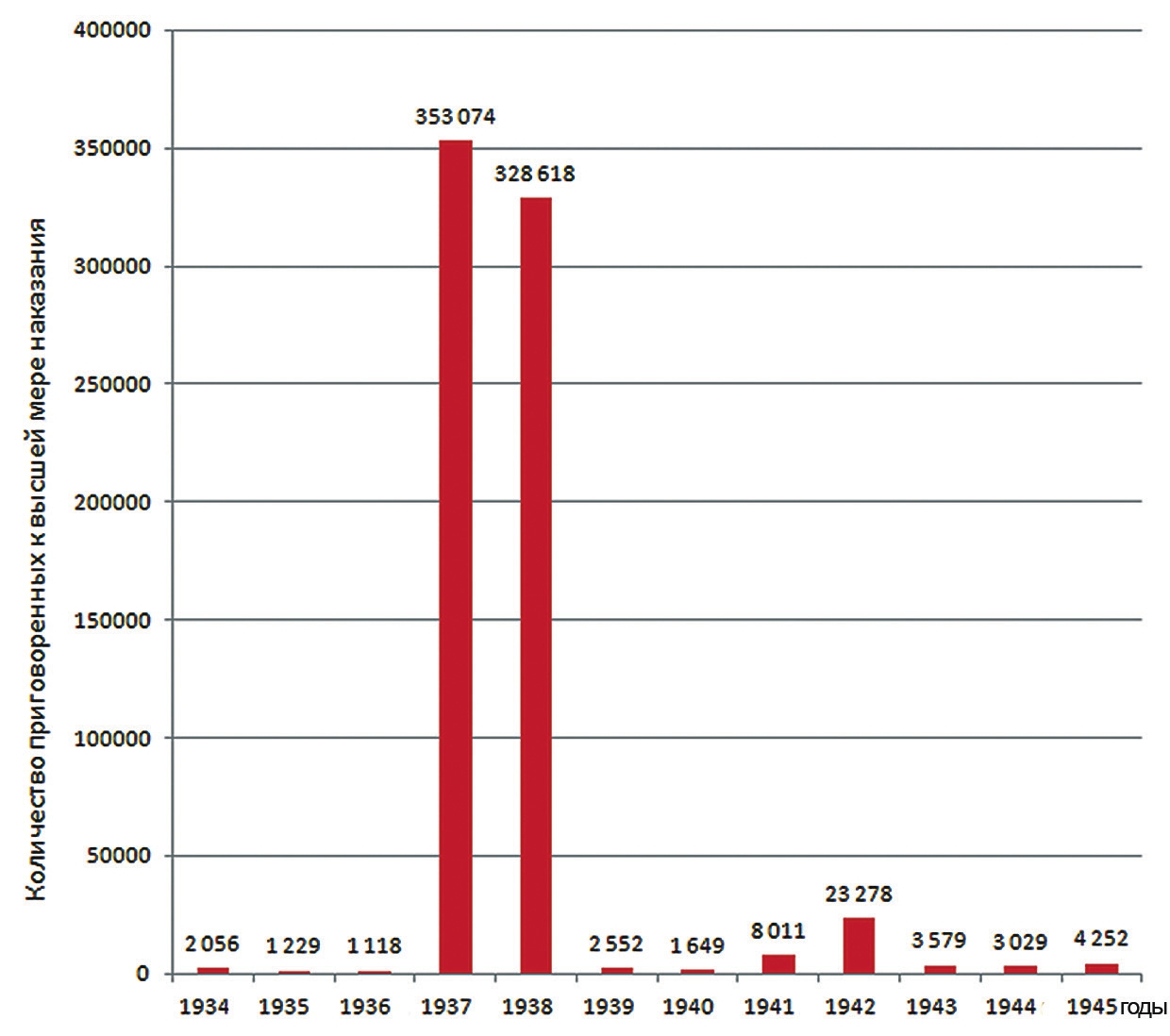
Statistics perfectly shows that during the time known as the period of large terror, the number of prisoners and executed abnormally large in terms of all indicators, and attempts to underestimate it in the perception of society are a rather primitive manipulation.
To questions, what caused such an increase, who was condemned for what, the answers have long been given in studies on repressions, fate of convicts and the rehabilitation of victims.
Pavel Kolosnitsyn,
archaeologist
1. Starikov N.V., Puchkov D. Yu. Sparkling: Nikolai Starikov about Stalin and Repression. www.youtube.com/watch?time_continue=509&v=2lbyQvfglfm
2. Krasnov P. The myth of mass repressions. oper.ru/torture/read.php?t=1045689095 .
3. What do you need to know about repressions to a person who loves his country? http://burckina-new.livejournal.com/316979.html .
4. See Zemskov V. N. On the scale of political repression in the USSR // Political Education. 2012. No. 1 (66).
5. Okhotin N. G., Roginsky A. B. On the scale of political repressions in the USSR under Stalin: 1921–1953 // Weekly demoscope. 2007. No. 313–314.
6. Lunev V. The prison population in the USSR // Weekly demoscope. 2007. No. 239–240.
7. See https://ru.wikipedia.org/wiki/ Sign_post_politism_ -made
8. Prisoners 1925-81/ Bureau of Justice Statistics. December 1982. Www.bjs.gov/content/pub/pdf/p2581.pdf