
Translated material
China: reorganization of the oligarchy
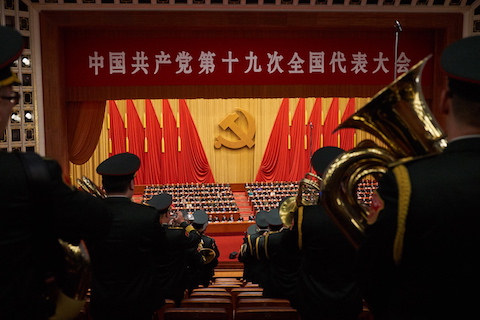
The XIX Congress of the Communist Party of China took place in conditions when the country became one of the world leaders. Old recipes for a combination of socialism and market began to obsolete. The parties are required, and Xi Jinping has achieved the approval of their scenario, developed taking into account Soviet experience, recognized as negative.
The Chinese party leadership will not tolerate any political pluralism, somewhat reminiscent of the Gorbachev perestroika. Hard control over all political processes, the media, the Internet, and religious organizations will remain. At the same time, the middle class is growing in the country, and Xi Jinping seeks to show flexibility. The times when the Chinese were ready to work for several tens of dollars have gone in history. Last year, the average salary in the country was $ 750 - this is a little compared to Europe, but it is very decent when compared with the incomes of the Chinese and a half decades ago.
At the same time, in recent years, the salary has grown steadily, and the growth rate is reduced. For a long time there are no double -digit figures for GDP growth - last year it increased by 6.7%, 6.8%predict this. Compared to the current Russian pace, this is a lot, the dream of government economists. However, this growth does not fully correspond to Chinese ambitions.
In these conditions, the country faced the problem of social stratification. If a person receives $ 50-100, he does not think about what millions the bosses receive. He works a lot and thinks about survival, his own and his family. But with $ 750, thoughts about justice become a natural phenomenon that threatens political stability. Under these conditions, the country -ruling party oligarchy faced a choice of two options, which excluded political liberalization (its opponent is not only Xi Jinping, but all the bureaucracy).
The first option can be called populist: it assumed a partial return to the rhetoric of the "cultural revolution", directed against the bureaucracy as a whole. Supporters of this approach were considered such prominent party figures as a member of the Politburo standing Committee (the Elites of the Elites of the party), the former head of the state security of Zhou Yuncan, the first secretary of the Chunzinsky party committee Bo Silai and some other leaders. Following the rhetoric, practice could also follow, including direct appeal to the “Nizam”.
The second option - the authoritarian - provided for the strengthening of the fight against corruption, but rigidly controlled "from above", without excessive populism. A policy of continuing the growth of income aimed at the formation of a stable middle class, which will not be too much envious of the “tops”. A decrease in inequality is recognized as a more important factor than growth rates. And the strengthening of the influence of “Man number 1” in the party leadership is in order to keep the situation under control.
Most of the nomenclature chose the second, more comfortable option for it. Moreover, the first victims of the anti -corruption campaign were just the “leftists” Zhou and Bo, accused of a large number of crimes and sentenced to life imprisonment. Their and two more former high -ranking officials were even called the “new gang of four” - by analogy with the inner circle of Mao Zedong, defeated after his death. Such an approach with all the degree of conventionality can be compared with the activities of Yuri Andropov as the head of the CPSU and the USSR - however, Andropov was seriously ill and soon died, and Xi Jinping was quite healthy.
At the congress, Si proposed a party bureaucracy not only a whip, but also a gingerbread. The whip, of course, is tangible. The fight against corruption, during which Si got rid of his opponents and at least partially neutralized others, will continue. And practice has shown that any party, state or military leader can become a person involved in a criminal case. But still, in order to spend as many people as possible to key posts as possible, Si had to not only “press”, but also maneuver. His statement is connected with this at the congress on the formalization of the arrests of party and statesmen accused of corruption. Now it is considered an intra -party business. And if so, then the accused is actually losing the right to defense, is contained in a place unknown to his relatives and as much time as party investigators need in order to achieve sincere recognition and sincere repentance. Now Si proposes to extend to them a general practice, which gives at least a ghostly hope for a better fate.
According to the results of the congress, Xi Jinping significantly strengthened his position. This is a consensus point of view of experts, expressed before the congress. There are many arguments in its favor - including the mention of the party’s charter about the “ideas of Xi Jinping about socialism with Chinese specificity in the new era”, which puts it along with Mao Zedong and above not only two direct predecessors, but even Dan Xiaopin. In relation to Dan, the charter uses the word “theory”, which is honorable, but not so. As for the two predecessors of SI - Jiang Zemin and Hu Jintao - their ideas are also spelled out in the charter, but without indicating authorship.
Important arguments in favor of the growth of the influence of SI are the absence of a successor among the seven members of the Politburo of the Politburo, the Elite of the Elites of the party. And the composition of this committee, in general, profitable SI. His close allies are three members of the seven organ (Lee Zhanshu, Van Khunin, Zhao Laszy) plus another voice at Si himself. As well as the fact that he spent the loyal General Zhang Yusia to the post of his deputy in the Central Military Council.
Nevertheless, the Chinese government remains oligarchic, and Si is not a dictator. The question of whether he will remain the head of China after 2022 is not today the topic. Maybe it will remain, although for this it will be necessary to change the Constitution, which provides for a stay at the post of chairman of the PRC for only two terms. And this can be a too much change for the oligarchic system. Therefore, it is likely that, following the example of Dan Xiaopin, he will retain the leadership of the Central Military Council. But how events will really develop, it will become clear by the year by 2020, hardly earlier. And the successor may well be appointed from among the "simple" members of the Politburo. As an option - the current leader of the party organization Chunzin Chen Minier, who previously worked under the leadership of SI.
There are several signs that the power is limited. The prime minister’s post remains with Lee Katsyan, whose relationship with the leader is not cloudless. The closest ally of SI and the main fighter with corruption Van Tsishan left the highest party building. He is more than 68 years old (the time of resignation for Chinese leaders), but for him they did not make the expected exception. The new member of the Standing Committee, Deputy Prime Minister Van Yang, is historically connected with the predecessor of SI Hu Jintao. It is noteworthy that he is considered a supporter of further reforms (of course, economic, without politics) and a convinced opponent of various kinds of “mobilization” scenarios.
Finally, the Shanghai Partyer Han Zhang, who also first became part of the elite of the elites, is a nominee for 91-year-old Jiang Zemin, a direct successor to Deng Xiaopin. Relations between the group of Jiang and Si are complex - and the purpose of Khan shows that Si should compromise with this group. However, Han is listed in the list of members of the standing committee by the last - this means that he is the least influential participant in the new leadership.
Thus, at the party congress, the most significant reorganization of the oligarchy, which had consolidated the championship of SI in Chinese politics, was completed at the Party Congress, which over the past decades ended. The system seeks to adapt to new challenges before the thunder breaks and the events begin to get out of control. And change without changing in essence.
Author - First Vice President of the Center for Political Technology
Photo: Artem Ivanov / TASS