
Translated material
Save your souls
On Monday from 11:00 to 00:00 on the Colt, the online prime minister of the documentary of Sergei Kachkin "Perm-36. Reflection "about the three former prisoners of the correctional labor colony convicted of" anti-Soviet activity "-the worker Viktor Pestov, philologist Mikhail Meilahe and human rights activist Sergey Kovalev-and the Memorial Museum of the History of Political Repressions" Perm-36 ", destroyed by the authorities several years ago. The Arkhangelsky who saw the film thinks in connection with him how the ethical experience of dissident could return to today's Russia on new grounds, where a lie became a political and household norm.
Soviet experience plays the role of a mirror for us, it seems that all aspects of life have been investigated; The exception is only dissidents. They are still an anomaly, and even when they are portrayed with sympathy (as in the series “Once in Rostov” (2015)), it is still a general pathos is as follows: it is not clear why they did it, why they printed on their squeaks, why tormented themselves and relatives? "After all, the Soviet government created him all the conditions!"
Dissants are not even built into liberal culture. It seems that since the Grebenshchikov performed in 1991 from the scene of the GCZ “Russia” the song of Nikolai Williams “The Communists caught the boy” , the topic of dissidentity did not sound “from high stands” - it has not yet been inscribed in the history of the country, not legalized. They did not say “thank you” a big and small business-yes, for this that seemed in the 1970s something from Harms-“Long live private property.” Only the Sakharov Center and the Memorial retain local memory about dissidents. Only recently, the film “Anatomy of the Process” about Viktor Krasin and Petra Yakira , who translated the conversation about dissidents from political to the moral plane, as well as Gleb Morus, “Dissidants , by the way, showed how heterogeneous dissidentity inside, have changed something in the mass consciousness of the film.
Dissants are still not inscribed in some understandable, human experience. Is it possible to reduce dissident to some simple, universal principle today-to understand what they have done for us?
"All lie"
Dissidentity is not an anti -Soviet, not a struggle against ideology; This, first of all, is the history of the struggle for human rights - this is how it can be said, but this phrase gives it today with frog formalism; You can simplify it before the "struggle for a person." The Soviet government did not distinguish between individuals, but preferred to deal with the masses. This was her essence. And only the dissidents, in fact, were the first after 1917 again raised the question of the existence of an individual in the USSR. The very formulation of the question - "Do you dare to go to the square?" - returned this modus. That was then the path of gaining individuality - through the resistance of the collective. By the way, Brezhnevskoye “Everything is in the name of a person, all for the good of a person” - was it not, as they say now, an attempt to “intercept the agenda” of dissidents? ..
Dissentism in the USSR is, first of all, the experience of independence, the return of subjectivity. Understanding conscience as what belongs to you, not the state. Emphasizing today - “it is not clear what they wanted”, from our memory they want to erase the struggle of dissidents for the liberation of the individual and, wider, the human spirit. This is today the main state secret - that everyone has a private conscience. All the efforts of the state are aimed at ensuring this inner voice to drown out as soon as possible the pronoun “we”, by the voice of the state.
However, this also coincided with the inner desire of society in the 1990s, which did not find itself in the present. Amazing: the post -Soviet person eventually found the meaning of life in negation, in a mockery of the best human qualities. The peak of this spiritual self -destruction was the mocking expression “Non -Flood”. It doesn’t matter if these words were put into circulation specially or were born “from below”. They amaze with the frankness of cynical consciousness. It was not without reason that it clung to the most famous dissident slogan, which was not, we were not noticed, anti -Soviet, but appealed to the very universal norm (social, religious, ethical - for which, of course, thanks to Solzhenitsyn). A mockery of this slogan means literally this: no one here can "live not by lies." Everyone is lying, in this our strength, we stand on that; And the one who denies the inevitability of lies is an upstart and essentially an enemy - because he compromises the rest. Here, in its infancy, morality is already visible, which triumphed at the official level after 2014: “Try to prove”; “We are not there”; "The Kremlin does not confirm." We are not bad - it’s just that there are no good ones here.
This mockery is designed to blur the very difference between truth and untruth, to deprive the legitimacy of those who want to live not by lies - and those who wanted this before.
It is believed that the experience of dissidentity was possible only in a closed totalitarian system - and therefore is not applicable today. One could agree with this, if we assume that the 1990s Russia made conclusions and extracted lessons from the sad experience of totalitarianism, found a new meaning in life, a new identity. But while we see the opposite: the modern mass person “does not see the problem” in totalitarianism, he “lived well” there; He “does not understand” what happened to him and the country in the 1990s. This existence is, a hole through which any experience passes, leaving no traces. And just as it is impossible to go to postmodern without assimilating the experience of existentialism, it is so impossible to move on to modern experience and technologies of the political struggle, not making any basic decisions before, not answering the questions “who I am, why I live, what is important to me”.
Civil religion
The author recently talked with one of the creators of the View program ; The interlocutor admitted that although he did not like Soviet power and illusions did not have illusions, he would not take risks like those seven who went to Red Square in 1968, having the slightest chance of winning. After all, they were also told then: "It is pointless to fight the Soviet government." And the answer to the question "Why did they go out?" As part of common sense, it will always be incomplete. By paraphrasing the tenant, we will raise the question: what was stronger inside these seven than the fear guaranteed deprivation, lack of freedom? ..
One of the heroes of the film by Sergey Kachkin "Perm-36. Reflection ”, human rights activist Sergei Kovalev, once told the author of this text: we fought for ourselves, not against the authorities. We knew that the Soviet government could not defeat, we just wanted to maintain ourselves.
Translated into religious language, this means “save the soul” - what can be clearer and easier? .. From the point of view of common sense, these actions look like a hopeless and meaningless business; But as soon as we put the salvation of the soul in the center (not so much in a religious sense as in the spirit of Foucault, in the meaning of “care for oneself”) - immediately logic and meaning appear. So dissidentity becomes a origin of the civil religion, secular faith, an analogue of the new church. Когда ложь делается нестерпимой и тотальной, когда она въедается в кожу, спасение души становится важным; And we are now more understandable to us, let's say than 10 or 20 years ago.
Idealism with a human face
The current civilization border, tipping over to archaic, the rejection of the democratic values, Samuel Huntington (“Clash of Civilizations”) considered as a reaction to the mass existential crisis of the 1990s, which arose after the collapse of the Soviet project and ideologies. In Russia, this also exacerbated the coming postmodern - with its situation of fundamental openness, the need for communication - in the complete absence of the skills of interaction with the world. Lyotar very successfully described this as “fear of finding himself before nothing” - a fear of being in an ideological void, vacuum. In the search for the ideal and at the same time supports, a person frantically clutches for being at hand - religion, territory, race, nationality - that is, all that we see today in the form of revived phantoms of racism, clericalism or diabetes. New idealism, as a rule, turns out to be old violence. Such idealism invariably lifts either in the left rhetoric (criticism of capitalism, corporations, money - as that enslaving a person), or in clericalism, in religious fanaticism (rejection of modernity, violence as salvation). Putinism, in turn, tried to find a collective version of idealism; But, since the bureaucratic in it always defeats the living, only hollow forms are born - such as patriotism or worshiping the past. In addition, the collective forms of idealism do not leave the opportunity for independent solution.
So, we observe only repressive or bureaucratic forms of idealism. On the other hand, we were convinced that without new idealism today it is impossible; The 1990-2000s taught this, both Europe and America need it today, which have been having forgotten about a person in a technological race. Where to get "good idealism"? Not destructive, but creative? How to give a personal measurement of the words “freedom”, “conscience”, “ideals” - and how to combine them with the global economy, with capitalism?
Such idealism could have the form of the very “care for oneself”, about the preservation of pure conscience. The dissidents in Russia were the last idealists of the twentieth century. This is an example of idealism with a human face.
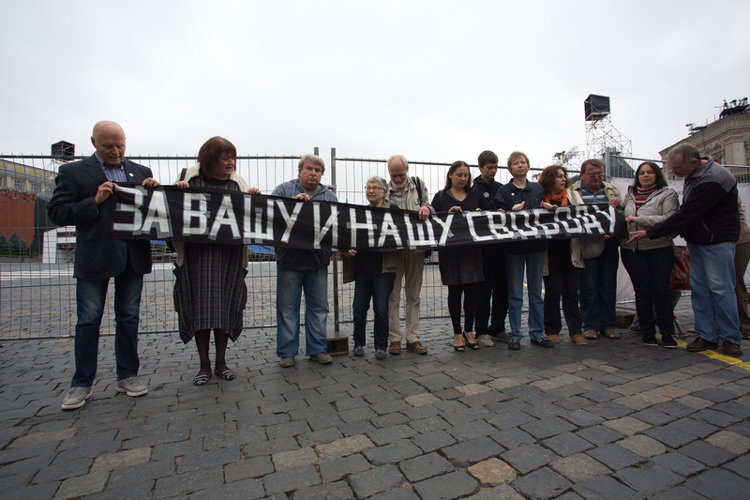
A typical illustration of dissident idealism is the slogan “For your and our freedom”, which is now repeatedly ridiculed and allegedly lost. Here is a well -known argument addressed to Russian liberals: you support Ukraine, and Ukraine forbids you - just like everyone else. You defend her freedom, and she wanted to spit on your freedom! There was no “yours” left - now everyone has their own. This argument, in addition that it indirectly justifies lack of freedom, is also morally incorrect: this can reason as a person who thinks only in the categories of benefits, calculation for someone’s praise or recognition. Such a statement of the question is committed does not take into account the natural feeling of guilt before Ukraine, which the Russian liberal experiences. Those who say today “for your and our freedom” do this not out of the desire to please the Ukrainian or Brussels official. They do this, first of all, for themselves to save their own conscience. And appealing to the general, albeit unattainable, ideal of freedom, which includes Russia, Ukraine, and all the others.
“For your and our freedom” - this is addressed today and to migrants. Their opponents again repeat the same argument: you are freedom, but they wanted to spit, they do not respect you and are not going to respect your laws! .. Again, this is not done for gratitude. Germany opened the boundaries of migrants not for the sake of benefit, but in the name of confirming the versatility of democratic principles, in the name of the future, including guilt for its own catastrophic experience of the past.
Another dissident question, he is Kantovsky, to which Russia is standing again: is it possible to act ethically in an unethical situation?
Any of your action, even excessively good, tell us, will be used by the Kremlin for their selfish purposes, one or another tower. This is the fee for paternalism. Again, the answer to this question can only be found in an idealistic concept-in any case, to act according to conscience, and not according to profit or calculation. No need to think about how it will be interpreted and by whom it is used; It is necessary to act based on universal considerations. To ask myself: how would I act in an ideal situation if there were no “towers”? .. And to do so. This is intelligent behavior, this is the idealism of the New Age, the example of which we can gather in Soviet dissidents.
Chronicles
There is a sphere for which dissident experience is critical today - this is media. The current disconnection of the propaganda press recalled the problem of the origin of the modern Russian press. It mainly inherits Soviet newspapers and magazines; There is, however, new media copied from Western analogues - but the form does not guarantee the spirit, you can’t borrow freedom. Actually, the problem of these new media, when they are faced with a “double continuous” situation, is not that they do not understand the absurdity of what is happening, but that they have no place to draw moral forces to resist censorship. These spiritual foundations can only be found in the experience of dissident printing. New identity, journalistic ethics and objectivity must be sought there. In Ukraine, for example, there are still publications that lead their history from the dissident press, underground, the 1980s. There are no such examples in Russia. The free press in Russia should not be counted from the Soviet press, but conditionally from the "chronicle of current events." Since only this publication is, as they say, the experience of spiritual resistance, the struggle for freedom of speech in hopeless conditions.
One of the functions of modern media in Russia, as in the dissident “chronicle”, should be a certificate. The degree of current division is important to record, remember, record - not for information, but as a negative example, the lower plan of the fall. New ethics should be built, starting from this threshold - for which it is impossible to cross.
... Ever since Dostoevsky’s underground person got tea to drink and work on state television and radio, he has multiplied in hundreds and thousands of copies, it seems that he could not escape from this dusk. So there is a feeling of anthropological disappointment - and it remains only to nature. These are the important words of another hero of the film Kachkin - Mikhail Meilah: "I always felt different." Dawn, a friend who is a mistake of nature. But this is the last hope of Russia. Nature, as you know, always retains spare ways of development. Therefore, it is always surprising how “others” literally ripen in Russia-that after 1953, which in 1968, which in 2017. This speaks of the underground reserve of humanity in Russia - and confirms the primaryness of conscience as an irrational propeller in progress. All calculations, common sense advise to do this, and conscience - otherwise; It changes everything at once, and the story moves the other way.