
Translated material
The art of war
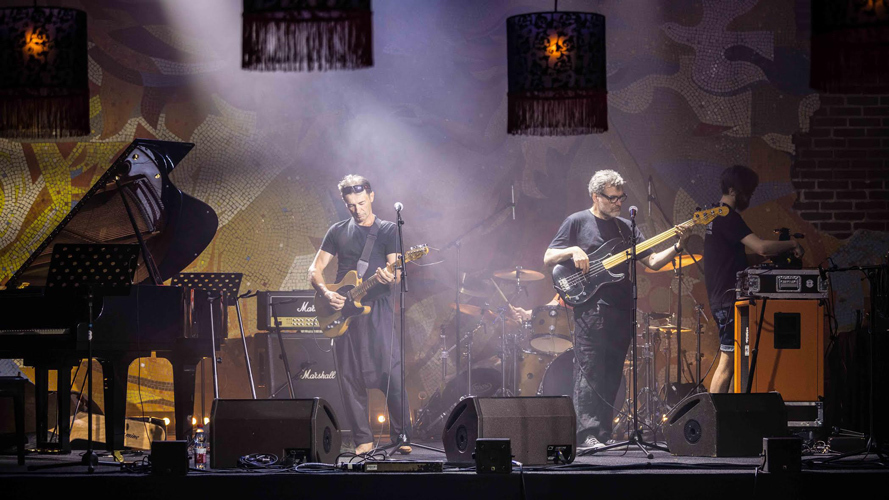
Chapter I. Preliminary calculations / "What if!"
Sun Tzu said: war is a great matter for the state, it is the ground and death, it is the path of existence and death. You need to understand this.
I will not be mistaken if I name a new album of “polite refusal” long -awaited. I have been waiting for him for six years for sure - from the very moment that I first heard in the concert one of the tracks, ultimately into it. And indeed: a year later the name "Military Films" was published. It wandered from mouth to mouth, not realizing in any way. Meanwhile, the element, which is dedicated to a new release, walked closer, approaching the boundaries of the territory that we consider to be my homeland, and every time, coming to the “refusal”, I heard it howls in lines from different songs of the group: from “machine gunner, scribb” to “the best friend of the soldier is a black raven”. At the same time, it was clear that the topic was by no means pedal, just a bifurcation point - it is here. How could it be otherwise if in the 4th century BC. Sun Bin (and not Sun Tzu, his distant ancestor, as previously believed) expressed a thought with which the most famous treatise on military strategy and politics begins?
Roman Suslov approached the military theme as a true musical anatomist and deconstructor: recalling the Soviet military songs obsessed in his memory, he, as he sees from the outside, wanted to dig into the topic with the excitement of the researcher. So he once plunged into an ethnic, so he re -claimed dance music - but you won’t get away with this.
Chapter II. Warfare / "Guderian and ice cream"
If you have a thousand light chariots and a thousand heavy, one hundred thousand soldiers, if the provisions must be sent for a thousand miles, then internal and external expenses, the costs of receiving guests, material for varnish and glue, equipment of chariots and weapons - all this will be a thousand gold per day. Only in this case you can raise the hundred thousandth army.
To whom the war, to whom the mother is relatives - this saying a Russian person knows cheism, and you do not immediately understand that she is bitter, but not condemning. Reading the treatise “The Art of War”, in the cold and rational lines you not only see the great Chinese strategist (no matter, ancestor or descendant) and the army he led, but you also feel the invisible presence of those who consider those same thousands of gold, prescribes varnish and glue and so on. I don’t know how Suslov refers to Sun Tzu and whether it refers at all somehow, but in the “refusal” the rationality is always bribed-as opposed to everything that was, is and will be Russian rock. This team, if it was an element, is driven and always rigidly controlled. It is thanks to this that, it seems that he still remains himself - a partisan musical formation, which differs from everything that was on the domestic stage. “Refusal” can do everything - but he wants and does only what he considers necessary and important.
Chapter III. Strategic attack / "infantry in the trenches"
... to fight a hundred times and win a hundred times - this is not the best of the best; The best of the best is to conquer someone else's army without fighting.
The war is always somewhere nearby. In the psychology of a Russian person - for sure. I still remember the reaction of the old women to news from the kitchen radio points about the machinations of the Israeli or American military: “Lord, if only there was no war!” On the other hand, I recall the son of a tenant in the Crimea of the late 1990s, a hefty small age of 22, who lit up and yearned in the resort town and eventually left, as they said, in the French foreign legion. The war is constantly present in consciousness in three hypostases: as a reminder of the feat of the people, which supporters of patriotic education so love to poke in the nose; As a horror and horror in the memory of the very people who was not going to commit a feat, but simply wanted to live - and as a light and convenient way to solve all problems. “... In the basements and half -basements, the children wanted to under the tanks,” Vysotsky sings, indicating the vector, but without opening it. Suslov and his colleagues had to work with this triune myth, but they managed to look at him from above and a little on the side.
“Refusal” can do everything - but he wants and does only what he considers necessary and important.
Chapter IV. Form / "Gopak"
When the winner fights, it is like accumulated water, from a height of thousands of fathoms casting into the valley. This is the form.
In the spring, Suslov told me that he physiologically suffers from imbalance: “... this is not even perfectionism is an increased demand for harmony. When I see an imbalance, I feel sick. ” In the new work of the group, almost mechanistic sound structures, in which echoes of past marches are heard, are replaced by chaotic impulses (in fact no less thoughtful and structured); It is worth free to freeze and carefully listen to each of the eight compositions in order to realize the unity and struggle of the parts that make up the whole. It would be easy to simply declare that the musicians managed to combine the theory of war with its practice in sound form, planning with the noise of the battle, but it is unlikely that this will turn out to be artistically justified by truth. This music is non -painful and extraordinary. Although, of course, everyone draws conclusions for himself.
Chapter V. Power / "Zenitchik"
No more than five tones, but the changes in these five tones are impossible to hear; there are no more than five colors, but it is impossible to see changes in these five colors; There are no more than five tastes, but it is impossible to feel changes in these five tastes. There are only only two actions in the battle - the correct battle and maneuver, but it is impossible to calculate changes in the right fight and maneuver.
Here, the name of the head of these semi -spont reflections with a real composition, the studio version of which was the first to come into the field of view of the general public, was one of the few, in which there is a meaningful and articulate text, not a set of abstract phonemes, correlated. Indeed, if you monitor these torn phrases, as if descending from the posters around the parade ground of the artillery part, the “anti -aircraft gunner” is about how to fulfill the task: “I should know everything: / where the sun is, where the wind, / strength, speed come from. / Indicate me the goal, / angle of lifting, / leading, / sight ... ”Immediately, listening to the song on the Sound C Loud , you see from below the commentary of the other user of the service -“ NISA Emerson Lake & Palmer ”, you instantly remember both of them, and you understand that the user had in mind: yes, a rhythmic drawing flashed with it, and a rhythmic drawing flashed for a minute. Partly reminding the first famous group with the participation of Keith Emerson, but what does it related to what is happening to you and this music here and now?
Chapter VI. Complete and emptiness / "We will win!"
Sun-Tzu said: who is the first on the battlefield and is waiting for the enemy, he is fulfilled; Those who later appear on the battlefield late and rushes into battle is already tired. Therefore, the one who fights well runs the enemy and does not allow him to control himself.
The most famous of the songs of the program and probably the oldest of them. One of the few “new hits” of the “polite refusal” and at the same time the song, in which it seems that the meanings of the words of Suslov, said in the commentary on the premiere of the “Zenitchik” on “Medusa” were concentrated: “War is something very mixed, contradictory: some kind of irony, and the game, and unconditional tragedy.” The march -shaped rhythm of the verse, poster words, flavored with a fair amount of irony, and a bully chorus, thanks to which the song was immediately called “Clezmer”, where both the pipe, the violin, and the rollingish piano, and the voice, going into a furious, half -craft, cause undisguised pity, and it is unclear who is its addressee: those who are about, who are the same, you are from. Is, who listens to her, or in general everyone who lived and lives on this earth? “Chu, do you hear the guns scorch somewhere? So, this is a salute ... ” - here, in fact, the last words of the song, phenomenally hopeless, and not at all the cheeky line, a third of which is made into the name.
Chapter VII. War struggle / "Overture"
Being close, they are waiting far; Being in full force, they are waiting for the weary; Being full, they are waiting for hungry; This is power management.
For Suslov, music is a work done with pleasure, solving fairly abstract problems. Sometimes it seems to me that a concert for him is a public evidence of a theorem or, conversely, a refutation of evidence. Therefore, the overtures - there are now two of them (the second - on “ethnic experiments”) - are by no means at the beginning. The plate is almost finished, the abstract bursts are replaced by a lingering melodic line, so reminiscent of some Soviet songs-and at the same time completely unlike them, then again leave at the peak. The partisan detachment named after a polite refusal once again deceives everyone and is deleted.
Chapter VIII. Nine changes / "final"
There are roads on which they do not go; There are armies that do not attack; There are fortresses that do not fight; There are areas because of which they do not fight; There are commandments of the sovereign who are not fulfilled.
What did a “polite refusal” with us this time, letting the stamps, cliches, stereotypes in their crooked mirror? I noticed for a long time: people at the “Refusal” concerts change before our eyes. Such an effect is usually attributed to collectives of a completely different property, in that they are appealed to feelings and emotions or, moreover, spiritual practices; There is a different story. “Military battles” is an incredibly important record for today. The fact is that the music of “refusal”, if you want, is the very pure art that is free from ideology, responsibility to society, but extremely responsibly for itself. In the current world, this is incredibly rare.
And what was there with something-the artist, so that every breath has changed something in the surrounding world. Which, however, is eagerly waiting for this sigh.
Quotes from the treatise "The Art of War" are given in the classic translation of academician Nikolai Conrad.