
Translated material
Universities were given a chance
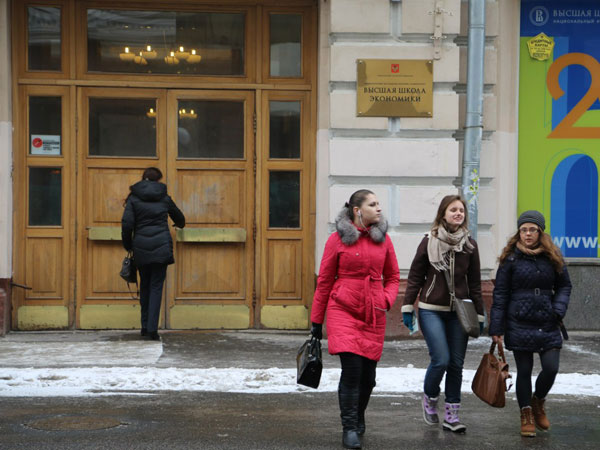
On the eve of Yekaterinburg, a meeting of the Council was held to increase the competitiveness of Russian universities among the leading world scientific and educational centers-or the council of the 5-100 project. He, filled, was created in 2012 at the initiative of Russian President Vladimir Putin. The essence of the program is simple-so that by 2020 five Russian universities would be quoted in the international arena, entering the top 100 world ratings of educational institutions.
From the moment of the project, 21 university has been included in it, but recently the head of the Ministry of Education and Science of the Russian Federation Olga Vasilieva proposed reducing the number to the most effective to distribute funds from the federal budget between them.
“We must leave effective universities - no more than six ... The remaining money is invested in the development of these universities, so that by 2020 these universities enter the very five, which the president requested us about. All other universities will report on the work done and spent money for the period that was - I repeat once again, 50 billion 200 million rubles. Here is my offer. I can’t offer anything else. Because if we do not concentrate the situation in six universities and do not invest the remaining money there - almost 30 billion, there will be no solution to the problem posed by the president, ”Vasilyeva RIA Novosti quoted.
The minister’s proposal consisted in distributing money between the Moscow Physics and Technical Institute, the MIFI National Research University, the MISIS National Research University, the Higher School of Economics, ITMO University and the Novosibirsk State University, TASS recalls.
The representatives of the remaining 21 university, of course, did not inspire Vasilyeva. Firstly, due to reputation costs-those 15 universities that were offered to be excluded from the program would suffer powerful damage. Secondly, due to the overlap of financing within the project.
“At the same time, they, of course, put forward an argument that until 2020 there are several more years and they would, they say, could reach the treasured goal - and they cut their wings. So it can be expected that in the university environment discontent will increase sharply. I’m not talking about the fact that these universities are losing money, ”said Tatyana Klyachko , director of the Center for Continuing Education of the Institute for Applied Economic Research, Tatyana Klyachko, earlier.
Perhaps that is why the advice of the Deputy Prime Minister of the Russian Federation Olga Golodets in Yekaterinburg decided to leave in the project all universities that were originally declared to participate in 5-100. But something has changed. All universities and institutes were divided into three groups, depending on this, funding will be distributed.
“For the first group, the“ 6 ”coefficient is installed, this is about 780 million rubles per year, the second group is the“ 3.5 ”coefficient, it is about 480 million a year, the group three-the“ 1 ”coefficient, a little more than 100 million rubles,” citizes the Vice Prime Minister RIA “New Day” .
The agency clarifies that at the end of the year, universities can move from one group to another. So far, a group of leaders looks like this: the Higher School of Economics, St. Petersburg National Research University of Information Technologies, Mechanics and Optics, the National Research University MEPhI, the Moscow Physics and Technical Institute, the Novosibirsk State University, the National Research Technological University "MISIS" and the Tomsk State University. It is reported by RBC .
Kazan Federal University, Russian University of Friendship of Peoples, the First Moscow State Medical University named after I.M. Sechenov, St. Petersburg Polytechnic University named after Peter the Great, National Research Tomsk Polytechnic University, Tyumen State University and Ural Federal University.
Finally, in the third group: the Baltic Federal University named after Immanuel Kant, the Far Eastern Federal University, St. Petersburg State Electrotechnical University, Samara National Research University named after Academician S.P. Koroleva, Nizhny Novgorod State University named after N.I. Lobachevsky, South Ural State University and Siberian Federal University.
At the same time, it should be reminded that the purpose of the project was to get into specific world ratings - the British Quacquarelli Symonds and Times Higher Education, Chinese The Academic Ranking of World Universities. However, so far none of the 5-100 universities have come close to the goal. Only Moscow State University, which is not included in the project, got into the TOP-100 QS and Arwu. Recently, the prestigious American universities in US News Best Global Universities 2018 included 15 Russian universities, 12 of which are 5-100 participants. True, the results were not the most outstanding: for example, the best of the project participants showed Niyau MEFU with a 438th place, then the Novosibirsk State University with 471 places and the Moscow Fiztekh with the 534th.
“If we look at the quality of promotion of Russian universities and, for example, Chinese universities at the stage that corresponded to the first years of the first Chinese project, we will see that Russian universities are growing faster than about two times in the ratings,” VSHE Rector Yaroslav Kuzminov “ Indicator ” quotes.