Date
Author
ПЕТР ФИЛИППОВ; ИГОРЬ Г ЯКОВЕНКО
Source

Preserved copy
Translated material
You must be a citizen!
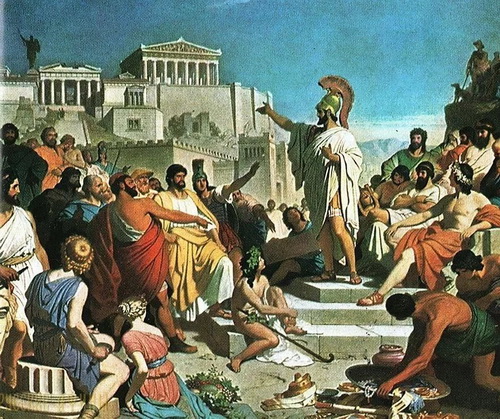
Most Russians want to be away from politics. Like, we are small people, you arise less - you will live longer. They would have lived in ancient Athens, they would definitely be punished with atymia - public impasses, dishonor, contempt, deprivation of civil status rights. A person who has undergone atimia had no right to perform in a national assembly, occupy positions, serve in the army, participate in the Olympic Games. So harsh was punishment for non -participation in politics. The law demanded that during excitement and feuds, citizens adjoin one of the fighting parties. This requirement allowed to avoid prolonged troubles and seizure of power with an energetic minority, which enjoyed the political passivity of the townspeople. In Greece, a person who avoided participating in public life was called "idiotos." For the ancient Greeks, our do not care is a sign of inferiority.
For many centuries, Russian society has been based on the passivity of people controlled by a self -serving elite. Those who tried to defend their interests in the eyes of contemporaries looked dangerous troubles: what can gentlemen be, then the slaves are prohibited. In fact, even today, the idea that the supreme power is not from us, but from God or, better to say, it is the governor of God on earth. At the same time, the king (president) is good, and the boyars (governors and ministers) are bad. In Russia, people are used to scolding power in kitchens, to write petitions to the king (president).
We ourselves are to blame for the fact that we feel like slaves. We give bribes to traffic cops and doctors, turn the forests into landfills, ignore laws, do not fight for our rights. We put up with the elections in elections, repressive laws and custom sentences of ships. We failed to create political competition in Russia - the only effective cure for systemic corruption (with free media and television). We do not form new party independent from the authorities and do not work in those that have already been created. Why?
Power is the way our people allows her to be. Do not think that people are in power are some special-except perhaps it is faster and more prudent. Everyone is not saints, everyone is rowing for themselves, and ministers too. There is no control by this opposition - theft of taxpayer money cannot be stopped. And if the people do not want to control their power, is not able to approve orders in which there will be no arbitrariness and theft, then he receives what they deserve. From Russia, so much money was taken out of Russia that every family would have enough for a new apartment. And we are silent, afraid, we do not participate in rallies of protest (even agreed with authoritarian power). We are the slaves!
In democratic countries, society is responsible for power of any level. There are political institutions, traditions and practices that allow people to influence power, adjust its behavior and shift objectionable rulers. Read how power is controlled in Finland, Sweden, Germany. But our authoritarian power crushed such institutions in the bud, called out by “foreign agents”, and planted activists. But does this abolish the responsibility of the people for what is happening in the country? After all, the duty of a citizen is to resist authoritarianism, which destroys democracy, deprives people of political rights, doom them to poverty.
Interrupting friends, and they will tell you that our civil duty requires the laws and legal orders of the authorities even when it is unprofitable for us. It requires a loyal to the state, supporting politicians alien to us, even if they are elected with frauds in dishonest elections. And in civilized countries, it is civil duty that encourages not only to control the authorities, but in life to behave differently. A witness to the unworthy behavior of the driver who threw an empty pack from the window or crossed the continuous strip from the window, immediately reports the number of his road police car. Who is he - a scammer or citizen fighting for cleanliness?
It turns out that civil duty is understood in us in different ways. The European tradition of debt is based on democratic values and involves the confrontation of tyranny. In the Asian tradition , which is much older than the European one, any confrontation of despotic power is interpreted as a crime, and the very concept of civil duty loses its meaning, since citizens disappear. Their place is occupied by slaves, slaves, troublemakers, unreasonable mob.
In the European sense of civil debt, society is responsible for power. For traditionally, Russian consciousness, on the contrary, the sacred power is responsible for society as a whole and for each subject (to drink, feed, give work, defend from especially zealous bribes and assertive foreigners). With such ideas , a civil debt is a subject of a subject in relation to power. The word "civilian" here is nothing more than the words we borrowed from the Europeans, in fact, we are talking about the debt of a loyal.
With a despotic tradition, there is no conscious responsibility of subjects for the policy of power. And this is natural: people cannot be responsible for their gods, they perceive the formidable ruler as a natural disaster, which must be endured. There is no other conscious exit within this tradition.
The basis of Athenian democracy , on the contrary, was the cult of tyrannobyan of harmony and Aristohyton, which passes through the entire European history. Harody and Aristohyte in 514 BC. They organized a conspiracy against the tyrant of Hippia, but managed to kill only his brother Gipparha. Harody was killed at the crime scene of guard. Aristogiton disappeared, later he was seized, tortured, but he did not betray accomplices, but made a pronounced tyrant. After the overthrow of tyranny, harmony and aristhython were revered as the greatest national heroes. They put a statue in the Acropolis. The descendants of the heroes were freed from duties and used honors. Scoli (table song) “Harmia” in honor of tyrannobyan has become the unofficial anthem of the Athenians.
It is impossible to imagine something similar in Russia. In the history of Moscow Rus' with Greek tyrannoyans, one can compare the killers of Prince Andrei Bogolyubsky. He was a tyrant, planted an autocratic style of government, destroyed the democratic traditions coming from Kievan Rus, when the prince’s power was limited by the city veche, the council of the squad and other institutions of early state democracy.
The Orthodox calendars report that "the holy and faithful prince Andrei accepted the martyrdom by the hand of the traitors in his Bogolyubsky castle." True, after the murder of the prince, the castle was chewed and burned by the rebellious people. It is characteristic that Russian history did not seek to preserve the names of the conspiracy participants against the tyrant. The chronicle calls individual names, and pre -revolutionary history textbooks cost the collective word “the palane”. The murder of the prince was followed by the indicative execution of the conspirators, their corpses were drowned in a cumulative lake.
From these stories you can extract a lesson. If, after the murder of a tyrannical ruler, a democratic tradition wins, then he is declared a tyrant, and his killers - heroes. If a despotic tradition is approved, the tyrant is declared a martyr, and its killers - villains and criminals.
Not a single political regime, not a single government is equal to the people. The governments come and go, the peoples remain. The interests of the nation are wider and more significant than the attitudes of the authoritarian regime, which seeks to pull the people into the abyss. In their demagogy, authoritarian leaders represent the fight against dictatorial or authoritarian regime as a struggle with the people and the state. The fact that this is a lie, in critical moments of history, it becomes clear even to the most loyal society. It is self -organized and changing orders in the country. The only question is when it will come in Russia?
Peter Sergeevich Filippov, Igor Grigoryevich Yakovenko
Illustration Grekoline.ru