
Translated material
Who will solve the Catalan issue
Why Scotland can be held a referendum on independence, and Catalonia can not be - the answer will have to be given to Brussels

A rally dedicated to the integrity of Spain. Barcelona, October 29, 2017. Photo: Twitter.com
On October 29, two days after the Catalonia parliament by a majority vote proclaimed an independent republic, a powerful demonstration of supporters of the Spanish unity was held in Barcelona: the organizers of the action counted more than 1 million participants, the police on the eve of the head of the Catalan autonomy of Carles Puchdemon, removed from the post of Madrid along with the entire cabinet after introduction after introduction Catalonia of direct management from the capital, called the local population to the "non -violent democratic resistance" by the Spanish authorities.
Supporters of Catalan independence, insisting on their own, are very at risk today - given that Madrid on October 1 had already sent detachments of the Civil Guard (special police units) to the region to disrupt the referendum. However, for the Spaniards, the aggravation of violence will mean an unprecedented war of state power in the history of the European Union with the rebellious region.
The 155th article of the Spanish Constitution, to which Madrid resorted to pacify the rebellious region, is not able to resolve the conflict-only to postpone it. This article, although it introduces the temporary management of the region of the capital's officials, implies the holding of new elections in the autonomy. Madrid has already appointed them - on December 21. But today there is no doubt: supporters of independence will again win in these elections (if they take place). And, perhaps, even more votes will be gained - Madrid's power actions have repeatedly in the history of relations with catalonia led to the opposite effect: in this case, separatist sentiments in the region are only intensified.
And by the way, it is not yet a fact that the Catalan Zeneralitat (Government) will wish to “self -open”, which the government of Mariano Rajoy expects him. Catalan leaders say that "they received the mandate not from Madrid, but from the Catalan people." And the forceful acceleration of people's chosen ones is able to finally undermine the image of Spain as a European democratic country. (Photos of hundreds of people affected by police batons during a referendum on October 1, have already passed all the world media). The parallels with the era of the dictator Franco, who like to conduct catals, will turn from hyperbola into reality. Anyway, this will become an unprecedented event in the history of the European Union, where the police have never dispersed the institutions of the chosen authorities anywhere and never. And if, in resolving this conflict, its significant word should finally say the EU (represented by the European Commission and the European Parliament), confirming or refuting the legal declarations on the basis of which it was created.
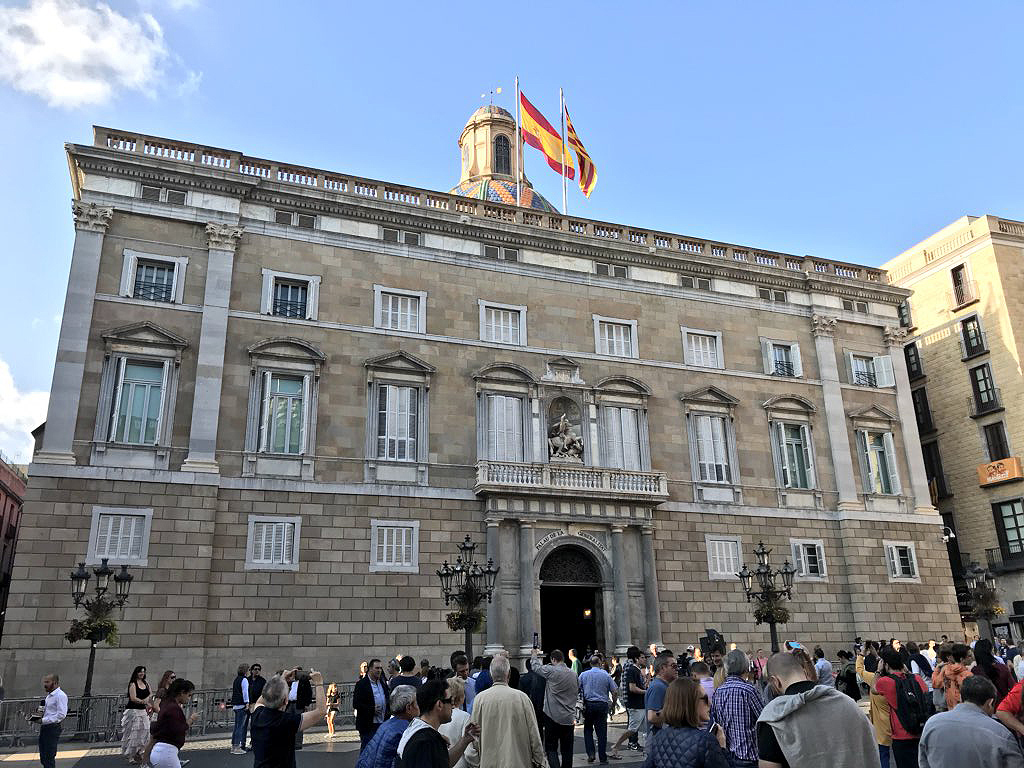
The Spanish flag is still fluttering over the building of the Catalan government in Barcelona, October 29, 2017. Photo: Twitter / @straussmarine
"Europe a hundred flags"
The current Constitution of Spain was adopted in 1978 - back in the "Daesian" era, and therefore does not take into account the many political transformations that have happened since then. However, today this document has become a kind of “sacred scripture” for the Spanish authorities, in which they refuse to amend the amendments dictated by modern political development. Therefore, the question that many Catalans are asked fair: do we have a constitution for the people or people for the Constitution?
Since the beginning of the 1990s, the European Union has been formed on a dialectical principle-on the one hand, there were pan-European structures, and on the other, the local and regional movements of large EU countries have increasingly sought their own political subjectivity. This combination of pan -European and regional interests was considered as a reliable antidote from interstate conflicts with which the history of Europe is overwhelmed.
In 1985, the Assembly of the regions of Europe (ARA) was created, uniting by the end of the 20th century about 300 territorial communities of European countries with a population of 400 million people. In 1996, the Assembly adopted a declaration of regionalism in Europe - the authors of this document insisted on improving the political influence of regions in European institutions of power and promoting the principle of subsidiarity, according to which significant decisions should be made at a level as close to citizens.
The further development of the ideas of regionalism in the EU was the formation of more than a hundred Euro regions - cross -border territories of neighboring countries organizing joint projects of economic and cultural cooperation. This is a fairly vivid regional measurement of European integration.
“Europe of a hundred flags” - the book of the Breton regionalist Jan Fouéré (Yann Fouere), in which he substantiated the need for “disaggregation” of European states and the creation of a new pan -European self -governing regions, was figuratively called back in 1968. The wars between these regions, according to Fuer, will be impossible, since all of them are economically interdependent. But such a transformation of Europe would radically bring power closer to citizens and get rid of multi -storey state bureaucrats.
Although this radical project has not come true, today the European Free Alliance party continues to develop the idea of “European Free Alliance” - it unites more than 40 regionalist movements from different EU countries and in the coalition with Green takes 50 seats in the European Parliament.
Supporters of this party reasonably indicate - why, for example, Scotland in 2014 had the right to hold a referendum on independence, and Catalonia does not have it? The Catalan Prime Minister Carles Puchdemon also says about this: “We asked the Spanish authorities to hold the same referendum that was held in Scotland 18 times. But we were refused over and over again. "
Great Britain, obviously, remembered the tragic experience of the war in Olster - and therefore agreed to hold a referendum in Scotland. But the no less difficult history of the relationship of Spain with the Basque Country, it seems, did not teach anything “Madrid court”.
Supporters of the “unified Spain” claim that most of the inhabitants of Catalonia do not want independence. Well, a referendum - just the best way to find out! Come and vote against - as the inhabitants of Scotland acted in 2014: then the opponents of independence won, albeit with a slight advantage, and as a result of Scotland remained as part of the UK. (Although now, after Brexit, the Scots are going to hold a new referendum because they do not want to leave the EU).
However, the position of Spanish unitarists surprises with its anti -democratism. They do not advocate that their supporters in Catalonia had the opportunity to vote against her independence in a referendum - they oppose the referendum as such that means the refusal to all residents of the region in the right to make their choice.
But attempts to resolve such issues by prohibitions and violence can only lead to response violence. Great Britain, obviously, remembered the tragic experience of the war in Olster - and therefore agreed to hold a referendum in Scotland. But the no less difficult history of the relationship of Spain with the Basque Country, it seems, did not teach anything Madrid court. If the region is deprived of democratic self -government, its supporters move to more radical methods of struggle.
The modern Catalan movement for independence is not at all belligerent, but creative and artistic - there are many clips of local music groups on the Internet. However, with their imperial batons, the Spanish government can achieve a change in these moods. And then she will have to blame herself in the appearance of a new “hot point” on the map of Europe.
"New European Country"
There are several reasons for the struggle of Catalonia for his independence, but not one of them explains the problem completely.
There is a historical reason - Catalonia became part of Spain only in 1714, and before that, several centuries were one of the sovereign regions of the vast Mediterranean kingdom Aragon. However, the memory of such a long -standing past can hardly become the main “motor” of the modern mass movement for independence, which take millions of people on the streets.
There is a cause of cultural-linguistic-the Catalan language is different from Spanish, but it has been quite official since 1979.
Paradoxically, it turns out that the fighters for the independence of Scotland and Catalonia, who are called "separatists", are more for united Europe than official London and Madrid
Finally, the reason is economic: Catalonia is one of the most developed regions of Spain that pays multi -billion dollar taxes to Madrid, and in return, as we saw October 1, receives police batons.
Historical, cultural and economic reasons are united in the main one - Catalonia wants to become an independent political entity, a “new European country” - as banners at Barcelona demonstrations say. This was told by the author in an interview with another 3-year-old Catalan politician Elizabeth Negro: “For us, the question is not more or less authority. We are talking about our basic law - to make political decisions, to freely and democratically determine our own future. ”
Paradoxically, it turns out that the fighters for the independence of Scotland and Catalonia, who are called "separatists", are more for united Europe than official London and Madrid. Conversely, the EU is destroying the former empires, which violate the democratic rights of citizens (like Spain) basic for Europe or completely leave the European Union (like the UK).
Questions to Brussels
Indeed, from a logical point of view, it is not clear - if there is a single European Union, then why should Catalonia consist in it not directly, but “through Madrid”, paying his taxes to the Spanish treasury? And obeying the Spanish laws that prohibit regional referendums about independence.
In order for the “Madrid court” to recognize the Catalan referendum “legitimate”, we need amendments to the Constitution of Spain, adopted by the qualified parliamentary majority and approved by the king. However, Catalans can hardly count on such courtesy ...
Today they expect that the official European Union, if it does not recognize their referendum automatically, then in any case, will react to the will of citizens with respect and condemn the violent actions of the Spanish police. However, so far such statements from official Brussels have not been heard.
Why can Luxembourg with its half -million population be an equal member of the EU, and more than seven -million Catalonia cannot?
The Catalonia Foreign Minister Raul Romava noted that the lack of reaction of the European Union to violence by the Spanish police “undermines confidence” to unification and its institutions. And this is perhaps the most disturbing questioning result of the October events in Catalonia. If Brussels is not capable of demanding from the countries participating in compliance with pan-European legal principles prohibiting the resolving political problems of violence-will “united Europe” remain as an attractive project in the future?
There are simple, purely arithmetic issues - but, surprisingly, very difficult for Euroborlars. Why can Luxembourg with its half -million population be an equal member of the EU, and more than seven -million Catalonia cannot?
By the way, the Catalan GDP economy is about € 225 billion! - surpasses many EU countries - Portugal, Czech Republic, Greece ... The share of Catalonia in the Spanish GDP in 2016 amounted to 19%, while per capita income - € 28,600, while the Current income per capita in Spain is € 24 thousand per year. Catalonia receive 14% of all investments in Spain ...
The European Union must show that it is not built on some kind of frozen, “once for all this” model, just as the Spanish unitarists consider their constitution “inviolable”-but is developing taking into account modern civilian requests
Catalan events are clearly shown: today, with the growth of regional self -awareness in different EU countries, the political reform of the European Union has ripened, which would delegate the regions high rights of self -government.
No, this will not at all become the “collapse” of the European Union, on the contrary, small territories, due to its economic interdependence, will be interested in strengthening ties with each other. And on the contrary, the destructive role in the EU is sometimes played by large countries, where the inertia of imperial traditions is still strong. And the heralds of these traditions are often right -bending forces. In France, for example, the ideas of Frexit (Frexit - from the word Brexit) is expressed by the leader of the French National Front Marine Le Pen.
In other words, the European Union should show that it is not built according to some kind of frozen, “once for all this” model, just as Spanish uniitarists consider their constitution “inviolable”, but is developing taking into account modern civil requests. The fact that such a restructuring is necessary is also said after the Catalan referendum - residents of the Italian regions of Veneto and Lombardy also spoke out for their autonomous status.
But the position of Russia on the Catalan issue leads to some bewilderment. On the one hand, the official Kremlin states that this is an internal business of Spain. But on the other hand, shelter television propagandists frankly gloating about the next “European troubles”.
However, the word "bewilderment" is not quite suitable here. Rather, even the opposite - the gloating of Russian federal channels is quite natural. In recent years, Russia belongs to the European Union with poorly hidden hostility. And uses EU errors to strengthen anti -European propaganda. Although it would not hurt to think better about the crisis of federalism in Russia itself, since the current hypercentralist policy of the Kremlin, which suppressed regional self -government, can lead to much more sad consequences than in the EU. But this is another topic ...
See also: “Madrid vs of Barcelona ” , “how Crimea differs from Catalonia” , “ in Barcelona, hundreds of thousands of people went to a rally against the independence of Catalonia , ” “ Madrid appointed a new head of Catalonia ” .