
Translated material
In India, a skeleton of ichtiosaurus was found for more than 150 million years
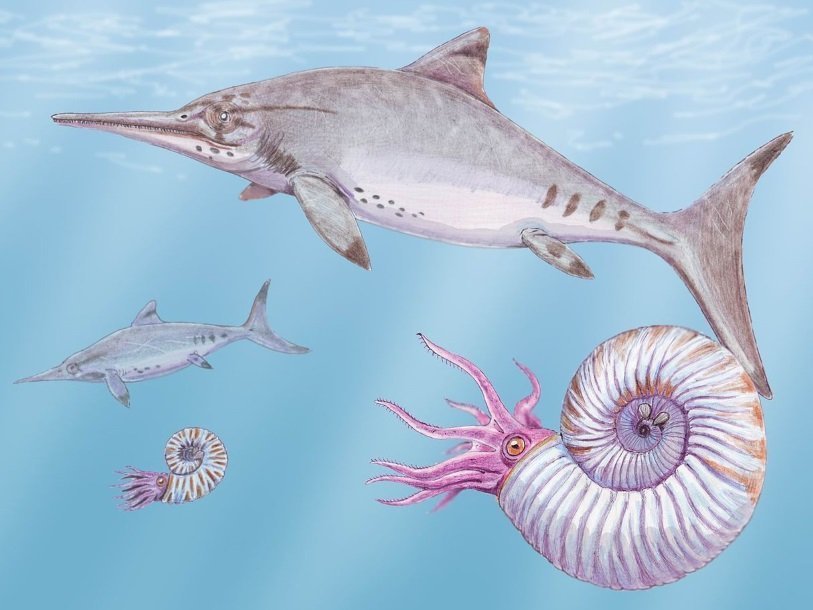
In the electronic scientific journal PLOS ONE, a description of the skeleton of ichtiosaurus, which was found in 2016 south of the village of Lodai, in the Indian state of Gujarat, was published . He became the first complete skeleton of Ichthyozaur found in India, and the first Jurassic period in the country in the country.
Hundreds of copies of fossil representatives of the ichthyosauria unit ( Ichthyosauria ) are known to scientists, but most of them were found in Europe or North America. Now Guntupalli Prasad from the University of Delhi and his colleagues presented the scientific community by the Indian copy of the ichthyosaurus about 18 meters. It belongs to the previously undeveloped family of the Ophthalmosauridae family. Representatives of this family were distributed from the Middle Jurassic period to the early-late Cretaceous period. Their fossil remains came across paleontologists in Asia, Australia, Europe, North and South America. The name of the family was received by the basic genus of ophthalmosaurus , opened by the British paleontologist Harry, as early as 1874 and had very large ones - up to 10 centimeters in diameter - eyes.
Prasad et al, Doi: 10.1371/Journal.pone.0185851
The age of the Indian copy is from 152 and 157 million years. Ichthyosaurus was in an extremely solid sedimentary breed, and its extraction became grueling labor for paleontologists. According to Gundall Prasada, it took a total of 1,500 man-hours of work at an air temperature of more than 35 degrees. The reward for scientists was an almost complete skeleton of the ancient sea reptile. The spine of ichthyosaurus was found in an undeveloped form, the left front fin also retained the lifetime form. Prasad admits, says that the find was a surprise: “Previously, I did not conduct a search for fossils of vertebrates in this region, since it was believed that they are extremely rare here.”
Paleontologists have noticed traces of the wear of the teeth of ichtiosaurus, which indicate that he was feeding on solid food: with shell fish and ammonites. The petrified ammonites and whitemenites were also found next to him.