Translated material
Ktulhu Gahn
What the most prominent intellectuals did in the twenties and why everyone forgot about it
The publishing house “New Literary Review” was published by the two -volume “Art as a language - languages of art”, dedicated to the State Academy of Artistic Sciences, an important institution of the twenties, in which Gustav Shpet, Alexey Losev, Vasily Kandinsky and other largest Russian thinkers, scientists and artists of that time took part. Gorky discussed Gakhn with one of the editors of this publication-Nikolai Plotnikov, a philosopher, a cultural scientist, director of the Eastern European Collegium North Rhine-Westphalia and an assistant professor of the Institute of Russian Culture named after Lotman of the University of Bochum. Art as a language - languages of art. State Academy of Arts and Aesthetic Theory of the 1920s. Volume I. Research / Ed. N. S. Plotnikova and N.P. Undemsky with the participation of Yu. N. Yakimenko. M.: New Literary Review, 2017
Art as a language - languages of art. State Academy of Arts and Aesthetic Theory of the 1920s. Volume II. Publications / Ed. N. S. Plotnikova and N.P. Undemsky with the participation of Yu. N. Yakimenko. M.: New Literary Review, 2017
What is gahn and how it is being studied
I became interested in the State Academy of Arts because I have long been engaged in German-Russian philosophical connections in Germany, European intellectual history and the interaction of German and Russian philosophical spaces. In this plot, which begins with the first third of the 19th century, with the fascination of Bakunin and Belinsky Hegel and generally German philosophy, the history of interactions is especially interesting - there are different phases until today. And Gakhn, which was created by Lunacharsky, Kandinsky and Spet (I will name only three names, there are actually a lot of them) in 1921, is one of the most striking pages in this story. We can recall the German-Russian philosophical magazine "Logos", which arose before the First World War: these ties and contacts resulted in such an interesting organization as Gakhn, it existed for almost a decade, until 1930. It was not just about borrowing or overdating German philosophical movements, but about an attempt to create something new not only in intellectual, but also in organizational terms.
The result of the research work conducted by a group of scientists from different countries was mostly published within the framework of our two-volume-this is an attempt to describe a gahn precisely as a humanitarian and philosophical institution. It is necessary to briefly say how the gahn was previously studied: since it was defeated and as a result of the ideological campaign and party-ideological pressure in 1930 it was reorganized and then disbanded, most of its former employees who survived repressions practically did not talk about it, although much of what was started there managed to continue. Even people as the philosopher Alexei Losev, one of the active figures of the Academy, did not mention in any biography before perestroika that he had worked there for all ten years. Therefore, the main period of exploration of the Gahn fell in the 1990s. Firstly, the relatives of scientists did this: the daughter of Spet, Marina Gustavovna; The niece of the chairman of the philosophical department, the artist and philosopher Alexander Gabrichevsky, Olga Seversva; The daughter of the philosopher and science of Zubov. They took the first steps. Our research work was a continuation and attempt, on the one hand, to study the philosophical contribution of the academy, and on the other, to describe all the structures and the Gahn itself in it.
How Gakhn functioned
At the Academy, art was considered in all dimensions: as a structure of influence on the viewer, reader, listener, etc. (studying art from the point of view of physics, natural sciences and psychology), as a social phenomenon (this was done by the sociology of art) and from the point of view of aesthetics (philosophical study of art). That is, we are talking about an attempt to combine at least three main directions in the study of art together, since in the 1920s a situation arose that can be called the loss of the boundaries of the concept of art. Even before the revolution, modernist movements appeared, the avant -garde, and the question arose: what is the subject of scientific study of art today? The boundaries of art are shifted each time a new area of artistic practice, and how to work with it? There are completely new types of art (for example, photography, cinema), there is an intensive development of new media, up to design, the question arises: what is their artistic status. Gahn arises as an attempt to synthetic binding of art and science to find a new form of discourse about art. This is a transition from a situation where the boundaries of art were determined either by the university history of art from antiquity to the Renaissance or classicism (here is art, and everything else is not a science, but artistic criticism), or the Academy of Arts, which created the norms of what the right art is. But in the era of modernity, all these institutions come in motion, because it is not clear how impressionism, cubism, etc. to involve a scientific research. There is a completely new request for an institution that would establish the relationship of science, art and society, because not only artists interact with scientists, but, of course, the public itself also requires some clear landmarks and interpretations of what art is. From these three requests, artistic, scientific and public, the Academy arises as a new type of institution.
Moreover, the matter is not only in the long -term processes that have been taking place since the end of the 19th century in Europe and in Russia - the gakhn arises in 1921 as an element of Soviet cultural policy. This is not just an institution of a pan -European type, but a Soviet one, one might say, is a office subordinate to the People's Commissariat of Education, Lunacharsky, who clearly says (as Medinsky is now), that we need scientists in order for them to explain: this art is correct, and this is not, it serves the interests of the people, and this is not. He clearly formulated this social order, set the impulse, which began to grow additional plots - they were introduced into the concept of the Academy such people as Gabrichevsky, Shpet and Kandinsky. Of course, the plans of Lunacharsky and, say, Kandinsky were different. Kandinsky proposed an interesting model - he believed that it was necessary to create art in a scientific way. That is, you must first analyze the most basic things: paint, sounds (he called it elements of art), you need to study the physical, mathematical, biological ways everything connected with this. And on the basis of such a study of the material, we will understand how art affects a person. His important work “On Spiritual in Art” is the concept of human transformation with the help of art. Kandinsky developed the theory that natural sciences and psychology are combined to set the results of a scientific research to an artist who will use them as a strategy for artistic work. It is interesting that Lunacharsky met with Kandinsky and suddenly found a common language, because for them it is a common platform - to combine science and art with a social order. Then Spet comes-and the third idea of the academy arises: the understanding that art is not just a kind of entertainment and not only aesthetic pleasure, but the art is also broadcast or creating some kind of knowledge about the world, this is knowledge about visual, acoustic forms, that is, how we organize our sensory experience. For SPET, an artistic form, the structure of how we see, hear, feel the world - this is what art should do, that is also a certain type of knowledge, therefore it was important that art is combined with scientific research.
1/4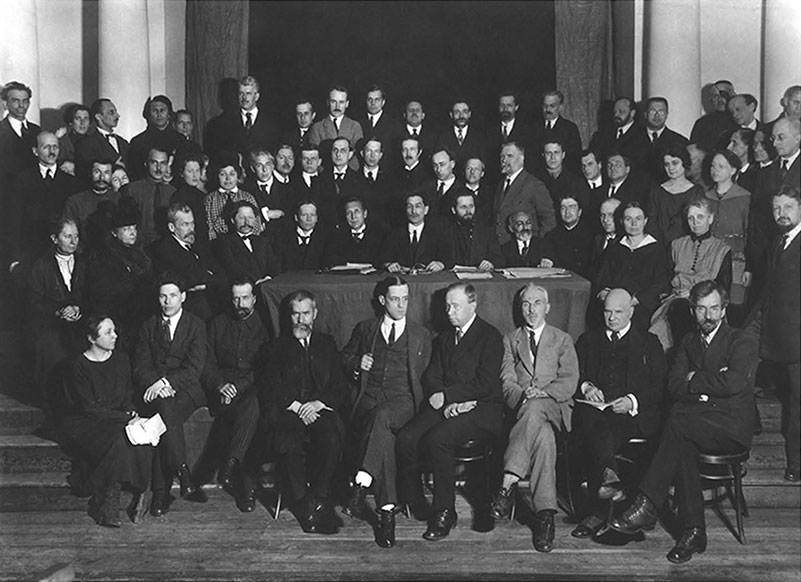 Gahn. Group photography, the first half of the 1920s. In the foreground in the center: D.S. Nortovich, B.N. Ternovets. At the table are: G.G. Shpet, N.K. Piksanov, P.S. Kogan, M.V. Morozov (?), M.O. Gershenzon. Among those standing: A.A. Shenshin, V.E. Meyerhold, B.V. Shaposhnikov, A.A. Sidorov, S.D. Krzhijano. Archive O.S. Severtseva 2/4
 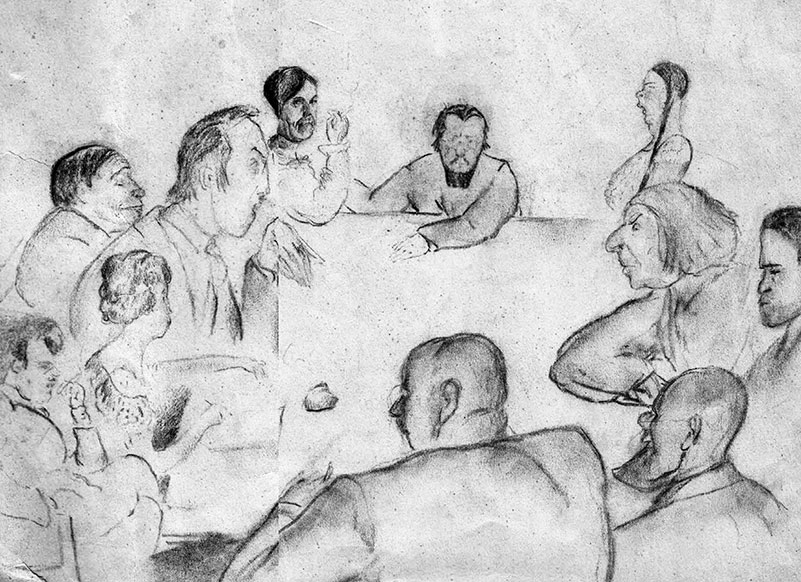 A.G. Gabric. A meeting in a gahn (supposed, in the literary section, end of 1920s) paper, pencil. Collection of M.V. Zubovova 3/4
 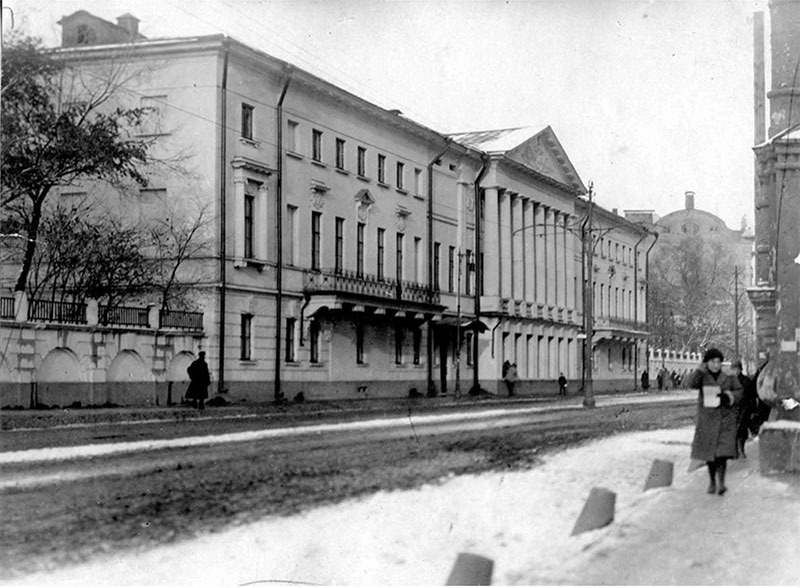 Gakhn building. Moscow, Prechistenka, 32. Archive O.S. Severtseva 4/4
 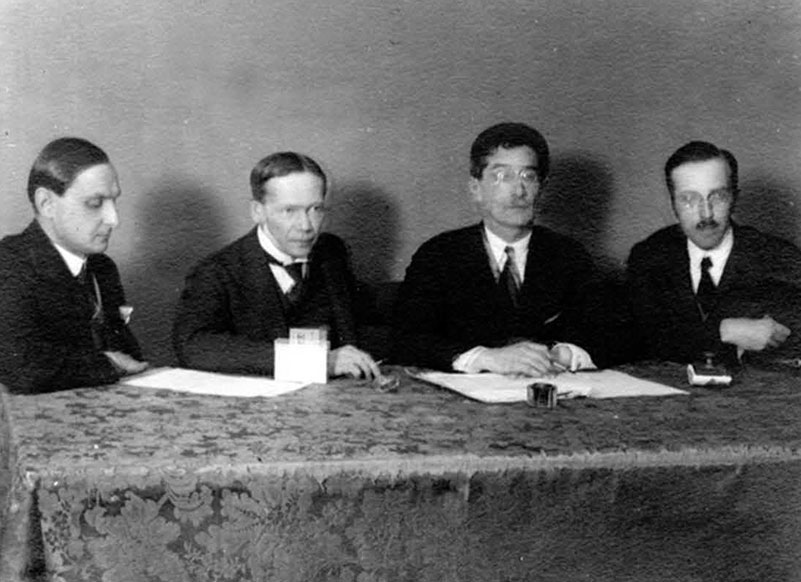 A group of members of the People's Commissariat of People's Commissars. Moscow, 1921. From left to right: R.R. Falk, E.D. Shor, N.E. Uspensky, V.V. Kandinsky, E.P. Pavlov, A.A. Shenshin. Archive O.S. Severtseva
 In addition, the Academy was a scientific and defensive department, that is, Gakhn acted as an institution engaged in the organization of art-exhibitions, concerts. Moreover, the exhibitions were giant. For example, in 1926 the famous exhibition “Revolutionary Art of the West” was held, many Western artists of the left -wing, German expressionists, etc., were sent to it. There was an exhibition by the decade of the revolution, “The Art of the Peoples of the USSR”, one of the first, within the framework of which they tried to include the works of the peoples of the USSR in the context of cultural policy. Exhibitions of Soviet revolutionary art were held in Venice, in Paris - all the same was organized by a gahn. The President of the Academy, the Marxist-Litrate-Littleist Peter Semenovich Kogan, was not famous for little, wrote something about literature after October, was friends with Lunacharsky, but basically dealt with representative work and went to all these exhibitions. And since 1924, Shpet has become vice president, it had all the organizational work on it. Surprisingly, he can be considered a successful administrator, since he was able to gather people and create an environment at the academy. There were 200 actual members, full -time employees, plus a huge number of freelance, who performed and read reports. Malevich, Vygotsky, Meyerhold - all whose work was connected with art were involved in the field of Gakhn. After 1928, relations with Germany were gradually worsening, and this plot rejected a significant shadow on the activities of the German -oriented Academy. From the beginning of 1929, ideological pressure on the gahn begins: that it is non-minor, there is not enough class analysis there, that the Shpet of his rotten bowels of the gahn transferred the outside, recruits students alien to the proletarian public, the former people who are aesthetic producers to work in the wild-idealistic philosophy, which flourishes in the Gakhn. ” This is the “Komsomolskaya Pravda” of 1929 - well, in fact, she writes the same thing now (laughs). The monstrous discredit of the gahn begins, the cleaning was completed by the formula that, they say, Shpet created a “strong citadel of idealism” as part of the academy, established a financial dictatorship, and so on, and so on (partly, it was indirectly recognizing that he organized the gakhn’s activity quite effectively). The academy was closed: they tried to reformat it in the 1929-1930s, but nothing came of it, and it was closed in 1931, they simply showed off the units of other Academic Narkoproovsky institutions, and the history of the gahn ended on this. Of course, it was not just a reorganization, but a defeat and cleaning. The cleaning commission was an employee of the NKVD, the watchman of the Academy, a retired military man, and there was no one who could really evaluate the results of her activities. And when after 1953 people began to rehabilitate, including Spet, the structure itself remained covered with a veil of oblivion.
What were the results of the gakhn
Oddly enough, with such an idea, the fruits of the Academy are difficult to identify. Of course, there were collections: “The art of a portrait”, “Artistic form”, the magazine “Art”. All this can be seen on the website of our project “The Language of things. Philosophy and humanitarian sciences in the Russian-German scientific ties of the 1920s ”-there are most part of magazines and collections (in the section“ Research Work in the Gahn ”). The main form of work within the Gakhn was a discussion-reports with discussions-in a sense we are talking about the traditional Academy of Sciences, where academics read reports, discuss different topics, that is, present the results of research. The second volume of our publication is almost completely consisted of protocols of discussion. It is interesting that the Academy left behind not some monumental project, but a certain continuum of discussions, although there was the main plan to which all the work of the gahn: the creation of an “encyclopedia of artistic terms” of the same scale as the French encyclopedia Dalalamber and Didro, covering all areas and aspects of art of art-philosophy, psychology, sociology and art. disciplines. The work of Gakhn all the time revolved around this encyclopedia, it was constantly planned that now the first volume, then the second, then all this was reorganized, planned separate volumes on music, theater, painting, literature, then combined together and so on. It was a productive chaos, some fragments of this encyclopedia were published by Igor Chubarov in 2005 under the name "Dictionary of artistic terms of Gakhn." He managed to find something according to the archives, in places these are not over art, but blanks. That is, the encyclopedia as such did not take place, it was an epistemological utopia - to create something global regarding the scientific analysis of art. We can say that the result does not correspond to the grandiose plan, partly (but only partly) this can be explained by the defeat of the academy. On the other hand, the project participants knew that they were doomed, but at the same time tried to somehow organize work. Gahn was created in 1921, its leading members in the beginning were Berdyaev, Stepun, Frank, Vysheslavtsev. Berdyaev’s reports on the end of the Renaissance, the crisis of art were made within the walls of the Academy. And already in 1922, when they did not work for another six months, they were in a certain way. Spet was also included in the list of expulsion and only thanks to the troubles of Lunacharsky, who needed someone to organize affairs at the academy, he would be deleted from this list, and he remained in Soviet Russia. In general, the situation of a constant threat, that now everyone will disperse, existed initially. If you summarize, the result itself was the functioning of the gahn - the organization of exhibitions, the formation of discourse about art, and so on. The Academy was its product, such a Gesamtkunstwerk - a combination of various types of artistic and scientific activities.