
Translated material
Nationalist Day
November 4 is the Day of National Unity, to which the post -Soviet authorities of Russia are unsuccessfully trying to replace the "red day of the calendar"
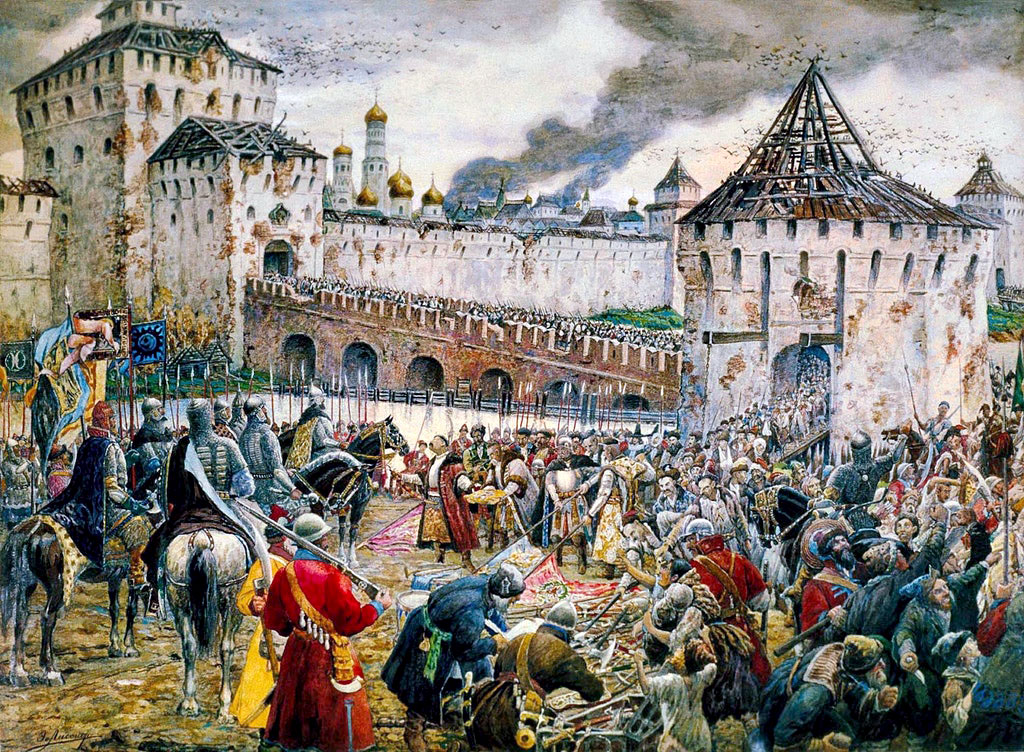
*Assault on the Moscow Kremlin by the militias of Kozma Minin and Dmitry Pozharsky. November 4 (N.S.) 1612. *Photo: GK170.ru
Indeed, this holiday, established in 2005, did not, of course, did not. And I want to hope that he will not. After all, the choice of a festive date is based on a gross chronological mistake, and the “enemy” over which the victory is celebrated is fictitious. The political force for which this strange day is really a holiday is Russian nationalists and fascists.
What a day, unknown
The Day of National Unity is celebrated on November 4 “according to the new style”, that is, according to the Gregorian calendar, which is used to account for time by most countries of the world. Russia switched to it only in 1918 - before that, the Julian calendar was used. In the works of pre -revolutionary historians, thanks to which, in fact, it is known when the surrender of the Polish garrison in the Kremlin occurred, this event dates from the old style - October 26. As the historian Sergei Platonov wrote, “the United Militia on October 22, 1612 stormed Kitay-Gorod. Negotiations began immediately on the surrender of the Kremlin, and on October 26 he moved into Russian hands ” 1 .
1 Platonov S.F. Essays on the history of Troubles in the Moscow state of the XVI - XVII centuries. M., 1994, p. 360.
In modern textbooks, almost all dates of pre -Soviet history are indicated by the Julian calendar, and the need for the correct transfer of the day of the liberation of the capital by the militia of Kozma Minin and Dmitry Pozharsky did not arise until the invention of a new holiday. And when it arose, in the Old Square and Okhotny, apparently, there was not a single expert on historical chronology at hand. Otherwise, October 26, 1612 would never have been on November 4.
How to translate the date from the Julian calendar to Gregorian?
Perhaps you should at least once dwell on this issue in more detail. After all, the majority of even completely educated people are convinced that for this it is enough to add thirteen days indicated by the “old style”. This is how it was done when everyone was transferred to everyone on October 25, 1917 on November 7. And this is absolutely correct in relation to the events of the past XX and the occurrence of the 21st century. But not for other centuries! The fact is that the Julian calendar invented by the Roman emperor Julia Caesare (from it), which has been used for the chronology in the entire Christian world, has significantly lags behind the so -called tropical year, that is, the time of circulation of the Earth around the Sun, from the time of the Nicaean Cathedral. Every year, this lag is only 11 minutes 14 seconds, but over a thousand years - by the end of the 16th century - the difference with natural time has reached ten days already. As a result, for example, the spring equinox came a week and a half a week earlier than the calendar was supposed to be. To correct the error that has arisen, in 1582, by order of the Roman Pope, Gregory XIII, a new, improved calendar was developed. It was the name of Gregorian. The difference of 10 days was liquidated in an orderly order, ordering a special papal bullla on October 5, 1582, the 15th. And so that the difference does not accumulate from now on, they decided to not consider those years to be lean, the last two numbers of which end to zero: 1700, 1800th, 1900th, etc. Only once every 400 years, when the first two digits of this year can be divided into four without a trace-as in 1600 and in 2000-it is customary to leave it with a leap. In Russia, the calendar invented by Catholics refused to admit, citing among other things that it was still not absolutely perfect: the annual difference with the tropical year is 26 seconds, and the day of the error will run in 3323 years 2 .
2 more about the Julian and Gregorian calendars, see: Leontyeva G.A., Kobrin V.B., Shorin P.A. Keys to the secrets of Clio. M., 1994, p. 211–214.
Meanwhile, it is easy to calculate that as a result, the difference between the numbers on calendars in Russia and Western Europe by the 20th century was 13 days, and in 2101 it will be 14.
Returning to the events of the Time of Troubles that interests us, we recall that since 1600 was a leap in the Gregorian calendar, the difference between the “new” and “old” style at the beginning of the XVII century, as in the 16th century, was ten days. Therefore, in order to transfer to the Gregorian calendar on October 26, 1612, it is required to add ten to 26 and take 31 from the calculated value 31 - the number of days in October. It turns out five. That is, the real historical event related to the liberation of the Kremlin did not occur on the 4th, but on November 5, “according to the new style”. This date is confirmed by the majority of Polish and Lithuanian sources: the Catholic Commonwealth, unlike the Moscow kingdom, already lived according to the Gregorian calendar.
We can do the unreasonable paws
What was so historically important happened on this day? When in 2004 one of the newspapers asked this question to the director of the Institute of Russian History of the Russian Academy of Sciences Andrei Sakharov, he honestly answered that on this day "nothing happened." There was no surrender of the Polish garrison in the Kremlin, separate skirmishes occurred around the city. As Vasily Klyuchevsky wrote, “in October 1612, the Cossacks took Kitay-Gorod by the attack. But the Zemstvo militia did not dare to storm the Kremlin; A handful of Poles sitting there surrendered herself, brought by hunger to cannibalism ” 3 .
3 Klyuchevsky V.O., Sobr. Op., t. 3, p. 57.
Describing the events of October 26, when the Kremlin finally fell, the monarchist Sergei Platonov, with all his sympathies to the militias, was forced to admit: “The triumph of this long -desired victory was more than once overshadowed by Cossack riots, which brought the Russian army to open on an open feud ... However, the“ chiefs ”managed to cope with the instincts of the long -standing mass, which wished, which wanted After the victory, not only food, but also prey. ” Against this background, the mythology of the new holiday looks all the more strange - it was still very far from popular unity in October 1612.
What was so historically important happened on this day? When this question was asked to the director of the Institute of Russian History of the Russian Academy of Sciences, he honestly replied that on this day nothing had happened "
In itself, the capture of Moscow by the second militia of Kozma Minin and Dmitry Pozharsky (it was the first, led by Prokopius Lyapunov, which was defeated a year earlier) did not at all put an end to the vague time as such. It cannot be called a complete and final victory, equivalent in meaning, say, May 9, 1945. Rather, we can talk about the “radical fracture”, the beginning of a long process of restoration of the country. Mikhail Romanov was elected king in 1613. The real restoration of the “vertical of power” began in 1619, when the imperious father of the young king Patriarch Filaret returned from Polish captivity. The Polibovsky world with Sweden, who participated in the intervention in the northwest of the country, was concluded in 1617, according to which, until the beginning of the 18th century, Russia lost access to the Gulf of Finland. In 1618, after the next unsuccessful attempt to seize Moscow, the Deulino truce (in fact on the temporary termination of hostilities) for fourteen and a half years was concluded between the Commonwealth and Russia. The Polish king officially abandoned the claims to the Moscow throne only in 1634, after the signing of the Polyanovsky peace treaty unprofitable for Russia as a whole, according to which Smolensk remained over Poland for several decades.
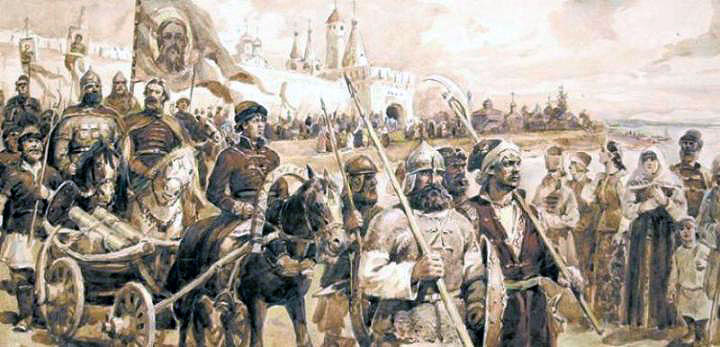
People's about the flight of Kozma Minin and Dmitry Pozharsky. Photo: gk170.ru **
The reflection of the Civil War
But then what about the notorious “victory over the Poles”? Perhaps the saddest of the possible consequences of the holiday on November 4 is that in the mass consciousness of Russian citizens a negative stereotype is formed in relation to the whole ethnic group and the country, which is among the closest neighbors of Russia. We, as always, are built on the well -known principle: "Who are you friends against?" Of course, throughout history in Russian-Polish relations, long-term periods of mutual hostility have occurred. This is especially true of the time when a significant part of modern Poland was part of the Russian Empire. In many ways, against the backdrop of the Polish uprows of the 19th century, the myth of the “centuries -old hatred” of the Poles to the Russians was formed in the minds of the then Russian society: about “kiclovy Lyakha”, always arguing with “faithful Ross”, even Pushkin wrote in the poems so beloved by all the Russian patriots of the “slanderers of Russia”.
Meanwhile, professional historians are well aware that the events in Russia of the first quarter of the XVII century were the result of not foreign aggression, but above all, the internal political and economic crisis, who had matured from the time of the oprichnina of Ivan the Terrible. Indeed, in the struggle for power, various court groups and political adventurers “from the lower classes” were looking for support abroad, and primarily among the influential magnates of the neighboring Commonwealth. Not only numerous False Dmitry, but also most of the Moscow boyars tried to look for military and monetary assistance in a neighboring country at different times. The Romanovs themselves were no exception: Filaret Nikitich initially received the patriarchal dignity from the impostor False Dmitry II in Tushino, he also headed the Russian embassy to Poland in 1610, discussing the election of Korolevich Vladislav to the Russian throne. Among the supporters of the interventionists who had seized Moscow were close to the Romanov family nobles of the Saltykovs.
The saddest of the consequences of the holiday on November 4 is that in the mass consciousness a negative stereotype is formed in relation to the country that is among the closest neighbors of Russia
Actually, the term “intervention” in relation to Polish-Swedish intervention in “first Russian turmoil” arose because historians tend to consider the events of the early 17th century as a civil war, in which not only Russians, but all the peoples of Eastern Europe were involved. The ethnic composition of the interventionists in Moscow in 1612 was heterogeneous. The Lithuanians, Ukrainian and Russian Cossacks, representatives of the West Russian population who lived in the Polish-Lithuanian state, finally, mercenaries from Western Europe, went to search for easy prey on the Moscow campaign. The Poles did not constitute a majority of 4 in this European “International”.
4 Read more see Nazarov V.D. What will be celebrated in Russia on November 4, 2005? Domestic notes No. 5, 2004.
However, it is unlikely that all this can be explained by the aggressive crowd of cheers-patriots, constantly threatening to pass the “Russian march” along the streets of Moscow and other large Russian cities. From the point of view of both the authorities and the sane part of society, in this holiday, almost everything is uncomfortable and absurd. Even the name, appealing to folk unity, causes associations with the notorious "Russian national unity" Alexander Barkashov. Now we have a whole holiday that could well be called "Nationalist's Day." It is based on not civil consent at all. Ignorance and hatred - these components of ordinary fascism every year more and more master the consciousness of Russians.
First published in NT No. 44 of November 3, 2008 .