Date
Author
Андрей Вифлянцев

Preserved copy
Translated material
Two by criminal law
This is a personal blog. The text could be written in the interests of the author or third parties. The 7x7 editors are not involved in its creation and may not share the author’s opinion. The registration of blogs on 7x7 is open for authors of various views.
In Novosibirsk, a criminal case was brought up on a schoolboy: he cleaned his grades in the journal. It sounds incredibly, but the official message is posted on the website of the Ministry of Internal Affairs, and the student threatens up to 2 years in prison. The lawyers of the Open Law project decided to figure out that in this story it is not so and what it threatens any of us.
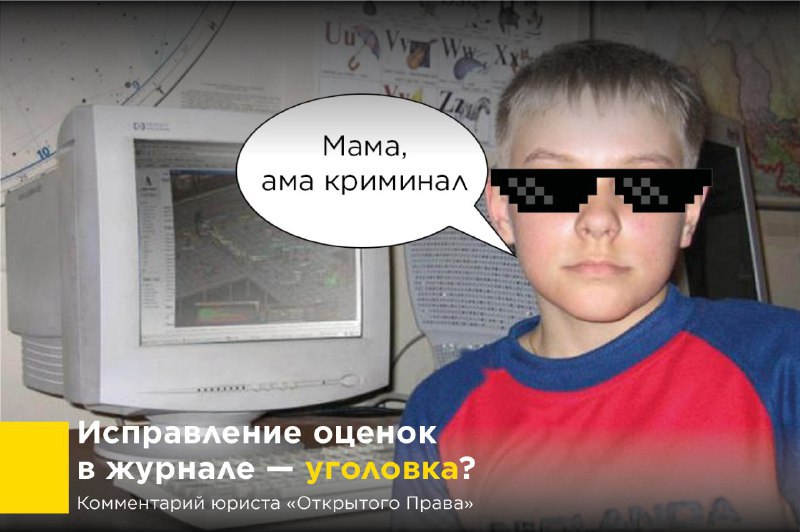
At first - the essence of the matter, as described in the Ministry of Internal Affairs. “A student of one of the gymnasiums in Novosibirsk, with the help of a special computer program, received the login and password of the administrator of the electronic journal of the educational institution that his classmate informed. Having gained access to the “Electronic Diary”, within the month of the next school year, a 16-year-old gymnasium student corrected poor grades for good not only for himself, but also to his classmates, at their request. ” https: //54. MVDrf/news/item/11475724
The result is a criminal case under Part 1 of Art. 272, "unlawful access to computer information protected by the law, if this act entailed the destruction, blocking, modification or copying of computer information."
It would seem - everything is like this: unlawful access - there is, a modification - there is. So, go, schoolboy, wash the deadline? Let's look at the situation more closely.
In the comments to the law, edited by the head of the Supreme Court, we find the following explanation:
(1) a person who has gained access to information should not have the right to do so;
(2) the information must be protected by law (and this is not all information);
(3) A certain work should be done with this information, namely the destruction, blocking, modification or copying.
In the first and third cases, there is no doubt: the student should not rule his assessments. But in paragraph 2, the error of the Ministry of Internal Affairs lies.
The information protected by law was strictly agreed upon by Decree of the President of the Russian Federation of March 6, 1997 N 188 “On approval of the list of confidential information”. It includes the secret of the investigation, official, commercial and professional (lawyer, medical and.) Secrets, information about the invention, the secret of correspondence ... It is clear that school grades are not of this. However, there is another type of secure data: “Information about the facts, events and circumstances of the private life of a citizen that allow you to identify his personality (personal data).”
Thus, it turns out that the Ministry of Internal Affairs considers assessment of personal data. If these grades were written on paper, in an ordinary class journal, it would be impossible to punish the student, but it was worth it to transfer them to an electronic form - and please, an article.
However, let's see what he understands by “personal data” the law of the same name: according to it, this is any information related to a direct or indirectly defined or determined individual. At the same time, the purpose of the law is to ensure the protection of human and citizen rights and freedoms in the processing of his personal data, including the protection of rights to the inviolability of private life, personal and family secrets.
If, nevertheless, the assessment is personal data, then what about the teacher who said in the lesson “Sit down, Sidorov, you are“ four ”? Did he criminally disclosed them? Is this law applicable, in our case, is it possible to talk about personal data at all? It turns out, no.
There are also a couple of arguments in defense of the gymnasium student.
The first is Article 14 of the Criminal Code of the Russian Federation “The concept of a crime”: “... is not an action (inaction), although formally containing signs of any act provided for by this Code, but due to insignificance not representing public danger”.
Does public danger represent the correction of the assessment even in an electronic journal? - The answer is obvious.
And the second argument is a commentary on article 272 edited by the head of the Armed Forces: “The danger of crimes in the field of computer information is that the destruction, blocking, modification of information important for actions related to the control sensors of complex computer systems of defense, production, economic, banking and other purposes are able to entail the deaths of their health, destroy property, cause economic damage to large ones sizes ".
Is the death of people captivation of evaluation in a school journal capable of? The answer is obvious again.
So we do not want to disappoint the Novosibirsk Main Directorate of the Ministry of Internal Affairs - but in the case of a gymnasium student they did not read the laws beyond the heading. With such an interpretation of the Criminal Code, each of us turns out to be a criminal - and this is definitely not involved in the Criminal Code.