
Translated material
"Trotsky" against the "demons of the revolution"
In honor of the centenary of the October Revolution, federal channels released two new series about its heroes
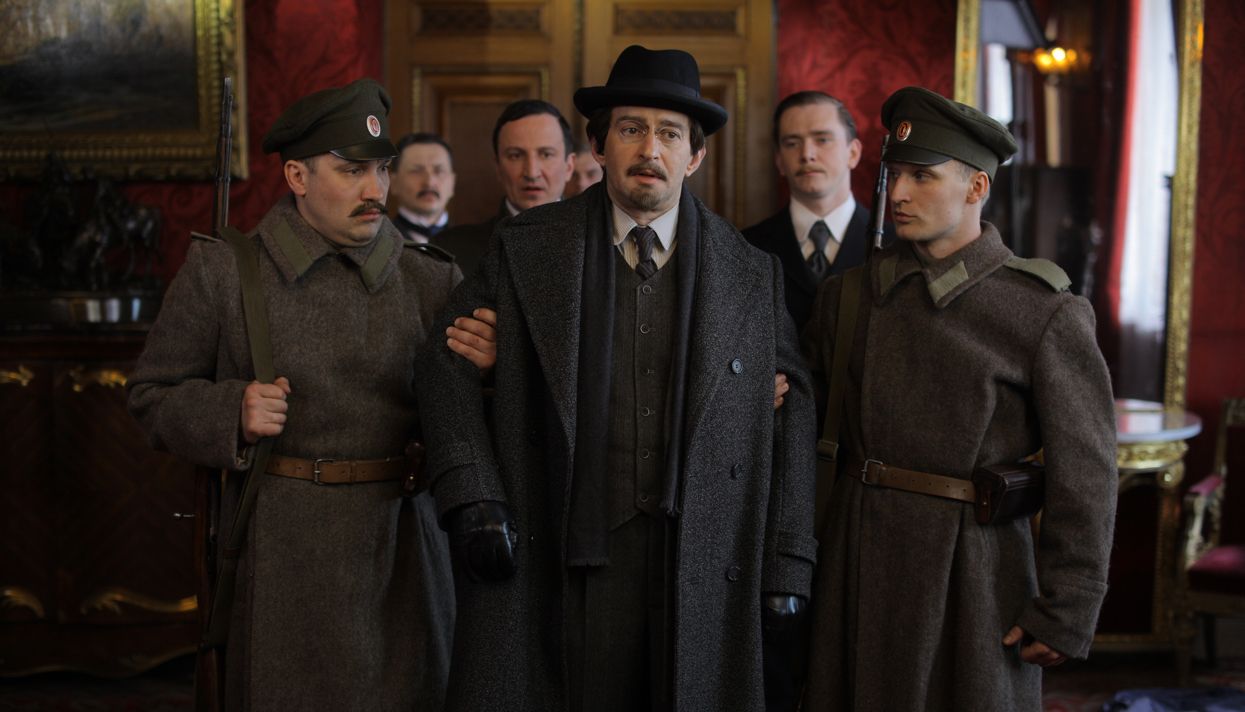
Two major projects dedicated to the centenary of the October Revolution are simultaneously released on Russian television. On November 5, the series “Demon of the Revolution” with Fedor Bondarchuk in the role of revolutionary Alexander Parvus and Evgeny Mironov in the role of Vladimir Lenin started on the channel “Russia”. And on November 6, on the first, the “Trotsky” show with Konstantin Khabensky in the title role begins. At the request of Medusa, the film critic Yegor Moskvitin compared the first episodes of two paintings and came to the conclusion that these titans were almost not fighting with each other.
"Trotsky"
From November 6 on Channel One
Unlike the multi -figure “Demon of the Revolution”, “Trotsky” - Bayopic, driven by one passionate hero (and actor). Energetic installation crushes the events of the series on three storylines: the one in which the central character makes the revolution; the one in which he summarizes his life, being in the Mexican exile; And the one in which the young idealist Bronstein transforms into Trotsky.
“Trotsky” is the project of Channel One and the company “Wednesday” Alexander Tsekalo, which produced “Method”, “Majora”, “Klim” and “Return side of the moon”. The co -producer of Trotsky is Konstantin Ernst, and the directors of the dynamic “Brest Fortress” Alexander Kott and the Major school, Konstantin Statsky, acts. It was the Statka that shot the first block of the “bridge” with Ingeborga Dapkunayt and Mikhail Porechenkov - the Russian remake of the famous international series.
Porechenkov in Trotsky is also-as a social democrat Alexander Parvus. Vladimir Lenin with a little comedic demority (at least in the first series) is played by Evgeny Podchkin. The second wife of Trotsky Natalya Sedova is Olga Sutulova. The police overseer Nikolai Trotsky, whose surname and character will appropriate the hero, is Sergey Garmash. The killer of the Trotsky Ramon Mercader, pretending to be American journalist Jackson, is Maxim Matveev. In total, the series will have 8 episodes divided into four shows. The young Joseph Stalin (Orhan Abuls) and the Russian General Vladimir Scalon (Sergey Bezrukov) will appear in them. The history of a climb can become useful shock therapy for the audience. Like other little -known episodes of the revolution, which a strong scenario brigade reached.
In the series, you can find out the handwriting of the operator Sergei Trofimov - the permanent co -author of Russian projects Timur Bekmambetov since the time of the Peshawar Waltz and the Night Watch. Together with the editor of Londongrad and Gogol, Alexander Ivanov, the operator Trofimov gives Trotsky the dynamism of the blockbuster and the logic of the clip. Infographics appears on the screen all the time, which allows you to quickly remember the heroes.
And Trotsky himself performed by Khabensky resembles the heroes of comics: each of his monologues is a clear declaration of intentions, hanging in the frame, like a cloud with words on the page of a graphic novel. Each of his inner fracture is accompanied by an understandable external illustration. Constant flashbacks and flashwords make the hero’s figure even larger - in the same way the authors of the comic book films turn sixteen pages of pictures into an integral epic. Trotsky’s accompanying “leather hundred” resembles the personal guard of Xerxes from “300 Spartans” by Zach Snyder. And the computer train “The Perevrevoen City Council” complements the character of the character as a superhero costume, and sets the pace of that part of the narrative that unfolds in 1917. Merkader in this universe is a journalist, a critic, and a judge, and an executioner. To emphasize this instrumental role of the hero, actor Maxim Matveev is turned into a revived picture from a comic book-with an unthinkable hairstyle, a look that seems even deeper due to glasses, and a chin that can be stabbed with firewood. This superkiller, by and large, is not needed.
Such a dramatic structure may seem simplified, but it is easy to imagine on some Netflix, and it really captures the attention of the audience. This is not at all a vaccine from revolutionary romance, as you could expect from the federal channel. Rather, this is a simple, visual and colorful illustration of a winged phrase about who the revolution is plotting, who makes them and who uses their fruits. The feeling of unbearable universal injustice, characteristic of the Russians as an audience, this series does not dull - but only weaving.
"Demon of the revolution"
Since November 5 on the channel "Russia"
The opponent from Russia, despite the equally spectacular budget and a similar plot, works in a completely different way. Firstly, it does not have the only hero, which means there is no superhero. If “Trotsky” is in a sense a monoscope, where the invited stars play “to eat” for a gluttonous revolution, then the series “Demon of Revolution” is a chessboard, which has a lot of figures. Alexander Parvus (Fedor Bondarchuk) and Vladimir Lenin (Evgeny Mironov) rise above everyone, but from the very beginning two fictional officers of the royal counterintelligence, played by the same Maxim Matveev and Alexander Baluev, appear in the plot. This detective duet immediately changes the viewer’s gaze at the main characters, since there are officers who want to save Russia, then we will root for them. Two positive characters quickly pull the blanket over themselves, and the viewer willingly refuse Parvus and Lenin in the right to internal complexity.
If Trotsky (and “Trotsky”) is passionate to Gumilev, then there are two main characters - demons in Dostoevsky. No wonder the detective appears in the plot, trying to expose them and doomed to lose. In 2014, Vladimir Khotinenko already came up with his version of “demons”, where Maxim Matveev played the demonic Stavrogin. Now the director applied the same technique in the series about the revolution - and again invited Matveev, but already to the role of the judge. And with Evgeny Mironov, the director worked in 2010 on a television Bayopic about Dostoevsky. Its production, as in the case of the Demon of the Revolution, was engaged in Non-Stop Production, Alexander Rodnyansky and Sergey Melkumov. Rodnyansky and Melkumov are accustomed to trust their authors completely, whether Andrei Zvyagintsev or the director of the Duelian Alexei Mizgirev. Therefore, if “Trotsky” is a production project, in which passionarity and the horizons of Ernst and Tsecala are immediately felt, then the “demon of the revolution” seems to be the whole story of the entire directorial.
From the channel "Russia" should not wait for curtsies towards the "advanced public." If you look for the TV shows, Western analogues, then Trotsky is the Starz channel, which can reduce high drama with not the highest needs of the audience. The relative media success of Starz began with the bloody and semi -eerotic “Spartak”, which eventually turned from a cruel comic book into a convincing tragedy. The “demon of the revolution” is closer to the BBC and Sky Atlantic products - this is rich, saturated with details, flaunting large actors, like stars on the uniform, historical costume drama. She is conservative in performance and thereby sides conservatism in dramaturgy. At the beginning of both TV shows, Alexander Parvus takes money from the German government to ruin Russia, but in Trotsky this circumstance is perceived as complexity on the path of the protagonist, and in the “demon of the revolution” - as an early exposure of the villain.
To judge by the first series frivolously, but so far in Trotsky the psychology of historical upheavals is more given more attention, and their business processes in the “demon of the revolution”. “Trotsky” due to visual saturation, density of colors and the dynamics of events seems to be a historical thriller on the verge of fantasy, in which a portrait of a person obsessed with power is more important than a portrait of the era. The “demon of the revolution”, like “demons”, is extremely journalistic and aphoristic, and it has much more hints of Russia-2017.
Egor Moskvitin