
Translated material
Russia says goodbye, but does not leave
What is behind the Kremlin’s new statements about the reduction of the Russian military presence in Syria
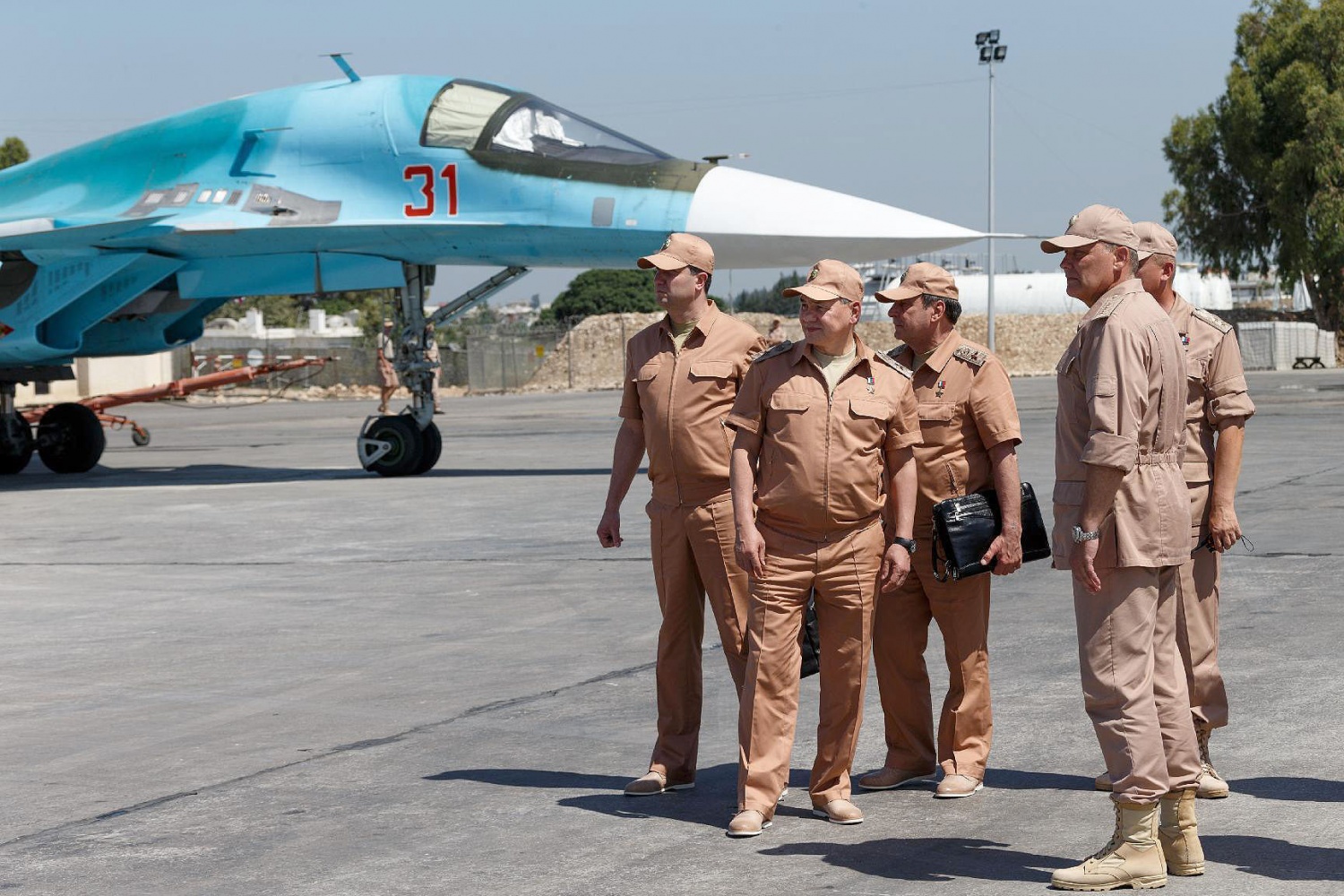
*The head of the Ministry of Defense Sergey Shoigu (in the center) with the inspection at the Khmeimim, Syria air base, June 18, 2016. *Photo: press service of the Ministry of Defense of the Russian Federation
The actions of Russia in Syria are increasingly reminiscent of the behavior of an annoying guest from a joke: he is forgiven, but does not go away. And now, in the domestic media, information about the Kremlin’s intention has once again significantly reduce the military group in this country.
Attempt number three
It would seem that this is quite a logical decision after the Russian leadership has repeatedly announced the defeat of the terrorists. For example, the head of the Ministry of Defense of the Russian Federation Sergey Shoigu has repeatedly stated that the operation is nearing completion and that no more than 5% of the country's territory remained under the control of terrorists. The head of state is expressed in the same spirit. In full swing is encouraging distinguished. Colonel General Sergei Surovikin has just been appointed to the post of chief of the Aerospace Forces (VKS) (the general was appointed “combined-up” general), who commanded the group in Syria.
Note, however, that we are already talking about the third attempt to reduce the Russian military presence. The first time Putin announced this in March 2016, then-at the beginning of 2017. It is obvious that the Kremlin, who was involved in the Civil War in the Middle East, in order to get out of the international isolation, which he had only been able to because of Ukraine, already realizes: in the Syrian sands you can get bogged down for a very long time, if not forever. It seems that Moscow all the time is looking for a reason that, if necessary, retaining the person (and military bases), to stop direct participation in the conflict. But it is not easy to do. Even now, when terrorists seem to be defeated, Moscow has to periodically resort to rocket and bombing.
Without direct and constant support of Russian aviation, ASAD will not last long, his army is exhausted by the six -year civil war
From nowhere to get nowhere
In addition, the impossibility of quick care is laid in how the Kremlin formulated the tasks of the grouping. It is appropriate to recall that in 2015, immediately after the start of the operation, Putin indicated the support of the Assad regime as the main goal of the Russian troops. “Our task is to stabilize legal power and create conditions for finding a political compromise,” the president said. However, he did not determine at what moment it would be decided that the goals of this “support” were achieved. When will the opposition under Russian airlines be forced to agree to preserve the Assad regime? Or when will government troops return control over the entire territory of the country? One thing is clear: without the direct and constant support of Russian aviation, Assad will not last long, his army is exhausted by the six -year civil war.
There is no need to talk about the complete defeat of ISIS* yet. The same Sergey Shoigu claimed that by the end of 2016 the VKS destroyed 35 thousand terrorists (in the recent relations of the Ministry of Defense, the figure of 50 thousand destroyed enemies appeared), and before the operation, the head of the General Staff Valery Gerasimov claimed that there were a total of* 70 thousand fighters in ISIS. So, even if you believe in this, in the highest degree of dubious assessments, at least 20-35 thousand terrorists remained in Syria. Paradoxically, the loss of territory can give the residues of ISIS* a serious tactical advantage. They no longer need to protect specific settlements. They can now appear out of nowhere, attack and disappear now. Of course, the Syrian desert is not a jungle, but with the support of the local population, a partisan war can last forever. Assada alone will not even cope with this military problem, which now no longer looks like the most serious.
The only alternative to the new stage of the Civil War is not settlement, but the section of the territory of the country. Under these conditions, deriving a military group from Syria means weakening the negotiation positions of Assad
Syrian opium for the people
About a third of Syria is controlled by the so -called moderate opposition focusing on the United States. It is no coincidence that in almost daily mode the Russian military department accuses the US military of hidden support of ISIS terrorists. Then air intelligence discovers their accumulations near the location of the US special forces, it turns out that with the support of Americans, terrorists go into the ranks of the anti -Asadian opposition. Moscow, obviously, does not understand very well what to do when and if full -scale military operations between Assad and the opposition supported by the United States unfold. While the Kremlin undertook to “stabilize legal power”, the armed opposition requires Assad's departure. However, she does not want to negotiate at the sites proposed by Russia. So most opposition groups refused to participate in the Congress of National Dialogue, which should open on November 18 in Sochi. Thus, the only alternative to the new stage of the Civil War is not settlement, but the section of the territory of the country. Under these conditions, to withdraw a military group from Syria means weakening Assad's negotiation positions.
Obviously, the war in Syria has become for the Russian government an instrument of both foreign and domestic policy of the state. The Kremlin tries to use this tool manually, if necessary, then amplifying, then weakening its effect. So, most likely, we will hear more than once about the “partial” conclusion of the group from the territory of Syria ...
* “Islamic state”, ISIS, IG - an organization banned in Russia as a terrorist.