
Translated material
Managerland
How "managers" ate experts and what happened to the norm
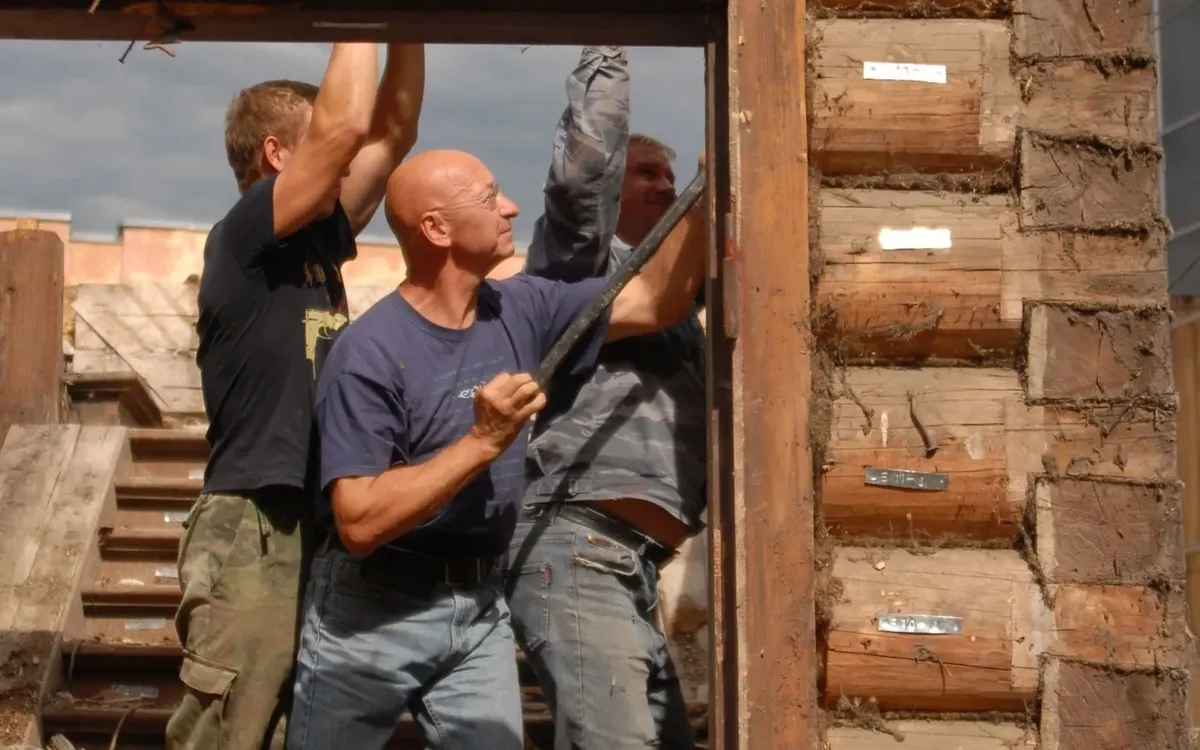
“And the masters lived behind the river ...” - begins Alexander Popov, pushing the carpenter with an iron finger in the cracks of the green “house of lace” - as if just a restored monument of Russian wooden architecture in Vologda. And I, immediately remembering, pick up, and we get in chorus: "We worked quickly, took inexpensively, but it turned out one shit."
When Popov called from Vologda in early autumn with another scream for help: now the arbitration court recovered 3 million rubles from him for this “house of lace” - I said that I would not come. I can’t help with anything, the court is a natural disaster, and I have already exhausted him as a topic. But on October 9, another court in Moscow announced a sentence to a “group of restorers, led by Deputy Minister of Culture Grigory Pirumov,” and now I called Popov. He knows everything about restoration, and in this much knowledge many of his sorrows.
In truth, nothing happens in restoration that would single out this sphere of activity (very special from the point of view of the content of work) from the general picture of what is happening in the country. But restoration means “restoration”, and in the political dictionary this word is already acquired by a sacred shade, close to “getting up from the knees”. Therefore, the results of “restoration” often look like especially sophisticated cynicism-and so the “criminal group of Pirumov” is no better and no worse than the rest.
The verdict issued by the Danilovsky District Court of Moscow on October 9 in a simplified manner (due to guilty and damage to defendants), it is said that Pirumov, as well as the director of the Ministry of Culture of the Ministry of Culture MAZ, the head of the Federal State Unitary Enterprise “Central Stances” Ivanov and others involved construction companies, headed by their acquaintances and mainly included in the group "Baltic".
The investigation was not reached all objects, focusing on the largest, but their list is impressive with geography and quality: the Novodevichy Monastery in Moscow, the fortress of Friedrich the Great in Kaliningrad, the Pskov Drama Theater, the Aceeva estate in the Tambov region, the museum of astronautics in Kaluga ...
Pirumov, the verdict says, found objects for restoration and provided anyone to win at competitions. And 164 million rubles, which the group, having returned to the budget, reimbursed as if we were with you - this, by coarsening, the difference between the prices for restoration work, requiring special skill, and for ordinary construction, usually performed by migrant workers.
Experts that follow the intrigue claim that the “group of restorers” is completely bargaining pawns in a much more exciting battle of the security forces (this is the investigation of Andrei Sukhotin in “New”, No. 42 for June 14). But the question remains, which for some reason eludes the general attention: what, in fact, are they crossed there?
In the corruption scheme of pirums, the figure is rather technical, and in restoration, it was completely random (it got to the Ministry of Culture in 2012 from CJSC Russian Real Estate). But with this sentence, the “architectural” completeness has gained a certain phenomenon, for which we and my long-standing friend-restorer (he himself turned out to be inside this design, as it were, in the role of fossil), we came up with the definition: “Manaherland”.
For the first time, I first came to Alexander Popov in the village of Verkhnyaya Uftyug, the Arkhangelsk region 35 years ago, when he, a first education physicist (like Pirumov, by the way), having graduated from the marshmallows, moved here from Moscow, and to help him from the neighboring colonies of the Komi were given conventionally liberated “chemists”. With them, he dismantled and collected a 47-meter church of Dimitry Solunsky from the multi-ton logs, for which in 1991 he was awarded the State Prize of the RSFSR.
But Popov’s creative fate was not predetermined by this award, but by the reinvention of the ax. On the first monument, as in all subsequent ones, many logs demanded replacements, but attempts to supplant the same did not satisfy him until he dug up an ax of the ninny century nearby, more like a corncase. Since then, his restoration method consists in the “complete bulkhead” and in the work by authentic tools that differ from each other both in time and in the geography of their manufacture. In the cabinets in Kirillov, where in the mid-90s he founded the school of carpentry art, several hundred different axes are stored, and with them there are 4 thousand such and ranges, shirts, brackets and God knows what other carpentry and carpentry tools.
In the restoration of “better” or “worse” it is measured only by the difference that moves a modern copy from the historical original. But out of dozens of students whom he raised until recent years, only the most devoted units are still working in this paradigm of Popov. What is the point of confronting progress if the same is the same - almost! - Can you make much faster and many times cheaper?
Of course, the Popov method is limited purely economically: it is long and expensive. Something is easier to demolish, and something can be replaced with copies. But the copy cannot be given as the original, otherwise it will be that in the language of restorers it is indicated by the terrible word “remake” - a lip of fake, bullshit, a simulacrum, a copy deprived of the original. And the whole difference fits completely in one word "almost."
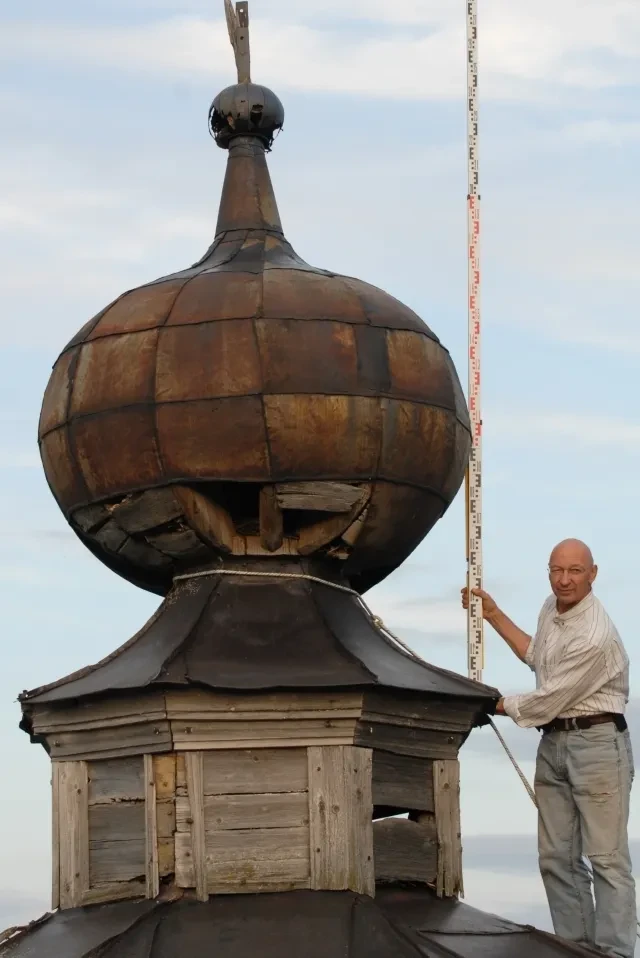
In the Ufyug, and then on the shore of the White Sea, where he undertook to restore the unique wooden temple ensemble, Popov once missed the moment when the former Soviet man understood: to trade (metals, urea, icons-anything), it is necessary not to know the quality of the goods, but the demand and offer for it. Accordingly, it is also not necessary to manage: factories, factories, state farms, anything - but financial flows. On this news, the people who were still then responded with the capacious Russian word "Manager". Unlike a modest "manager", a manager in Russia is a self -sufficient figure. He knows everything and is sure of everything, that is, he does not need to know anything but only accounting.
It was between the master and Manager that the contradiction arises that Popov described to me the following formula: “Previously, the customer said to me:“ You are the construction and what will remain, rolling it away. ” And now it’s not like that: “You’ll roll back so much, but what will remain for - build.” Further in this equation, only interest will grow, but not just a change in the places of terms, but the zeroing of the main one, and the “sum” simply could not but be imaginary value. Masters are interested in the thing (and in the case of Popov, even the very process of its manufacture itself is more likely), and Manager is only money. But it is his state that authorizes them to dispose of them.
In this almost elusive point “almost”, an inconspicuous lie is born first, but there is a certain backlash of financial capabilities immediately. The famous for everyone, standing at the window, appears, a painful choice between the beautiful and relatively inexpensive. But it is no longer so painful when the order is made “for the people”, “for the country”-in short, in accordance with the 44-ФЗ “On the contract system in the field of procurement of goods, works, services to provide state and municipal needs”.
The main principle, professed by state bodies in the field of procurement (as if to compete and saving the budget), is not quality, but cheapness: be you even Andrei Rublev, and the order will still receive the one who will throw the largest amount against the initial price. Until 2013, under the previous 94-ФЗ, the main predators in the field of procurement were one-day firms, they dumped, then to take those who can do something, “for a subcontract”. Some students of Popov were hired-after all, it was necessary to live, but he himself fought with the recruitors of the competitions mercilessly, which made himself a lot of enemies.
After the adoption of the FZ-44 in 2013, the one-day one was eliminated in the mass, but now (despite the fact that the principle of cheapness has been preserved) to win a good object, on the contrary, only giants like “Baltsro” received a chance. By tradition (we value traditions), competitions are held in the summer, and the money is received well if in November. To turn out, work must be started even before the competition, but this is a commercial (and criminal) risk, not to mention the interest on the loan. The conditional “Balts”, which can afford it, for nothing that does not have any tools or personnel for restoration, is again looking for whom to take “for a subcontract”, cutting off his share. And the deadline can be extended, but this requires connections in the “cultural organs” - and in this place “rollback” is buried.
Even at the beginning of the zero, the rollback rate was spinning about 10%, but then, as Popov says, “people came who began to write numbers on pieces of paper,” and these numbers, from the point of view of the expert, most often looked unrealistic.
No, Popov did not enter the “criminal group led by Pirumov”: who would let him in this pie? Of course, they intersected at meetings devoted to restoration problems, but they tried not to call Popov there. Since 2009, he has not received money from the federal level at all-it is good if something got from Vologda.
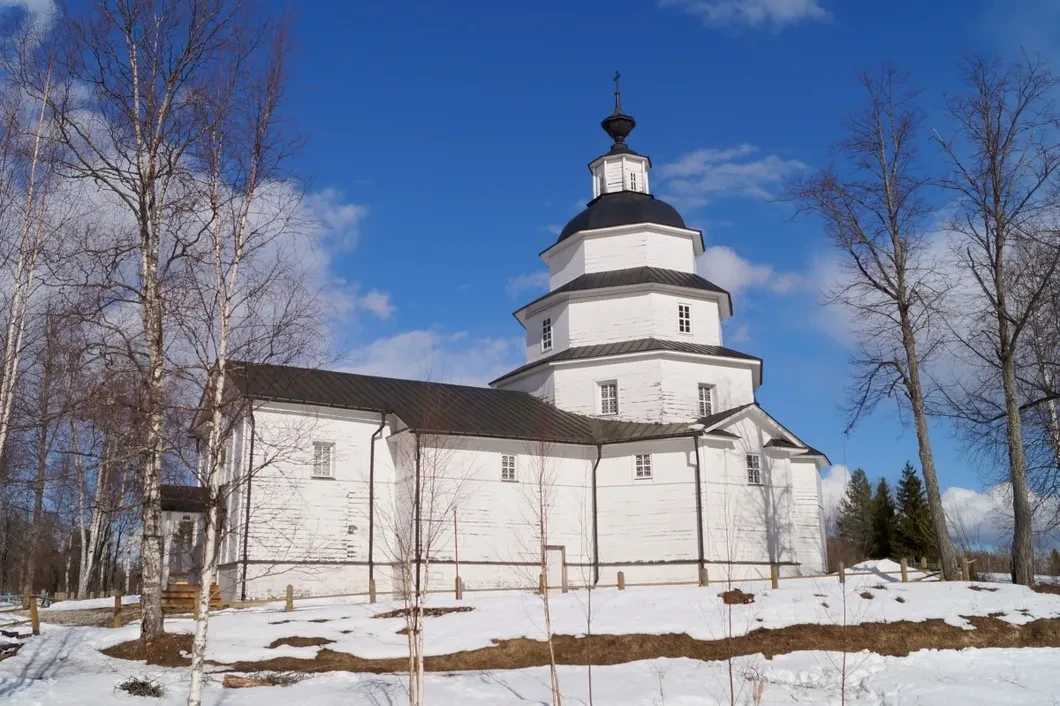
The last major object of the workshop of Popov was the Church of the XVIII century of the Prophet Ilya “Under the Tsypina Mountain” near the Ferapontov Monastery in the Vologda Oblast. It was disassembled in 2003 and re-collected in 2009 for 3.7 million rubles from the federal budget (the price is not the most expensive Moscow apartment, but Pirumov at that time served in one of the construction departments of Moscow).
The former mayor of Vologda, fascinated by the miracle of Ilya, concluded a contract with Popov for the restoration of the "House of Lackens" - compared to the temple in Tsypin, it was a real trinket. The log house was disassembled and taken to the workshop in Kirillov, where some logs were “treated”, and some replaced, and then on the new foundation was re-assembled in Vologda under the roof. There remained casing and finishing - the most beauty: platbands, railing, balcony. But then the former mayor was carried away by the elections to the Duma (where he then left), and the city began to delay the money for the next stage of work.
Popov extends its idealistic principles to all relations, but life rarely fits into its schemes. The administration responded to the refusal to continue the work “so far” by the announcement of the competition for their final stage. Popov slapped the door, left the Public Council under the Committee for the Protection of Cultural Heritage, and did not even declare the competition. Then everything is as written: the competition was won by a little -known (in any case, compared to Popfolio Popov), a company hired by it, not owning old technologies, drank door and window boxes from the log house and replaced them with a retaining novel, carved platbands and columns of the balcony were painted on the machine and all this was painted on top of a lightning paint.
Now we need to somehow describe the difference between what Popov would do, and what has been done-but here everything is built on the fact that this is impossible (or can be as possible) describe in words. And you just need to come closer and see - and then from the words it will only remain: "... ... ..."
(However, on the search in Yandex-Carts, both immediately jump out on the “house of lace”: a green remake, and an old, unpainted log house, and the difference between the living and the dead is noticeable even there.)
I met with the head of the Department of Culture and Historical and Cultural Heritage of the city of Vologda Nikolai Dyakov and with the chairman of the Committee for the Protection of Cultural Heritage of the Vologda Oblast Elena Kukushkina (before the appointment for this position, she worked through the material and technical support in the Office of the FSB). Both talked about Popov’s intransigence, that “he himself did not submit an application” and “he himself left the Public Council,” and in assessing his work they referred to the court’s decision and the conclusion of “competent experts”.
It makes no sense to disassemble the court decision: after everything else, the court also turned into a Simulakr. Popov, of course, is stubborn, like a donkey, in relations with civil servants he is a tyrant, he can, of course, do for a long time, can be expensive. But he cannot do badly by definition. And the conclusion of experts? And here, probably, the main question appears: who then the expert, if not Popov?
In Vologda, I stopped at the former Soviet hotel Spasskaya, where in the lift of the elevator I met a portrait of TV presenter Svetlana Sorokina. I know its origin: about 12 years ago, with her, with the dead summer in Kyiv Pavel Sheremet (his portrait, apparently, was removed from sin) and other “Internyus” held a competition of regional television programs here, and then there were really worthy programs. But then the creator of “Internyus” was accused of smuggling Manana Aslamazyan, she left for Paris, and the charges were removed, but “Internyus” has already collapsed, and today we have the television that we have today.
Does anyone seriously believe in "foreign agents"? No, this is only a smoke curtain, under the cover of which an examination is destroyed. The expert is not the one who gives the “correct” conclusion to the court, but the one who is able to not only distinguish the original from the fake, but also yells about this: after all, this is his mission and the honor of the expert. It is the main barrier of corruption (in the sense of the original Latin root of the “damage”), it must be destroyed, depriving him of reputation. Only in this is the meaning of the court decision, which blamed Popov, that instead of the moss he laid between the logs of the felt (which was also in the original). However, it could have been worse: after all, 3 million is not a criminal term.
The “war of the monuments” that we are drawn into is to take the eyes. The war, in truth, is waged against monuments. Against their background, it is more difficult for a fake to smash: taxpayers are also sometimes not blind, and the difference is too striking.
Rolan Bart, a researcher of things as myths, notes that the name of the phenomena described by him - in fact that do not exist - requires the invention of new nouns, usually formed from adjectives. He has in a well-known description of the cover of the magazine with a black soldier who is given the honor of the French flag, this is “French imperial”, and then we get something like “kondovo Vologda” (initially “condo” means made of dense wood with a small number of knots).
Bart notes that the myth "abducts a story from things, turning it into nature." At the "house of lace" in the form in which it is "restored", the story has disappeared, and we can no longer imagine the lace people, who, according to a local legend, once gave up. Their living breathing, once preserved in a tree, replaced "nature": like, it was always like that, for we are the same as proud.
Speculating with the concepts of patriotism and memory, about the monuments “restored by the Pirumov group”, his boss, of course, would like to forget. The verdict was sentenced - “on the transaction”, the money was returned - like, to the budget. But real experts will still go and see that they were drawing there, even if this will fall apart by the moment when power will change in the “organs of culture”.
And we do not need to walk so far. Right next to the “New Gazeta” on the corner of the alley was a square, where lilac once bloomed. Then, in an old mansion, a Russian military-historical society settled, headed, as you know, Vladimir Medinsky. For some reason, it did not live there for long, but this was enough to cut down the lilac and replace it with bronze sculptural copies. There are no less than a dozen of them there, on a patch: various commanders, cavalry-girl Durov, George the Victorious with a miracle about the serpent and for something turned by the ass.
Passing by three times a week, I can’t get myself closer. And so it is clear that such a density of bronze itself is the same: “they worked quickly, they took inexpensively” ... Well, you understand. But sometimes mothers with strollers come to this “Square of the commanders”, and in the absence of other samples, children might think that this is the norm of the beautiful: after all, these are large uncles for them, right?
It is difficult for children to explain that our big uncles rarely think about the beautiful - at work they think about how to snatch.
Meanwhile, Immanuel Kant even removes his famous ethics (on which all normal jurisprudence) removes from aesthetics, not seeing any other measurements for this. Lies and "ugly" are one and the same. If such monuments can be attached, you can lie, and if you can lie, then you can plant the innocent, but, on the contrary, you can forget about a much heavier “crime” into which the “cultural organs” pulled the country: this is the murder of the norm itself.
I remember the living warm smell and golden color of the chips in the workshop of his school of carpentry art, where now there is nothing of this: there are no students, skill no longer feeds, but feed theft and hack.
In a restaurant in Kirillov, where on the way back, priests fed me in an empty hall, a tourist map of the Kirillo-Belozersky monastery with pictures hangs on the wall. He poked in that direction with a fork: you see, the church - I did it, and the tower - I did it, and there, and I also did it too. As a master, he, of course, is conceited, but there is no great exaggeration here. Changing the Moscow residence permit, Popov moved to Kirillov more than 10 years ago, and his workshop has existed for 30 years. Любой город в любой другой стране гордился бы таким мастером, создал бы ему условия и тешил бы его самолюбие, но здесь мастер никому не нужен. Вообще уже никому ничего не нужно. Еще раз, по буквам: Никому. Nothing. No need.
Жан Бодрийяр, которому мы обязаны ключевым для понимания постмодернизма понятием «симулякр», описывает его как объект, «которому ничто не соответствует в онтологическом ряду бытия». Это, короче, нежить, но не просто выдумка вроде сериала по телевизору или компьютерной стрелялки: симулякр прочно вживляется в самую реальность и начинает оказывать обратное воздействие на нее.
Однажды мы просыпаемся в стране победившего постмодернизма, уставленной копиями, уже не имеющими оригиналов. Симулякр суда, симулякр парламента, симулякр искусства, симулякр религии, политики, прессы…
Попов, в одиночку отказывающийся жить по законам симулякра, — отнюдь не сахар, в известном смысле он даже разрушителен с экономической точки зрения. Он в этом смысле вообще не человек, он — идея. Но эта идея должна быть представлена, а иначе некому защитить нас от нежити.
Вологда — Кириллов — Москва