
Translated material
Maxim Rousseau: Portland Vase riddles
Maxim Russo 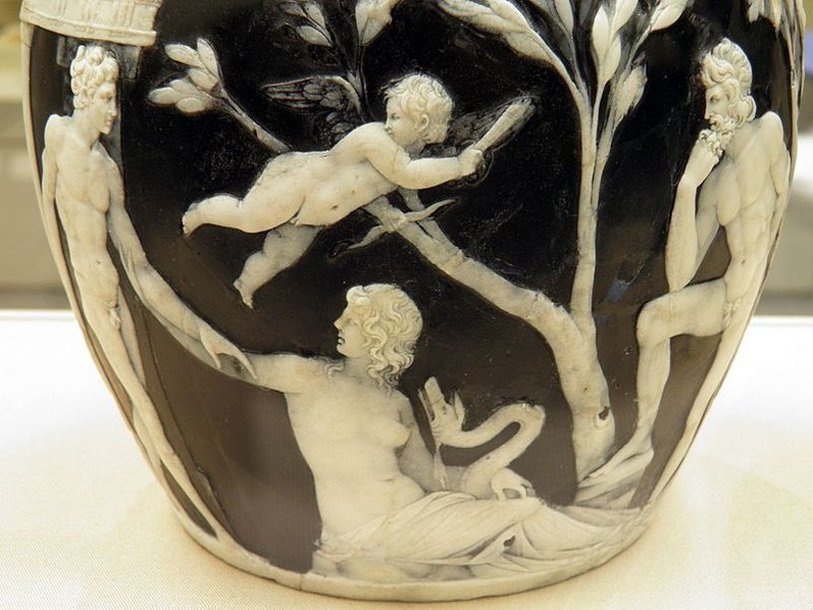 Porteline VAZ Wikimedia Commons
 Porteline VAZ Wikimedia Commons
A group of researchers, led by Richard Whitley from the Australian National University School of Arts, made a statement that the famous masterpiece of the British Museum - the so -called Portland Vase - was made in the way as it was thought. The Whiteley hypothesis and his colleagues applies not only to the Portland vase, but by all ancient products of this type.
Portland VAZ in the exposition of the British Museum
The vase is a relatively small glass vessel with two handles. Its height is 24.5 centimeters, the maximum diameter is 17.7 cm, the diameter of the mouth is 9.3 cm, the height of the handles is 9.6 cm, the width of the handles is 1.8 cm. It is most likely from 1 to 25 years of our era. A vase made of two -layer glass is made, the inner layer is blue, the outer is an opaque white. The white layer served as the basis for a relief thread. The skillful master cut out several figures and objects surrounding them. The level of execution is so high that sometimes they suggest that it was the famous Dioscuride cutter, the signature of which is found on some antique cameras. True, there was no mention anywhere that Dioscuride also worked on glass.
The technique of carved glass arose in the Roman era, about 30 years BC. e. It was used exclusively for the manufacture of very expensive luxury items. The thread was made after cooling the vessel with incisors and drills. The reliefs on glass products really resembled carvings on cameras of the same period. But due to the fragility of the glass, their glass has been preserved much less than stone Kama. Only about 200 fragments and 15 whole items are known: vases and bowls. White images on a dark blue or black background and mythological plots are common to them. This type of applied art did not exist long, from about 30 BC. e. In the age of 60, the era, then survived the period of revival from the end of the III century before the era of the reign of Constantine the Great and his sons (60s of the 4th century). In the second period of the existence of thread on the glass, the outer light layer was sometimes made translucent, imitating mountain crystal.
Sample on glass. Satire with a baby Dionysus. Pompeii glass tiles
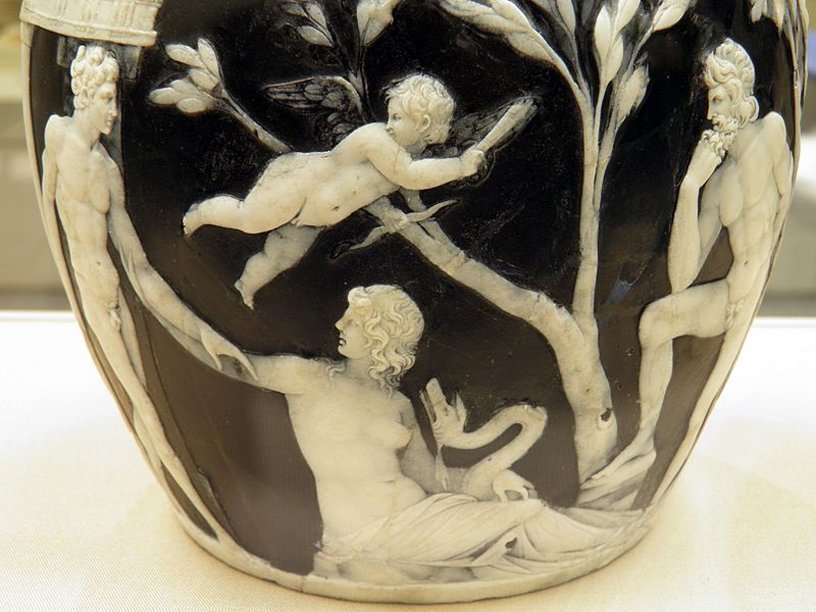
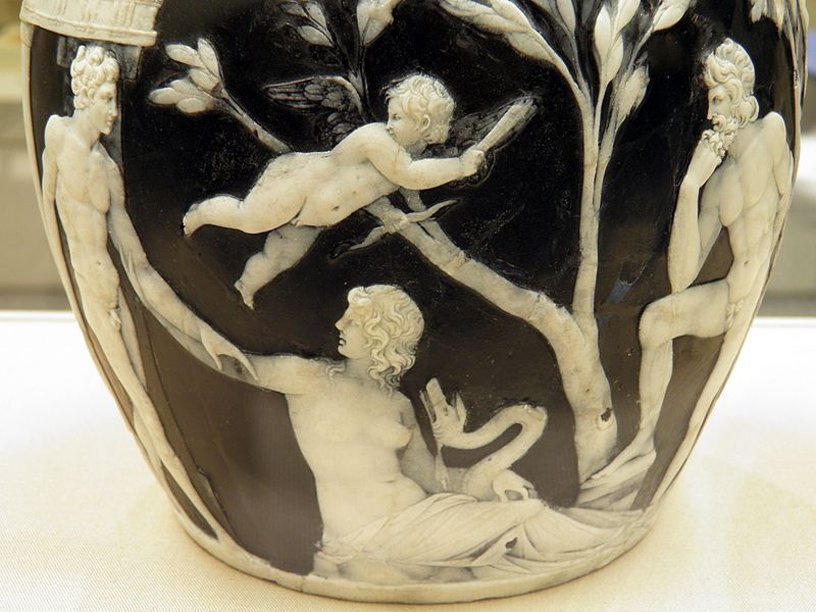
Portland vase is often called the top of this technique. But scientists could not decide what the ancient master portrayed on it. The reliefs of the Portland vase are divided into two scenes. In the first of them, a woman sits under a tree, her body is naked, her legs are wrapped in a cloth. At her feet lifts the head of a strange appearance of snakes, a cupid with onions and arrows fly on top. The woman is holding the hand of a naked young man standing on the left. Near the young man there is a column on which the frieze of the temple rests. An older man stands in the distance on the right, leaning his elbow on his knee, and looks at them.
The first scene at Portland Vase
On the opposite side of the vase, a woman under a tree rises from the bed, apparently waking up. A woman with a rod is sitting to her right, a man on the left. Both of them look at the awakened woman. Near the man is a low stele. Both scenes of the heads of strange horned creatures are separated. Their horns are covered by the bases of the pens of the vase.
The second scene at Portland Vase
Portland vase handle
In the first scene, researchers often saw mythological weddings: either the marriage of Pele and Fetida, or the meeting and marriage on the island of Naksos Dionysus with Ariadn. In the latter case, the figure on the right is strong. The plot associated with the cult of Emperor Octavian Augustus was also supposed. Then the vase depicts the conception of the future emperor by the god Apollo, who appeared to his mother aty Julia Balbe in the guise of a snake. The earthly father of Octavian Guy Octavius is calmly watching this. Or a man with a beard can be an Aeneas, who sailed to Italy the hero of the Trojan War, who was considered a distant ancestor of the Yuliev clan (the aty of Balb also belonged to this genus).
Other authors believed that before us the seduction of Mark Anthony Cleopatra (with a snake, which would then bring her death). In this case, a man with a beard becomes the mythical ancestor of Anthony - Anton, the son of Hercules, reproachfully looking at the fall of his descendant. Finally, the young man and the woman saw Alexander the Macedonian and his mother to the Olympics, the snake in this case again portrayed Apollo.
The interpretations of the second scene are slightly less. The waking woman was considered a hekuba, who had just seen a dream that her son would destroy Troy. Or Ariadne, which was left sleeping on the Naksos, this Finally, it was assumed that this is the sister of Octavian Augusta Octavia Malaya, who was considered the ideal of the noble qualities of the Roman Matrona. She suffers, as her husband Mark Anthony left her for Cleopatra. She is surrounded by God Octavian and the goddess Venus (or Libya, the wife of Octavian).
The first to mention this vase by the French scientist Nikola-Claude Fabrees de Painer (1580-1637), which was in correspondence with almost all outstanding people of Europe of that time. He talks about a vase in a letter in 1601 to the artist Rubens. Payrerek reports that the vase was found in Rome, in the tomb of Monte del Granno, located southeast of the Serviy Tulia wall. At that time, it was mistakenly believed that this tomb belongs to Emperor Alexander Severus and his mother Julia Mamema. It was even believed that the vase served to store the ash of the emperor after cremation.
Engravings of Giovanni Batista Piranesi from the series "Roman antiquities". Sarcophagus from the tomb of Monte del Grana. The back of the sarcophagus and a vase. Drawing images on a vase and relief on the sarcophagus (1756).
Payrke clearly liked the vase. Her drawing hung on the wall in his bedroom for many years. He belongs to one of the interpretations of the first scene, now rejected. He believed that a woman was Briseis, then a young man is probably Achilles, and the bearded man was Agamemnon. And the whole scene depicts the moment when, after reconciliation, Agamemnon returns to Achilles his favorite slave.
Payrerek also informed Rubenses that the vase is now in the collection of Cardinal Francesco Maria del Monte. In 1626, Antonio Barberini, the nephew of the Roman pope Urban VIII, acquires a vase. The Barberini family has owned a vase for almost two centuries, so for many years it was called the "Vasa Barberini." In the last third of the XVIII century, the VAZ was inherited by Cornelia Barberini-Kolonna, who sold it to the Scotsman James Bayres, who was engaged in the trade in art objects. Bayres somewhere between 1778 and 1780 sold a vase to the British ambassador in Naples Sir William Hamilton. He took out a vase to England, where she was bought by the Dowager Duchess Portland Margaret Cavendish Harley .
Margaret Kavendish-Harley, Duchess Portland
Lady Margaret was in a circle of scientists of women who went down in history under the name "Blue Stockings" and was a passionate collector. She owned her own museum, where works of art were collected, curiosity from different places of land from Lapland to the islands of the Pacific Ocean, “objects of the three kingdoms of nature”, and at the museum there were a zoo and the botanical garden. Alas, Margaret died in 1785, and after her death according to the claims of creditors, the collection was sold at a grand auction that lasted from April 24 to July 3, 1786. True, some masterpieces were bought by the son of Margaret Third Duke Portland William Henry Cavendish Bantic. He was not interested in science, but twice visited the Prime Minister. Thanks to him, the vase settled for a long time in the Baltic States, the estate of the Dukes of Portland, and got its current name.
The famous Joosaya Vedzhwood made with the permission of the duke a copy of the vase from the “jasper porcelain” invented by him. I must say that the creation of a copy turned out to be a very time -consuming task, so the researchers believe that the antique carrier on the glass should have been working on this vase for at least two years.
In 1810, the fourth Duke Portland transferred the VAZ to the exposition of the British Museum, retaining the ownership. There she had to survive dramatic events. On February 7, 1845, a VAZA is a certain William Lloyd after a weekly binge came to the museum hall and threw a fragment of ancient sculpture into a showcase with a Portland vase, breaking it. He was arrested and accused of intentionally causing damage, but the lawyer indicated that the law on this offense limits its application by the destruction of objects worth not more than five pounds. Then William Lloyd was tried for a broken window and sentenced to a fine of three pounds or two -month imprisonment. He was in prison until someone anonymously paid him a fine by mail. The Duke of Portland refused to initiate a civil lawsuit about the damage, because I did not want the relatives of the criminal to suffer "because of the act of madness, which they could not control."
During the year, the restorer of the British Museum John Dantey gathered a Portland vase in pieces. He successfully coped with the task, although in the end there were 37 small fragments that he failed to insert anywhere. They forgot about them for a long time. In 1929-32, the sixth Duke of Portland put up a vase for sale in Christie's, but no one could pay the required price. In 1945, the British Museum bought a vase from the seventh duke.
John Dantei with a vase restored by him and a picture depicting her fragment
In 1948, a certain Mr. Criker, who showed him 37 glass fragments and asked if they belonged to the British museum, addressed him to the British museum. With surprise, Eshmol realized that these were parts of the Portland vase. It turned out that the restorer Danterae decided to order a case with the 37th departments to store these fragments, one of the museum’s employees handed them to the master named Gabb, who was engaged in the manufacture of various kinds of boxes and boxes. But all participants in this case died one by one, and the fragments went to the widow of the master Gabba, who asked Croker to find out their origin.
When the fragments returned to the museum, it was decided to restore the vase again, but only three out of thirty -seven fragments managed to put in place. By the end of the 1980s, glue used by restorers weakened, so there was a need for a new restoration. From June 1, 1988 to October 1, 1989, Nigel Williams and Sandra Smith Vas dismantled the vase of pieces, photographing every moment of dismantling, cleaning all the traces of old glue, picked up the most successful new glue on separate fragments and again collected a vase. It was possible to put in place almost everything except a few small fragments. Since then, the vase has been calmly in the museum hall, and the keepers expect that it will not require intervention for a long time.
What did the Australian scientists say about the VAZ? The fact is that for a long time it was believed that the Portland vase was made by glassblower. The blowing glass for a long time was not known to the ancient world. Even the ancient Egyptians knew how to make a tube and thread from the liquid glass mass, give them the desired shape, cut into separate beads, and treat frozen glass. They knew how to mold glass vessels, covering the “bump” of sandstone with molten glass, wrapped in fabric and mounted on a long stick. Such a blank was rotated so that the glass layer became uniform. They knew how to and cast small products from glass. But approximately from the beginning of our era, the art of glassbuilding arises.
Since such a date is suitable for the Portland vase, they settled on this decision. Two colored layers, according to scientists, received as follows: first made an elongated bubble of dark blue glass, and then loaded it into a tiger with molten white glass mass. And then the glass -shower blurted out a two -tone vase.
But Richard Whitley and his colleagues believe that to create not only the Portland Vase, but, possibly, all products from ancient carved two -layer glass, a fundamentally different technique was used, known as Pâte de Verre , which can be translated as “glass paste” or even “glass dough”. Its modern inventor is considered to be a French sculptor and master of artistic glass , Henri Kro (1840 - 1907), who worked in the server manufactory for many years. However, there is evidence that a similar method of creating glass products was known in ancient Egypt. Descriptions of similar technologies are also found in Pliny the Elder.
Pâte de Verre is that finely chopped, to the state of the powder, glass is laid in the mold along with the binder. In the furnace, glass granules are rafted, forming the workpiece of the product. Then it is cooled and, if necessary, polished. This technique allows you to get multi -colored products by putting glass granules of the desired color in the desired part of the form.
The Whiteley team came to this conclusion after studying the small fragments of vessels made in the same style as the Portelenskaya vase and stored in the collection of the classic branch of the Australian National University. More precisely, after studying the smallest air bubbles concluded between the dark blue and white layers. The shape of these bubbles says that the product could not be obtained by glass.
In the study, Richard Whiteley was helped by Tim Senden from the School of Physics and Engineering of the Australian National University, where there is a computer tomograph. Scientists examined the structure of glass using tomography. And after Senden created mathematical models for the formation of bubbles in glass and found that they are not compatible with samples of bubbles arising in the glass -blowing process.
Image of a fragment of glass on a tomogram
Air bubbles in glass
“We saw the configuration of bubbles in glass, which is the result of pressing and turning,” says Richard Whitley, “I believe that the cold granular glass was laid in shape, and then a bubble of molten blue glass was placed there and pressed to the walls of the mold covered with white granuls. You simply would not get a bubble of this size and a flat shape with the help of a blow. ” That is, according to Whitley and his colleagues, the antique version of the “glass paste” technique was that the molten glass of the same color served to sinter the granules of the other color when the master pressed it against the walls of the form. Then, when the vessel was cooled, the white layer of sprinkled glass served as a material for a cutter.
According to Whiteley, in the 1990s, Rosemarie Lierke already expressed a hypothesis that the white layer of the Portland vase was obtained from sprinkled granules, but other scientists did not believe in her assumption, and the technical means of that time did not allow the hypothesis confirmation.
Whiteley and his colleagues told about their conclusions on November 4 at the conference of the Association for the History of Glass) at the British Museum at the Association for the Glass. Subsequently, Whitley, who is the experienced artist working with glass, intends to create a copy of the Portland vase using the methodology reconstructed by him.