
Translated material
People in green
The text continues the project on the Ecology "Variable" .
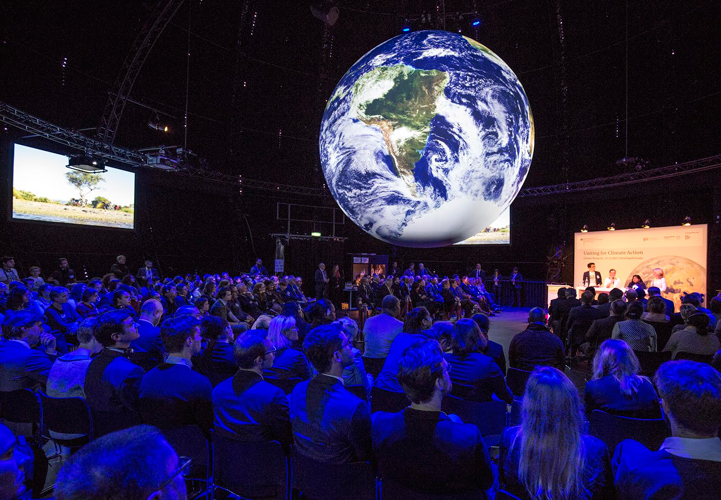
While we are celebrating the centenary of the October Revolution, the next UN Climate Conference, the largest in the history of Germany, started in Bonn. It is expected that at least 20 thousand people will come to it: almost half are members of the official delegations of countries, the rest are observers from research and scientific centers, environmentalists, activists and journalists. These large climatic conferences have been held once a year since 1994. Two years ago, it was at such a conference in Paris that the Paris climatic agreement was adopted, which will replace the Kyoto Protocol in 2021.
In fact, the climatic conference of this year was to take place at Fiji (island state in the Pacific Ocean, which, in particular, threaten flooding and forced migration). Groups of countries - Africa, Asia, Eastern Europe, Latin America and so on - take turns presiding in the negotiations, choosing their representative, who adopts a conference. However, in the case of Fiji, doubts arose, first of all, in the ability to accept and place several tens of thousands of delegates on the island and build the necessary structures for the conference. In addition, a trip to Fiji would become extremely expensive for guests and would lead to very high emissions of greenhouse gases. Therefore, they decided to hold a conference in Bonn, where the UN climate secretariat is located. Understanding that negotiations on the problem of climate change should not aggravate this very problem, the organizers usually try to “green” them in every possible way: this time, for example, guests deliver electric buses, and there are no plastic dishes in the buffets. What is not possible to avoid is compensated , that is, they pay money to projects to reduce greenhouse gas emissions in developing countries.
In general, any UN climate conference is always a holiday. Tens of thousands of people, daily shares of ecologists (on the way to the negotiation halls, it is difficult not to notice those lying activists dressed by white bears - they show the consequences of climate change in the Arctic regions), demonstrations against certain types of fossil fuel, exhibitions dedicated to the consequences of climate change, film screening, concerts. They read prayers for the climate, sing, dance and starve. Every day, during the negotiations, public observers present the anti -a -breed of day for special “merits” in climatic affairs. Russia also gave it more than once, at the last session of negotiations in Morocco - for the promotion of atomic energy as a low -carbon decision. The comic presentation ceremony itself includes the performance of a specially written song, disgracing the “anti -enlimatic” actions of a particular country. In anticipation of the UN conference in Bonn, a 25-thousandth “climatic” march was already held, the main theme of which was the curtailing of coal projects (both in Germany and everywhere in the world)-Bonn itself is located near the coal mining in the EU. The next day, about 4,000 activists blocked the work of a coal quarry near Bonn.
As a rule, the conference space is divided into two parts: the negotiators sit in one, the second exhibition space with the stands and pavilions of countries, cities, regions, research and environmental organizations, associations of activists and businesses is opened. The second zone also presents eco -technologies: here you can ride electric cars, recharge the phone, pedaling electricity, engage in urban gardening, try local organic food from different parts of the world. This year, Russia is opening its pavilion for the first time in a long time. There, visitors of the exhibition are poured and offered to take pictures with the nesting doll , and also talk about the work of Russian scientists, educational programs in the field of sustainable development and activities of Russian business (Gazprom, Rusal and En+ are represented in the pavilion). In total, there will be about 25 round tables, discussions and presentations: Russia will talk about new projects in the field of solar, wind and atomic energy, about forest protection programs, as well as about climate adaptation programs in various Russian regions. Note that environmentalists traditionally criticize the inclusion of atomic and large hydropower, among low -carbon solutions, the problem of global climate change.
However, in addition to the festivities and exhibitions of the achievements of the “green” national economy, delegates at a conference in Bonn will also develop further rules for the implementation of the Paris climatic agreement. The agreement itself was written in a very common language - including so that all or almost all countries subscribe to it (US President Donald Trump announced this year about the exit from the agreement, but this will take at least four years). As a result, until 2020, delegates will work out individual clauses of the agreement, explain them, prescribe new rules and requirements and meet technical, but no less important questions from this. For example, we need to agree on how to report on greenhouse gas emissions and confirm these emissions, as well as how countries can cooperate in a decrease in emissions.
Despite the name of the conference, negotiations are more likely not about the climate itself, but about politics and economics - and mainly about money and technologies. Let's say you need to take money from somewhere in financial assistance to developing countries so that they can adapt to climate change and reduce greenhouse gas emissions. The countries also want to agree on how to make “green” technologies available to the entire population of the Earth, and not only for the richest countries and how to preserve forests and other ecosystems, so that they at least partially compensate for human activity that is harmful to the climate.
If you still recall the climate, then, according to the World Meteorological Organization, the average temperature on the planet rose from the middle of the 19th century by 1.1 degrees Celsius. The purpose of the Paris Agreement is to make this growth by the end of this century does not exceed two degrees. Now the global emissions of greenhouse gases have not been growing for the third year - first of all, thanks to the growth of renewable energy in China and the USA. However, to achieve the goal, additional efforts are needed: while the promises of countries correspond to about three degrees of warming (if you do not do anything at all, then there will be more than four).
One of the main informal issues of the conference in Bonn remains “What is the USA?”. Now the US delegation is still participating in negotiations (since the country formally remains a party to the agreement until 2020); How and what she will say and do, let's see in the coming days. In the meantime, the main “front” of American climatic actions was transferred to the level of state, cities and individual companies, and it is they who will speak in Bonn about their achievements and new goals. Traditionally, the republican and oil producing state Texas, for example, will talk about how he became a leader in the country's windbuilding. Traditionally, democratic California is about new plans in solar energy and intentions to completely switch to renewable energy sources. In addition to the official delegation of the United States, the “popular” American delegation, representing just the unification of all forces “per climate”, came to negotiations in Bonn. On Saturday, a high -level event is expected in Bonn on the first week, where the mayors of American cities, state governors, as well as the presidents and CEO of American companies will present their actions and plans in the field of climate policy.
And what about Russia? In addition to the already mentioned pavilion and events, a delegation from ministries, departments, scientific and research centers is going to take an active part in negotiations. True, the Russian Federation, unlike 169 other countries of the world , has not yet ratified the agreement - it is planned to be done in 2019–2020. According to the official version, since the agreement has already entered into force, much does not depend on the decision of Russia. According to the unofficial - inside the country, there is still a fairly strong “anti -enlimatic” opposition (first of all, these are energy -intensive production based on coal, oil and gas), which sees in the Paris agreement a threat rather than a chance for further sustainable development. That is why the development of any "climatic" legislation is moving in the country extremely slowly. Many companies of the mining or processing sector do not believe in the good prospects of carbon regulation at all, believing that it will be a new payment or tax, the funds from which will be directed to not understand what. Of course, Russia, of course, have problems not only in Russia: even Germany, known for its successes in the field of renewable energy, is now experiencing serious difficulties with the folding of coal energy and can, as environmentalists warn, not to fulfill its ambitious climatic plans for 2020 - much depends on the composition of the coalition, which was now formed according to the results of the parliamentary elections that were held at the end of September.
Some particularly high-profile decisions are not expected from negotiations in Bonn, but it is very important that the countries do not leave the course for 2020 and a full-fledged “launch” of the Paris Agreement. Climatologists give an alarm signals: according to preliminary data from VMO, made public on Monday, 2017, with a high probability , will be included in the top three of the warmest observations in the history of observations. It remains to hope for the celebration of green - if not in the clothes of bureaucrats, then in their heads.