
Translated material
Parvus is lonely white
Crisis of identity: instead of demons, minor demons of the revolution
Hooray! The collection of enemies of the Fatherland was replenished with invaluable specimens - Lev Trotsky (aka Leiba Bronstein) and Alexander Parvus (aka Israel Gelfand). The disclosure of pseudonyms is an indispensable attribute of a good tone. The 100th anniversary of the revolution breathed a new life into these wonderful people. The last twenty years of the root event of the last century, TV generally tried not to notice, but then it suddenly insisted. The first channel was erupted by the series “Trotsky”, “Russia” - the series “Demon of the Revolution”, and even documentary projects and films cannot be counted. One thing unites different canvases - the main character of the coup, shocked the world, is appointed Parvus. However, one should not think that a lonely parvus whits on the screen. He is “whitening” along with the Germans, on whose money all domestic disgraces are made. It is in the shadow of the death of the commercial that such titans of thoughts like Trotsky, Lenin and partially Stalin ripen.
I would not be surprised if, after watching the new Leniniana, the Communist Party, led by Zyuganov, immediately self -exposed. On the screen, the amazed viewer sees not the demons of the revolution, but the small demons - corrupt, fussy, infinitely empty.
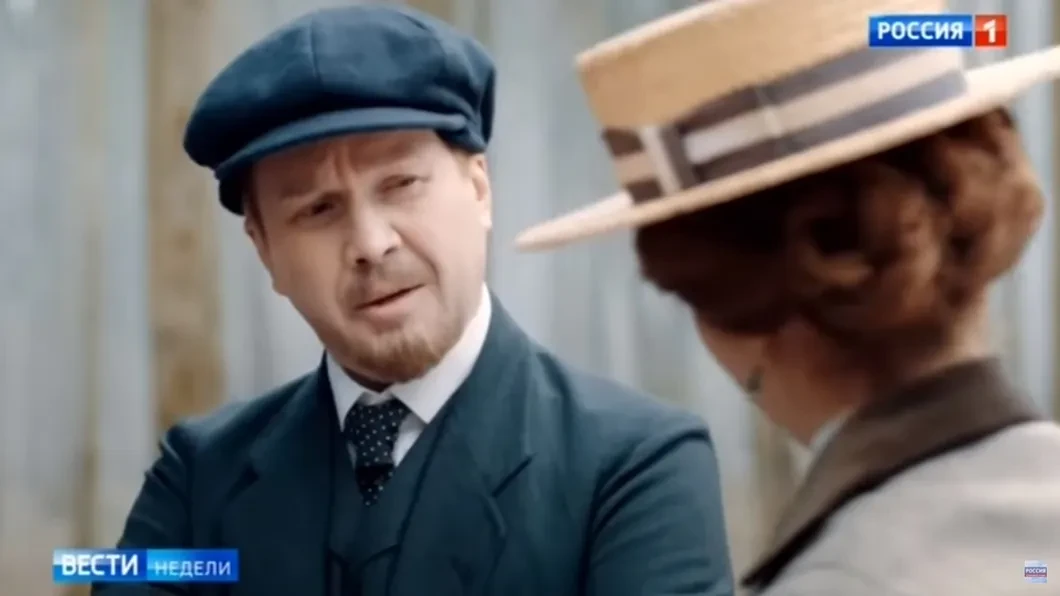
Lenin performed by Evgeny Mironov (“Demon of the Revolution”) - the grown up Peter Verkhovensky from the series Khotinenko “Demons”. Lenin performed by Evgeny Podchkin (“Trotsky”) - the same boring Petrusha from the “demons”, only in the production of director Felix Schultessa. Since Sedkin plays both of these roles, even the similarity of grotesque plasticity is observed. And this visual continuity is the best that is in both series.
The question arises - that this is another reassessment of values means? A country that goes into the future with a face turned into a past, says goodbye to advice? As if not. Will Lenin reburied? It is unlikely. Once upon a time, Novodvorskaya advised Prokhanov to hide the mummy under his bed if he was so dear, but even such a little did not happen. Will decommunization finally come? Do not wait. So why is the bum-brow?
In me, as Blok would say, the answer trembled. For global civilization, the axial time, that is, the time of reflection, understanding, choosing the path, occurs several times over millennia. In Russia, it seems to become an attribute of the next election shaking. The concept of the besieged fortress is strong today, more than ever. Two or three extra enemy, whether Parvus, Trotsky or German General Staff, on which you can write off all the bad ones, will not interfere. And if for this you need to throw the light ideals of Lenin-Stalin into the furnace-it’s not scary. The powerful propaganda experience of recent years masterfully copes with the configuration of the correct optics. Fans of Lenin and especially Stalin will forever remain faithful to their idols. But the rest before icotes are frightened by the ghost of color revolutions, saturated with overseas puppeteers.
This is the visible part of the iceberg; Invisible is much more pragmatic. When the artists begin to reflect on an unknown revolution, I always strain. They would be more precise - an unknown revolution unknown to the authors. Behind broadcasting statements lies a lot of crawle. Two main channels of the countries staged the next championship in tugting at the rating by the method of fresh interpretations. True, no one needs it, otherwise, better series of both Trotsky and the demon of the Parvus revolution would be presented to the audience. I still remember the old Bartoshevich Telecycle about Richard III, the spiritual fellow of the heroes, about which we are talking about. The figure from the world of black underground elements turns to the audience as its accomplices. And they become captives of his powerful hypnosis. Bartoshevich, to whom the rarest gift was sent - to talk about the complex simply, masterfully analyzed the essence of the bloody hypnosis, whose goal is the struggle for power. The current analyzers are most afraid of simplicity, which is why they got a cardboard instead of the music of the revolution. The creators of Trotsky, running away from the style of the classic Bayopic, ran to the poster. And even Khabensky cannot play well in the carelessly crushed stuck Lev Davidovich.
The creators of the film (the producer center of Tsecala "Wednesday", the best that is in the serial engineering today) was a thirst for adapting history to a new, certainly young audience. Hence Trotsky in the role of the headliner of the revolution. Hence the well-known audience of the style of bloody rock and roll, sex, drugs (in subtext). Hence the parvus as an image maker in the manner of some Yudashkin. Hence the dialogues of Trotsky with Freud almost in the format of Battle Oximiron with purulent. Hence the total predominance of the external (beauty of the picture, the effect of the phrase, the catchy wriggling of the composition) over the internal. The authors did not even try to understand how and why a prosperous Jewish boy turned into a monster.
This is not the first time in the fateful for Russians the November days are aggravated by the search for historical identity. But, perhaps, for the first time they lead to such deplorable results.
In the footsteps of fresh television countries, a country whose grandeur is customary to be proud of is born with the money of Jewish-German enemies with the help of a group of domestic adventurers. The disappointing outcome of the centenary development.
But television lovers of the Motherland do not despair. I finish the column to the accompaniment of the violent speech of Yevgeny Tarlo in the Sheinin program. Ex-Senator, Doctor of Law angrily insists: “Yes, quit you to trash the events of a hundred years ago. The new iPhone is more important than all revolutions. ” Clever Tarlo, a golden head, put a fat point in the next crisis of identity.