
Translated material
Damascus, I know you
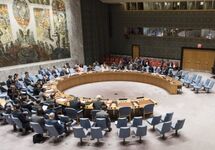
The responsibility for the use of chemical weapons in the Khan-Sheikhun in the Syrian province of Idlib carries the Syria government, and the Islamic State terrorist group is involved in the use of sulfuria in the UMM-CHOSH. This was stated by the head of the joint mechanism of the OPCHO-ON to investigate cases of the use of chemical weapons in Syria (SMR) Edmond Mule at a meeting of the Security Council, the UN news center reports .
The Council of People's Commissars of the SEM was presented with the SMR report. Mule emphasized that the work of experts on the collection and analysis of information was independent and professional. In the case of Khan-Sheikhun, the members of the expert group considered eight possible scenarios of what happened, in the case of Umm-cool, four scenarios.
The head of the SMR noted that the collection of samples at the Syrian government air base of the Ash-Shayrat was not held. "The mechanism examined and decided that if it was only one chemical ammunition, then there are very small chances to find traces of Zarin and the products of its decay and get specific information," Mule said.
The Deputy Permanent Representative of Russia at the UN Vladimir Safronkov nevertheless doubted the reliability of the conclusions of the SMR report and said that the actions of experts were "deeply disappointed." Safronkov noted that members of the expert group were investigated remotely, and one cannot be sure of where and by whom the samples were taken from.
The mandate of the SMR ends on November 17. The US Permanent Representative to the UN Nikki Haley said that the updated draft resolution on its extension will be presented in the Council of People's Commissars. Work, in agreement of Russian and American projects, is successful, the representative of the United States said, but unresolved issues remain. "Our Russian friends continue to insist on unacceptable formulations, which have only the goal of undermining investigators, their authority and the unity of the Council," Haley emphasized. According to her, the United States "cannot record the wording in the resolution that will protect the Syrians from the investigation of their fact of using chemical weapons."
On October 24, Russia imposed a veto on a resolution of the Security Council on the extension of the SMR mandate. 11 countries voted for the draft resolution introduced by the United States. China and Kazakhstan abstained, Bolivia and Russia voted against.
Before the vote, the Russian Permanent Representative to the UN Vasily Nebenzya suggested that members of the Security Council transfer the meeting. According to the Russian diplomat, the decision to extend the work must be made "calmly and balanced, and not under unprecedented pressure", which some members of the Council "try to refuse" to Russia. “When the issue of extending the SCR will be discussed in the Council, we will insist on changing and correcting its mandate in order to ensure the very professionalism and objectivity that we are all baking about,” said Nebena.
On September 6, the UN Independent International Commission on the investigation of human rights crimes in Syria published a report in which she came to the conclusion that the Syrian authorities are worth the use of Zarin in Khan-Sheikhun. According to the report, the regime of the Syrian dictator Bashar al -Assad used chemical weapons from March to July this year at least seven times.
On October 14, the director of the Russian Foreign Department for non-proliferation and control of weapons, Mikhail Ulyanov at a briefing at the UN for the Syrian Chemical Dossier, said that Russia was more and more inclined to the incident in Khan-Sheikhun . “We believe that the SMR should work out all the versions, including aviation. At the same time, we expect that the version of the staging nature of this incident will be carefully studied, to which, to be honest, we are inclined more and more,” Ulyanov said.
The Russian diplomat also stated that the children shown in the photographs from Khan-Sheikhun were not injured from Zarin, but from psychotropic substances. “Take a look, the pupils allegedly affected from the dawn to the limit, while in the case of the use of Zarin, they had to narrow to the size of the point,” said Ulyanov. “Who poisoned the children with drugs to raise a degree of emotions around the chemical incident?”
On May 1, Human Rights Watch Human Rights has issued a report on chemical attacks in Syria. The document provides evidence of the involvement of the Syrian government forces in the April attack on Khan Sheikhun. Invited HRW experts studied photos of the funnel at the scene of the explosion and found that the city bombs of the CAB-500 or Kab-250, developed for use with Zarin, were dumped into the city. In addition, human rights activists determined the signs of Himatima using Zarin, interviewing the witnesses of the event and studying the photos of the victims.
In addition, the report provides information about three more cases of the use of chemical weapons by the Assad regime. Human rights activists managed to establish the names of 64 victims of Himatak, which took place on December 11 and 12, 2016 in the east of the city of Hama, located near Khan Sheikhun. Another attack was recorded on March 30 in the north of Hama. As a result of this attack, no one died, but there were victims, including among the civilians.
The attack on Khan Sheikhun was committed on April 4 . Bombs with Zarin, as well as presumably chlorine, were thrown into the city. As a result of the raid, more than 80 people died, including children.
Damascus said that Assad’s aircraft did not use chemical weapons, but bombed the rebels for the production of chemical shells and a warehouse of ready -made weapons. At such an explanation of events in Khan-Sheikhun, they also insisted in Moscow. However, the international community is sure that Assada aircraft made a chemical attack.
On the night of April 7, the United States fired at the Ash-Shayrat base with winged missiles , destroying it almost completely. It was the most stringent US action in Syria for all six years of the war, continuing in the Middle Eastern country.
On April 12, Russia imposed a veto on the draft resolution of the UN Security Council condemning a raid on Khan-Sheikhun and the demand for Assad to promote an international investigation of this crime.