
Translated material
Ramses and feminists
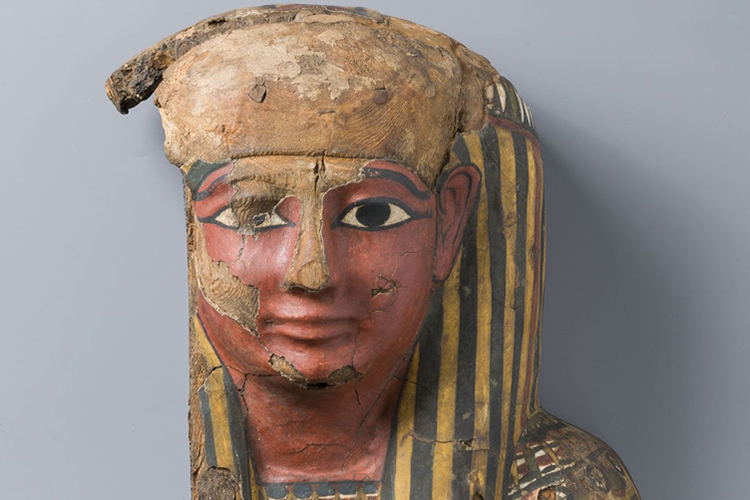
Interestingly, someone was already trying to form an exhibition-a correlation of the ideas of the ancient matriarchy and modern feminism? Surely yes. But in the arena of a small Hermitage, this turned out to be unintentional and a little ominous. Here is the exhibition “Nefertari and the Tsarits Valley. From the collection of the Egyptian Museum in Turin. "
How it sounds: the Valley is the queen. No, it doesn’t seem to you - the feminist subtext is really felt in the exhibition, although the ancient Egyptian masters, who have worked carefully on tombs for years, had nothing in mind. The viewer is on the move that a woman in ancient Egypt occupied a situation that is different from many other crops. Economically and legally equal with a man. And also (which is not so original), both women and men used cosmetics, jewelry - followed themselves in the sense in which this is not forgiven on the city outskirts. The Hermitage is unlikely to deliberately calls on to talk about “strong women” in ancient art. The exhibition is not the audience that goes to museums to drown for feminism. Even experts know a little about Egypt and leave the viewer one on one with an ancient, very straightforward and sensual art. And they look mainly either families with children (Egypt take place in high school), or couples, in order to touch the beautiful art, not burdened by theoretical growths. From them, it was a half-whisper: “Do you see how they treated women? It is written here. "
The exhibition is not the audience that goes to museums to drown for feminism.
The main part of the exposition is dedicated to Nefertari-the main wife of Ramses II of the Great (under him, the famous temple complex was built in honor of the king and queen on the rock of Abu Simbel in the upper Nile). The presented collection comes from Italy: at the beginning of the 20th century, Italian archaeologists carefully attributed the findings associated with the queen and examined her luxurious tomb. In Italian, a tender attitude towards the mother of the family is noticeable in everything: which is only a voluminous reconstruction of the tomb with lovingly painted walls and recreated sarcophagus. It is generally accepted that Nefertari was a beauty, and after her untimely death, Ramses married their eldest daughter Meritamon. As you can see, not only with feminism, but with family values in Egypt, everything was in order.
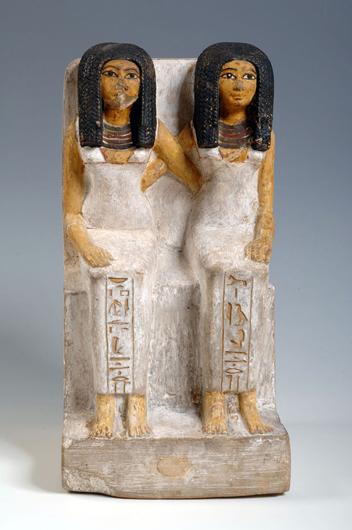 © State Hermitage Statue is also Ruiu. The new kingdom, the beginning of the XVIII dynasty (1480–1390 BC). Favan necropolis (?)
“I went to the Hermitage, looked Egypt. You know, he didn’t catch me at all when we studied. And now I barely got out of this hall. Cool, of course, ”the classmate told me the other day. Egypt always clung to me. For an impressive child interested in history, the first foreign trip to Egypt with excursions to the Luxor and the temple complex of Queen Hatshepsut determined a lot. Perhaps I still subconsciously consider the ancient Egyptian civilization not the main, but the most powerful of the existing ones. And after all, it turned out with her as with women's rights. Long before the new era - a stormy flowering and matriarchy, then complete oblivion and humiliation, then multiple plunder and meticulous redeeming archeology in the finale. And timid arguments that if the enlightened Europeans had not surrounded the unfortunate Egypt, the monuments would only be worse. And stylish flat little men with brown skin, so bright after centuries in dark tombs, look bewildered without blinking, at the outbreaks of cameras. They could not protect the innermost sarcophagus of the hostess. Although they seemed to be drawn for this.
They are not sure that these straight -blue people with eyes without pupils were not aliens.
We know so little about this civilization. We cannot really decipher the writing, we do not know where the descendants of the “same” Egyptians. They are not sure that these straight -blue people with eyes without pupils were not aliens. Here Ramses sits in an embrace with God and the goddess, and they all look at you seemingly friendly, but from a height. Not down, but from a height, and inaccessible.
Perhaps the main thing that attracts in ancient Egyptian art, in addition to its thousands of years, is the charm of self -sufficient prosperity. Stability extending for centuries, an unshakable way and a subtle household bliss. You will never see such half -smiles on Roman portraits, for example. The image of the ruler will never be so simple and unconditionally similar to idol - and at the same time devoid of militancy. The great conqueror of Thutmos I and no less great Ramses II are absolutely relaxed. I would like to be able to sit so evenly and with an expression of prosperity on my face to be photographed on a visa, for example. The ancient Egyptian sculptures sometimes evoke the idea that the depicted is looking at the lens of a coming Civilization-successor.
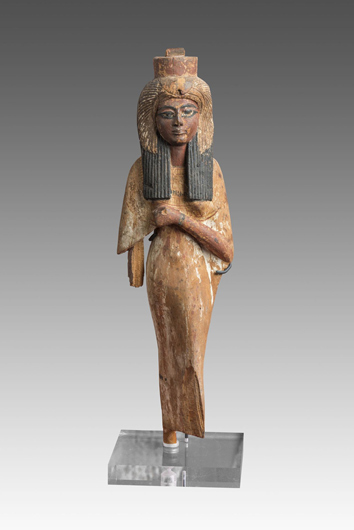 © State Hermitage Figure of the deified Queen Yahmos-Nefertari. New Kingdom, XVIII dynasty (1550–1292 BC). Deir El Medina
Smooth, slender sculptures Sokhmet. The goddess with the face of the lioness and "a character that is not amenable to control." The goddess of war and the scorching sun, but also a healer. The wife of the god Ptah; A fatal woman, in general. Sometimes she looks from top to bottom, lifting her chin. Sometimes - under the sneaky, as if preparing to butt (or spew out the heat of the desert). Sometimes-compassionately and helpless, like a lvitsa mother from the “king of a lion”, and sometimes-crushing half of the muzzle, as if oldly toothless. Numerous female yochebti and sculptures are so patronizingly surrounded by the guards and museum workers working at the exhibition (and all of them, as it were on purpose, men), which is involuntarily thinking about the script in the spirit of “Belfegor - Ghost Louvre”, only from feminist positions. About how in the evenings, when the arena with the exhibition works until late, the goddesses of black stone capture the mind of white men ... It is good that there are still people and their surprised exclamations: how long, the pharaohs ruled Egypt, it turns out that society was arranged, how cruel the goddess Sokhmet was cruel.
But back to the fragments of the sarcophagus of the main wife of the great Ramses. Broken pale pink granite, a little utensils. The sarcophages of the noble Egyptians were responsible, observing all the mods and “standards” for a prosperous afterlife. In the form, the presence or absence of murals on certain sides of the sarcophagus, it can be dated. The tomb of the queen has been robbed for centuries, and local robbers seem to somehow somehow pass on secret knowledge from generation to generation about "pharaoh places." The resellers took out everything that would look from Egypt without any attribution. As a result, now in Luxor guides are reverently offered to inspect the columns with capitals in the form of a blossoming papyrus - spectacular, proportional and heavy. Architecture is not so easy to take away. Palmyra - and that how long it stood. Flat men are walking into the profile in the columns. They make sacrifices, rejoice at the resurrected sun, worship the kings, and the kings to the gods.
The raids on Egypt can not be written off on fierce terrorists: after all, they were committed by civilized Europeans, declaring noble goals.
By the way, about Palmyra. A few months ago, the forces of the same Hermitage held a 3D “diagnosis” of the destruction of local monuments. Then, however, the terrorists again bombed the ancient city. As a result, the International Specialists Brigade created a model that will someday help to recreate the city. A rather rare on the part of our state is the use of “soft power” based on culture and the convincing performance of the Hermitage on this front. The raids on Egypt can not be written off on fierce terrorists: after all, they were committed by civilized Europeans, declaring noble goals. Stolen obelisks and sphinxes adorn the whole of Europe. And museum historians stubbornly pretend that science was too late realized that you can’t touch someone else's, that it was not necessary to enjoy the gods from sandstone and little men, in the profile of tombs walking along the walls. The “enlightened” white conquerors differ from the prohibited in Russia in Russia only in that terrorists destroy the sake of destruction, and Europeans - for the sake of assignment (and courage, must be thought). And in the case of Egypt, hardly anyone seriously talked about the restoration of the lost-not the geopolitical situation.
Against the backdrop of deceased figures with faces without wrinkles and eyes without the pupils of the civilization of white robbers look swarming thieves. Even taking into account active military expansion during the New Kingdom (which serves as a source of basic knowledge about Egypt), the art of this country speaks of the amazing self -sufficiency of Egyptian statehood. The strongman and warrior Thutmos III quietly waited for 20 years, while his aunt and the stepmother Hatshepsut were ruled. That is, the war, obviously, was not a necessity for the country, but the addiction of the pharaohs of the XVIII and XIX dynasties. Perhaps that is why it is difficult for us to analyze ancient Egyptian art-we are not ready to admit that some kind of alien-craftsmen went further than us, white people of the Old World. The society of miraculous feminism, which professes the idea of eternal life and even fighting, seems to be for the process (it is impossible, of course, to attribute the personality traits of the pharaoh throughout the country, but in the case of the Egyptian concept of the king-god it is difficult not to do this).
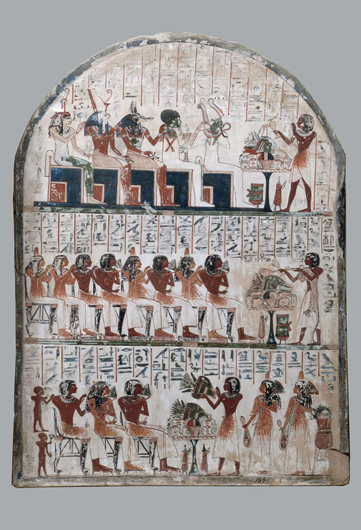 © State Hermitage Steel Kela. XIX dynasty, reign of Ramses II (1279–1213 BC). Deir El Medina
At the exhibition there is a papyrus with the names of order violators under the Great Ramses, and punishments are carefully prescribed for everyone. Without protocol details, with the humane "Kara befell it." Someone completely escaped with reprimand. And someone made a booze in a harem. Well, a mess. In combination with the pantheon of female deities and sometimes blurry gender identity of flat painted men, a certain alternative Egypt draws imagination. The embodiment of benefits, to which modern society is far, and the subtle edge of reasonable hedonism. After all, eternal life is the whole process in its own way, and if you exclude the episode with the court of Osiris, there will be a continuous pleasure in the form of bright jewelry, incense, convenient sandals from plant fiber, fashionable blue wigs with Afrocoschiki. Your photo for a passport, your gatherings with the gods.
It seems that Tolkien wrote that long before the events of the Lord of the Rings, the world was innocent, inhabited by elves and everyone lived forever and happily. Ancient Egypt is so far from us and so obscure that it seems to be a material version of such a legend. True, it has its own Sauron, and he is, of course, a woman. Our adored goddess-Lvitsa Sokhmet, as “Ok”, watched with pleasure how the sunny god exterminated humanity. In the course of the divine pogrom, red wine spilled, Sokhmet took it for blood and rushed to drink. Olar, the Lvitsa goddess could not complete the begun. And we, the descendants of the survivors, locked the goddess of sunny heat in a cold, dark and dank city. She will have to, apparently, defend the rights.