
Translated material
Faroka lessons
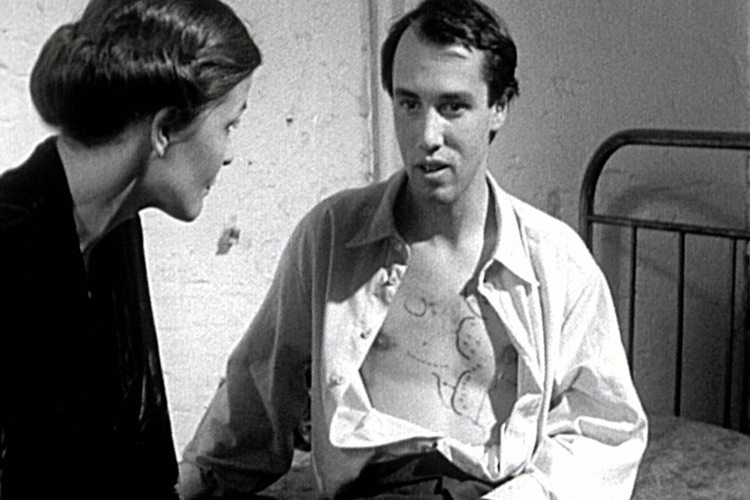
Yesterday, November 8, the Blick '17 film festival began in Moscow. Organized by the Goethe-Institute and dedicated to the legacy of Harun Faroki (as well as the works of his fellow travelers, like-minded people and even, it seems, unconscious opponents-like Alexei Fedorchenko), Blick '17 will be held at the Center for Documentary Cinema and the State Tretyakov Gallery on November 26, in detail its program can be found here . The official name of the festival is “Blick '17: Harun Faroki. Opening gaze. " Vasily Koretsky says about what is opening-and who belongs-a look in the didactic films of Faroki.
“Our eye sees very badly and very little-<...> And now people invented a movie camera so that <...> do not forget what is happening and what should be taken into account in the future,” wrote Vertov in 1924. Would he imagine that literally a quarter of a century, the film apparatus, more precisely, the very cinemalase, the almighty mechanical substant of the human body of vision, will be used by the “capital” - and not at all for the “entertainment of the masses”. The Metaphor of the film equipment invented by the helicopter as an agent of the GPU will literally come true - in the projects of German tele -controlled missiles, in aerial photography, in the SS TV cameras, in the recognition programs of images.
Visual vehicles as an instrument of control and alienation are one of the central topics of the video evidence of Harun Faroki, director-publicist-researchist, whose work seems to be the best illustration of the concept of “chambers-reer” . In these didactic films, a Dokufix, clearly leading from the militant “materialistic fixation” of Godard, Goren and Group Dziga Vertov , Faroki acted exactly the same as his opponent. The ambiguity of the German Erleuchtung , which means both “Enlightenment” and “Intelligence”, became for him a spell with reverse force. On the one hand, Faroki demonstrates how the humanistic project of European civilization evolves into the arms race, the escalation of a person’s alienation from all spheres of its existence and total observation (the plow’s stomach turns into a gun’s carriage, panopticon - into a private American prison with tear gas and rosy scanners and metal detectors in each doorway), On the other hand, it contrasts all this with its own method of investigation (intelligence), the purpose of which is the emanciper education of the viewer. The industry, production as an epistemological basis of the entire current civilization is another thought that is constantly repeating at Faroka (even speaking of the editing “eight”, it managed to draw a parallel between the screen dialogue and the work of two shifts). And in his practice of producing knowledge, he willingly used the finds of heavy industry - for example, a non -freeze method. Materials for his video banner were the frames shot by himself for the conventional television dock, corporate films, Found Footage , fragments of books read at work.
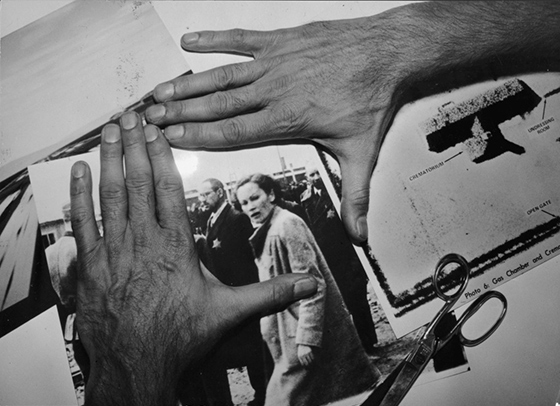 Frame from the film "Pictures of the World and Signatures of War"
What do these clippings are talking about? No less than about the self -denial of mankind. In a sense, Faroki managed to complete the Godard experiment on the search for “clear images”, images cleared of ideological patina and the noise of endless cultural connotations, images of the world that can clearly speak for themselves. But what turned out to be these pictures? The warfares of war (the unintentional irony - a film known to us under the name “ Images of the World and the Inscription of War” was originally named after Images of the W AR , but during the demonstration of the War picture was spontaneously replaced by World ). Video material withdrawn by the destruction machine - satellite guidance systems, cameras installed on ballistic missiles; records from monitors of combat simulators, etc. It is no better and the homologous cadres of peaceful life - a video from controllers in conveyor production or a footage of STR systems, recognizing images of parts. In the middle of the 20th century, the cars made the employee’s physical labor and hands unnecessary, pushing people into gyms and treadmills (in one of their texts, Faroki wittily equals the prison gym with a practice adopted in the British penitentiary system of the XVIII century: the camera was continuously filled with water to survive, the prisoner had to work, erase it). At the end of the century, the need for the employee’s eyes disappeared - and the sublimating simulators for our idle eyes, according to Faroka, became films and television programs. But will a person who stepped only on a treadmill be able to climb the mountain? Can an eye trained to see only trails, scripts and stage scenarios of the dominant mainstream cinema, read the image, identify in it information inaccessible to sensual perception? Faroki’s answer is a categorical “no”, and as an example of what a person sees only what he wants to see (Russian formalists knew this: as Sergey Tretyakov said to remove a good chronicle, you need to know that it is to shoot), he does not see the Aushwitz air intelligence, located a few kilometers from the plant for the production of synthetic gasoline - the initial search subject.
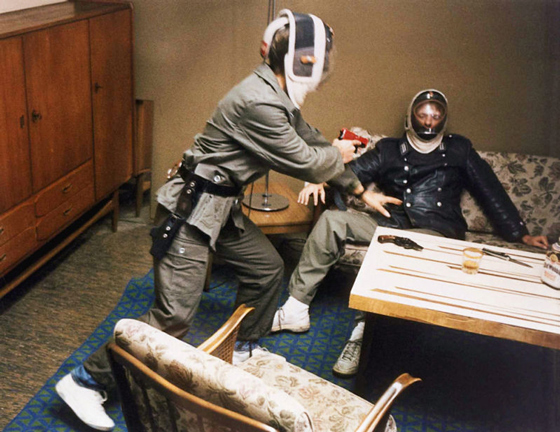 Frame from the movie "Live in Germany"
Films-Essis of Faroki himself were in a sense exactly the same simulators for the look-but to read the viewer to read from the pictures, to see between the lines, to resist the didactic voice of ideology, expressed in an edifying female warrior (for example, in the “Pictures of the World and Signatures of War” (1989) or “The release of workers from the factory” (1995). Due to the limited resources, the same photographer at Faroka often illustrates completely different statements (reassemblement), again raising the question of the struggle (class?) Of the image and sound raised by the member. The sound of totalitsa, it appeals to the blind faith: it is no coincidence that religious texts, as Faroki noted, use mainly auditory metaphors, while the image belongs to the sphere of cognition, science. Alas, today's cinema is hopelessly behind the scientific discourse, which has been operating for almost a century by concepts that are inaccessible for visual representation. But the goal of Faroka’s films is just the representation of the invisible - or seen, but immediately forgotten. The real one leaves behind a visual trace, and Faroki, as an experienced hunter, read the story of these vague ambivalent prints. Personnel begin to speak for themselves - the warsover is replaced by barely distinguishable titers (“Eye/ Machine” (2001)) or completely disappears, as in “Life” (1983) or “Live in Germany” (1991), the most terrible film Faroka. Compiled from the chronicle of all kinds of trainings - played with psychedram dolls, training courses for future mothers and midwives, courses for those who go through the interviews, and those who accept them, courses for waiters, visitors of restaurants and even for those who eat at home (sitting before empty plates, whose faces we do not see, learn to pronounce prayer before dinner. and baptized), courses for police officers and so on - it turns out to be a total catalog of life situations and social scenes, each of which, obviously, is the result of the indoctrination of the subject of the ruling culture of life (read - ideology). But the programming of all social reactions is only part of the apocalyptic picture “Live in Germany”.
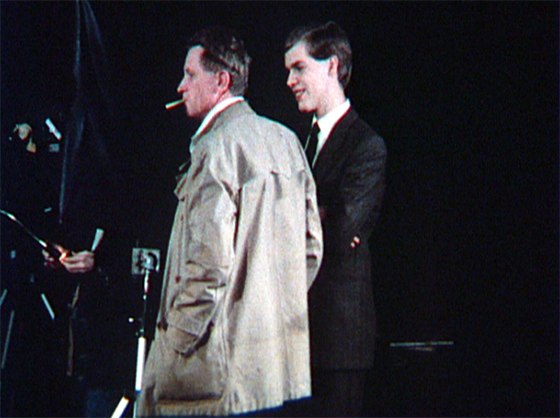 Frame from the film "Jean-Mari Straub and Daniel Yue work"
The simplest assembly comparison (scenes of mothers and unemployed are interspersed with the factory chronicle, in which we see machines that explore the amortization of household items: heavy rollers ride along sofas, mechanical hands open and close the cabinets, the comic device infinitely raises and lowers the toilet cover) Faroka turns the documentary image into a metaphor. The abstract, does not produce anything, in a sense equally useless that the work of the British prisoners to scoop up water from their cameras, the work of these mechanisms alienated from everything in the world-and the abstract, total residence of all life situations that we see on the screen. Did it replace the real, going beyond the boundaries of this screen and these training rooms? Has the gradual denial of the role of manual labor, skill, eye, the very view in industrial production (and its reflection-igan-military affairs) into the total self-denial of mankind? What remains of our life (and films) when (all) seeing electronic machines will control our movements and transactions, access to money, weapons, information, other people? And how do we find John Connor?