
Translated material
On the site of the Himatia in the Syrian El Latamin found the remains of the Soviet bomb with the traces of Zarin
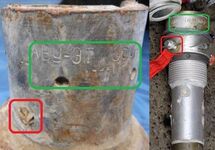
At the site of a chemical attack in the Syrian village of El Latamin, the remains of the Soviet aviation fuse of Au-ET were found. The chemical weapon prohibiting organization reported its photos, the Conflict Intelligence Team investigation group reports .
The first to the photo in the OPCW report , presented last week in the UN Security Council. The researcher Eliot Higgins drew attention. In the document, the fuse is called a "metal object." On it, sarin decomposition products and by -products of its synthesis were found, as well as hexamine, which is used to receive Zarin exclusively by the Syrian authorities.
In the same report, the remains of airbomb stabilizers appear, the tests of which also revealed the presence of Zarin and his traces. In addition, the document has photos of an object similar to the attack on the site in Khan-Sheikhun, which was applied four days later. Human Rights Watch previously assumed that this is the covers of the bulk opening of the Soviet Chemical Bombs of the Hab-250.
At about 6 a.m. on March 30, a airline was applied along the southern outskirts of El Latamin. People in this area experienced symptoms of poisoning. They recorded muscle cramps, nausea and foam from the mouth. Many lost consciousness. Eyewitnesses reported at least about 70 victims.
The OPCU notes that the experts failed to visit the place of the incident. Nevertheless, the analysis of the testimonies of the puzzles, the study of samples taken and the remnants of ammunition allow us to conclude that "Zarin was most likely used as a chemical weapon" in El Latamine on March 30.
On November 7, the Council of People's Commissars of the Council of People's Commissars were presented with the seventh report of the joint mechanism of the OPCHO-ON to investigate the use of chemical weapons in Syria (SMR). The responsibility for its use in the Khan-Sheikhun in the Syrian province of Idlib carries the Syria government, and the Islamic State Terrorist group is involved in the use of sulfuric and hopping sulfuries in the UMM-Khosha, said the head of the SMR Edmond Mule.
Mule emphasized that the work of experts on the collection and analysis of information was independent and professional. In the case of Khan-Sheikhun, the members of the expert group considered eight possible scenarios of what happened, in the case of Umm-cool, four scenarios.
The head of the SMR noted that the collection of samples at the Syrian government air base of the Ash-Shayrat was not held. "The mechanism examined and decided that if it was only one chemical ammunition, then there are very small chances to find traces of Zarin and the products of its decay and get specific information," Mule said.
The Deputy Permanent Representative of Russia at the UN Vladimir Safronkov nevertheless doubted the reliability of the conclusions of the SMR report and said that the actions of experts were "deeply disappointed." Safronkov noted that members of the expert group were investigated remotely, and one cannot be sure of where and by whom the samples were taken from.
On May 1, Human Rights Watch Human Rights has issued a report on chemical attacks in Syria. The document provides evidence of the involvement of the Syrian government forces in the April attack on Khan Sheikhun. Invited HRW experts studied photos of the funnel at the scene of the explosion and found that the city bombs of the CAB-500 or Kab-250, developed for use with Zarin, were dumped into the city. In addition, human rights activists determined the signs of Himatima using Zarin, interviewing the witnesses of the event and studying the photos of the victims.
In addition, the report provides information about three more cases of the use of chemical weapons by the Assad regime. Human rights activists managed to establish the names of 64 victims of Himatak, which took place on December 11 and 12, 2016 in the east of the city of Hama, located near Khan Sheikhun. Another attack was recorded on March 30 in El Latamin. As a result of this attack, no one died, but there were victims, including among the civilians.