
Translated material
“How did you celebrate? Succeeded? ""
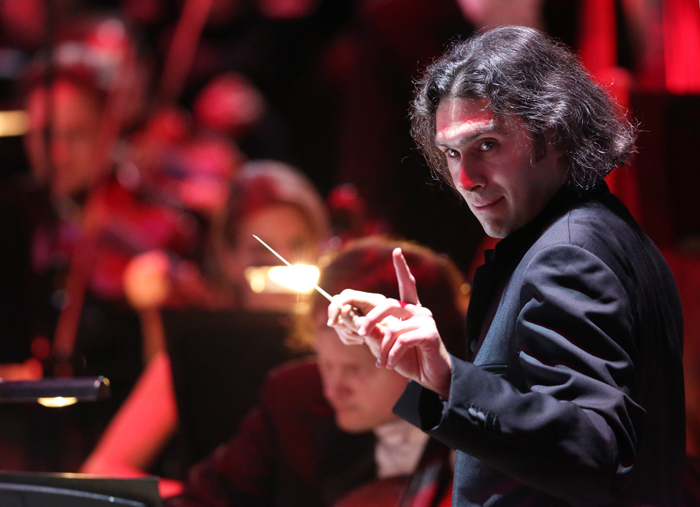
It is difficult to celebrate the 100th anniversary of October, but it is necessary. The most brilliant script was invented, of course, Vladimir Yurovsky for his GASO named after Svetlanov. All four names in his program in the Great Hall of the Conservatory are an aiming in pain points.
Two classics with little-playing, “uncomfortable” music, which they were still quite at the call of the heart and with great professional zeal responded to the early October round dates: the second symphony of Shostakovich-“October October”-was written in 1927, Kantata Prokofiev “On the 20th anniversary of October”-respectively, in 1937. The choir symphony for the verses of Alexander Bezimensky at the time of occurrence managed to come to the court, was a success, a dissonant triple fugue depicting an unclear fermentation of the revolutionary masses, and at the end of the twenties had the right to exist. But soon it was not up to fermentation and creative searches. Great bronze, socialist realism. Shostakovich’s symphony stopped playing, and Prokofiev’s Kantata, written with the enthusiasm and dullness of a Western specialist, did not perform during his lifetime; For the composer that had just returned to his homeland, this was the first bandwagon. Both works were allowed on the stage only in the 60s, with the cantata-with bashfully carved speeches of Stalin (in addition, the texts of Marx and Lenin were used in it). It is clear that the attitude towards this sincere plaster is not clarified to this day.
The violin concert of Mecherslav Weinberg has no such direct relationship to the revolution. But here the very name of the composer works, according to which the 20th century drove as tightly as October in Russia. The soloist Gidon Kreerer added cold charm to this music, and also introduced his five kopecks with a significant bead called the “Requiem” of the composer Igor Loboda, dedicated to, as the Internet suggests, the victims of the Ukrainian confrontation in the Donbass. The Ukrainian folk song quoted in a violin miniature, “The Revue is Stogne DNIPR Wide,” at first the blessed and beautiful, is gradually distorting and falling apart, Kremer turns on his branded intonation, and there can be no impenetration.
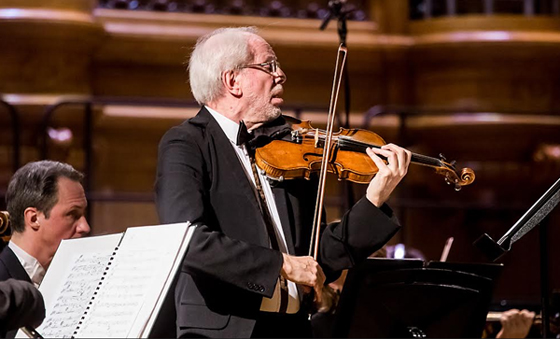 © Lidia Shironina / State Academic Symphony Orchestra of Russia named after E.F. Svetlanova
The next number of Moscow tour of the famous and beloved by the musician will be the violin concert of the composer Viktor Kisin (in Soviet times, who wrote for a movie that has long been living in Europe) in another program of HASO and Vladimir Yurovsky in the Tchaikovsky hall. And on November 13, Kremer will continue the Acting-Grazhda line with a charitable concert at Gogol Center in support of Kirill Serebrennikov , where 24 Winberg preludes will play for the first time in Russia.
But here the very name of the composer works, according to which the 20th century drove as tightly as October in Russia.
And finally, the fourth point of the Yurovsky revolutionary program was a world premiere. The composer-resident Alexander Vustin, since 2016, actively and successfully collaborating with HASO , this time wrote for the orchestra, soloist and choir an essay called “Three Poems by Olga Sedakova”, whose poetry he loves and subtly feels. Woustin is a completely original figure, floating (or raving) across all sorts of trunk movements and producing very whole, significant statements. A few days ago, in the event of a modern music studio, arranged according to the same revolutionary reason and assembled under the heading “Go, comrade, to our collective farm!”, The most powerful and intelligible number was the cantata of Vustin “Wind” on the texts of the “twelve” for the folk voices of the Pokrovsky ensemble and instrumentalists.
“Well, the brothers are comrade! / How did you celebrate? / Succeeded? / To us too ” - this is the end of Sedakova’s first poem“ In the subway. Moscow ”, which the soloist does not sing, but chants. The sculptures on the "Square of the Revolution" are in the way. Rudeness, strength and despair. The second is "the remaining remaining martyr." Pain, resistance, fidelity, patience, the last truth. The specific time of action is not indicated. But for the actual October theme it is quite suitable. And the third poem - “with tenderness and depth” - this is an exit to another dimension, you can’t say more mild. There is much more emotional condensation in this music than specific programmings.
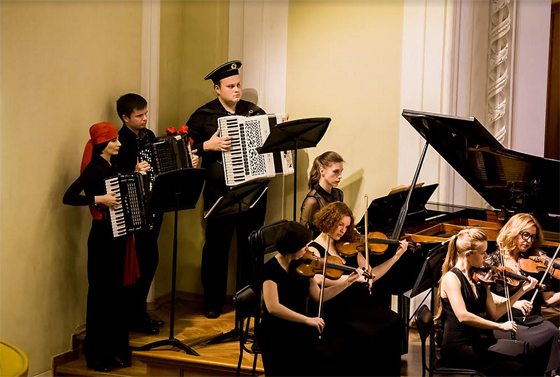 © Lidia Shironina / State Academic Symphony Orchestra of Russia named after E.F. Svetlanova
Throughout the essay, Maxim Mikhailov reigned on the stage, flashing the Sedakov poetry of the charisma of the Russian bass. It was this number of the program that turned out to be the most expressive. The final concert is a grandiose Prokofievskaya cantata, in which, in addition to the orchestra with an extended group of shock and huge choirs, the Bayanist ensemble, a gang of copper winds, sirens and a reproduct with the voice of Lenin, should have been offended the rest. But the choral massif was pumped up from the chapel named after Yurlov and the Sveshnikov choir. Neither power nor diction they flashed either in Shostakovich, nor even in Prokofiev. The classics of Marxism-Leninism were not heard. But the partner had the opportunity to take a selfie against the background of the button accordion.