
Translated material
I will give you a strict report
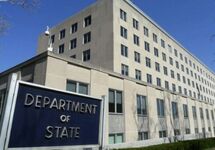
The US State Department transferred to Congress two reports of Russia's attempts to influence the election results in Europe. This was reported by RBC with reference to the official representative of the department.
"The State Department submitted to the relevant committees of the Congress reports provided for in Articles 255 and 256 of the Anti -Countering Anti -Councils through sanctions (Countering America's ADversaries Through Sances Actsa)," the State Department representative said.
The first report applies to the media under control and funded by the Russian authorities, as well as affiliated organizations operating both in Russia and beyond. The second refers to "financial resources that were provided or used at the direction of the Government of the Russian Federation or any Russian person in order to influence the outcome of the elections or an election campaign in Europe or Eurasia during the previous year."
In accordance with the law, the State Department was supposed to submit these reports to the Senate Committee and the House of Representatives for International Affairs, for Armed Forces and Intelligence by 31. In the future, such reports should be provided annually. The documents themselves do not imply sanctions consequences - the decision on restrictive measures is made by Congress. Whether these reports will be published is unknown. The reports themselves are not secret, but they may be closed with the application.
On August 2, US President Donald Trump signed the Caatsa law on new sanctions against Russia, as well as Iran and DPRK. The document was adopted in the House of Representatives with 419 votes against three , and in the Senate - 98 against two . About half the document is devoted to anti -Russian sanctions. It is noted that they are introduced "in response to a crisis in eastern Ukraine, cyber attacks, as well as human rights violations in Russia."
The document introduces a ban on the transfer of American technologies for exploration and oil production, limits transactions in the field of pipeline export of hydrocarbons, as well as transactions with the participation of Russian military and special structures. On October 27, the US State Department prepared and transferred to Congress a list of Russian persons and organizations that can affect new sanctions . It included 33 companies of the defense sector, including Rosoboronexport, Rostec, Uralvagonzavod Izhmash, Kalashnikov, Almaz-Antei MiG, Sukhoi, the United Aircraft Building Corporation, the United Shipbuilding Corporation. Of the reconnaissance structures, the list includes the FSB, SVR, GRU and three organizations for the production of special equipment.
On November 1, the US Treasury Department, in accordance with the law, expanded US sanctions against Russian oil companies for projects for the development of hard -to -recover oil. Now restrictions apply to any Arctic, deep -sea or shale oil projects in Russian territory. It is also forbidden to cooperate with any projects outside Russia if the Russian company includes 33 percent included in the sanctions list or more in such a project, or controls most of the voting rights. The latest restrictions do not affect the projects started before January 29, 2018. Also, purely gas projects do not fall under sanctions.