
Translated material
The run -up wave
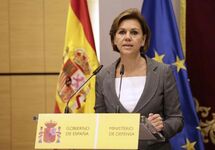
During the ongoing crisis with the catalonia, many provocative messages in social networks come from the territory of Russia. This was stated by the Minister of Defense of Spain Maria Dolores de Cosphedral, reports El Pais.
“The government confirmed the fact that many messages and operations that were seen on social networks come from Russia,” said de cospaceal. “I use the correct expression: from the territory of Russia. This does not mean that we have decided that this is the Russian authorities. Therefore, we must act with particular caution. We must clearly understand their origin. They are partially entered from the territory of Russia, partially from other countries, also outside the EU.”
“This is a serious problem when democracy should withstand the challenges of new technologies,” said the representative of the Spanish government of Yinigo Mendes de Vigo. According to him, the Minister of Foreign Affairs of Spain Alfonso Dastis will raise this question on the next council of the heads of the Ministry of Foreign Affairs of the European Union. The EU should approach the problem very seriously and not allow “foreign forces ... tried to change the constitutional foundations,” de Vigo emphasized.
The purpose of this intervention is an attempt to destabilize the European Union, says the raster of the People’s Party of Spain in the European parliament of Esteban Gonzalez Pons. "And at the moment, the main attention in achieving this goal was given to Catalonia," he said.
On Friday, Dastis also stated that there is “quite well confirmed data” that “Russian networks or hackers are behind actions that are aimed not only in Spain, but to destabilize the EU.”
According to the publication, "fake or distorted news associated with Catalonia and Spain" are published in social networks from Russia and Venezuela. In the bowliness, one of these "news" said that the Balearian islands advocated the independence of Catalonia, and in the other it was reported that the Castilian language stopped teaching in the region’s schools. It is noted that with the continuation of the Catalan crisis, the number of such news only increases.
On Thursday, the US State Department transferred to Congress two reports on Russia's attempts to influence elections in Europe . The first report applies to the media under control and funded by the Russian authorities, as well as affiliated organizations operating both in Russia and beyond. The second refers to "financial resources that were provided or used at the direction of the Government of the Russian Federation or any Russian person in order to influence the outcome of the elections or an election campaign in Europe or Eurasia during the previous year."
On October 31, Facebook, Google and Twitter submitted to the US Congress data on the publication of Russian political advertising. They indicate that Moscow’s intervention in the domestic policy of the United States turned out to be more ambitious than before . At the same time, in all three Internet companies, they concluded that the content was developed and promoted by the "troll factory"-the St. Petersburg "Internet research agency".