
Translated material
A masterpiece from a pilot
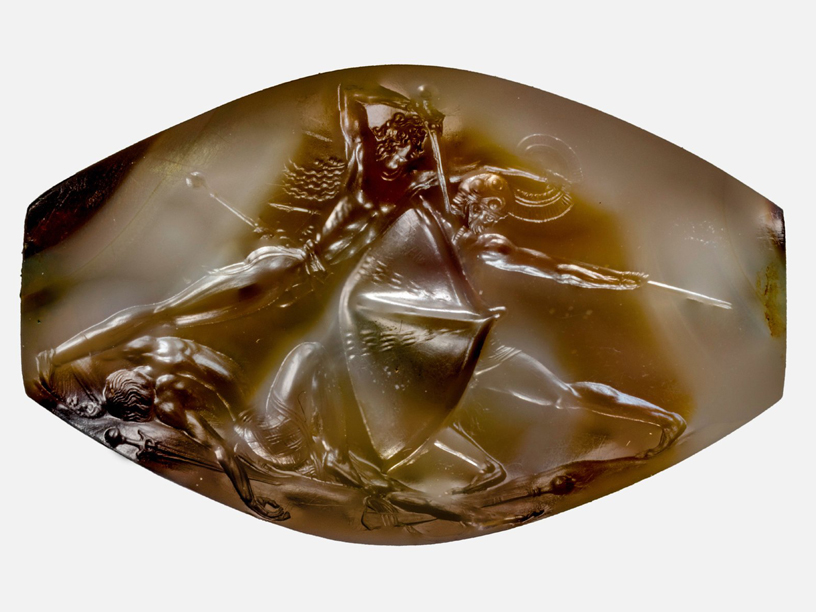
Two years ago, at excavations near the ancient city of Pilos, an intact grave of the Bronze Agewas found with so many burial gifts that it can be safely called the richest, well -known science of this period in Greece. But, as it turned out, in order to appreciate the most outstanding masterpiece from this tomb, the scientist needed a microscope.
The complex of ancient monuments of the Mycenaean era, located near the city of Pilos, is known as the “Palace of Nestor” - named King Pilos, the hero of the poems “Iliad” and “Odyssey”. It was discovered in 1939 by the American archaeologist Carl Blegen . The systematic excavations of this monument are carried out constantly, interrupted only during the Second World War. Over the years, scientists have discovered there a large number of artifacts of the Mycenaean era , fragments of frescoes, acropolis ruins and more than 600 tablets with a linear letter b . It is assumed that the palace was built about 1300 and destroyed around 1180 BC. More information about Minoan and Mycenaean cultures, as well as about genetic studies related to them, can be read in a separate essay .
The archaeologists Jack Davis and Sharon Stoker from the University of Cincinnati, working in the pilos for a quarter of a century, in 2015 discovered a grave of 2.4 and a width of 1.5 meters in an olive grove, in which there were remains of a wooden coffin with a skeleton of a man of 30-35 years old. The burial dates from about 1450 BC. e., that is, it is older than the Pilos palace. The upper part of the burial is almost flush with the surface of the earth, but surprisingly it remained untouched for more than three millennia.
Jack Davis and Sharon Stoker during the excavations of the tomb
Bronze sword with a golden hand
Next to the deceased lay a bronze sword with a handle decorated with gold and ivory, and a dagger with a gold handle. The burial contained numerous jewelry: more than a thousand beads from semiprecious stones, rings, necklace. There were also gold, silver and bronze vessels there (it is interesting that there were no ceramic dishes in the tomb at all), about fifty gemm. It is noteworthy that in the military burial lay a bronze mirror with an ivory handle, as well as six rowers, skillfully carved from ivory. An ivory plate lying between the legs of a man is also interesting. A griffin was cut on it. Thanks to this plate, the ancient monument was called the “tomb of a warrior with a griffin” (Griffin Warrior Tomb). Some objects during the burial lay next to the body, others, apparently, were located on the lid of a wooden coffin and fell down when it was decayed.
Golden necklace
Golden ring with the image of jumping through a bull
Golden ring with palm trees and female figures
One of the six rowers made of ivory
Bronze mirror
Jewelry are made in the style of Minoic civilization, which existed in Crete around 2000 BC. Characteristic of stone carvings on gems. On them you can see easily recognizable images of Cretan goddesses and people who perform jumps through a living bull. James Wright, director of the American school of classical research in Athens, says that he was stunned by the quality of the thread. In his opinion, such products were the products of the best workshops of Crete's palaces. According to scientists, the find once again confirms the assumption of the influence of the Minoic civilization on the Mycenaean.
All finds - more than three thousand objects - were sent to study and restoration in the archaeological city of the choir , closest to the "Palace of Nestor" of the modern settlement. This museum specializes in the artifacts of the ancient pilos. Among the objects entered the museum was a small processed agate, only 3.6 centimeters long, the surface of which was covered with limestone. In the tomb, he lay next to the buried with his right hand. The stone did not attract special attention, and he had to wait long for his turn, while scientists cleaned and investigated larger artifacts.
Carved stone before clearing
But, finally, the scientists got to this find and made sure that in front of them is one of the greatest works of Mycenaean art. On Agatha, the scene of the battle was cut out with amazing skill. Two warriors came together in a mortal battle. One is armed with a sword, the other with a spear and shield. Although the second warrior is better armed, his enemy wins. He is about to inflict a mortal blow with a sword in his neck. Another warrior is already killed, his body and the fallen sword lie under the feet of the fighting. The ancient carrier managed to convey the thin details of the muscles of fighting people. True, in order to fully evaluate his skill, you have to use a microscope. The size of some details of the image does not exceed half a millimeter.
Image on carved stone ( increase )
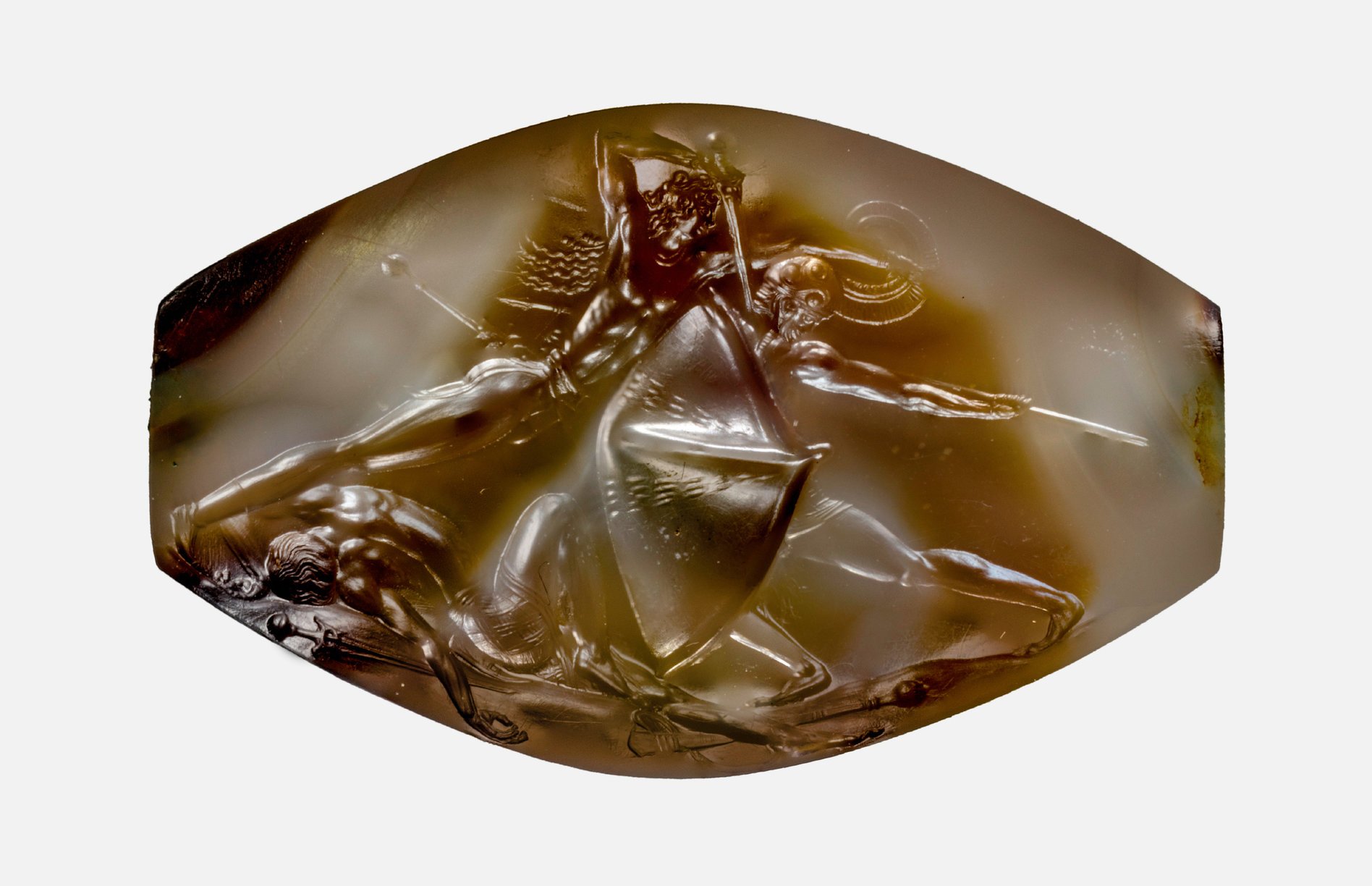
Image drawing ( increase )
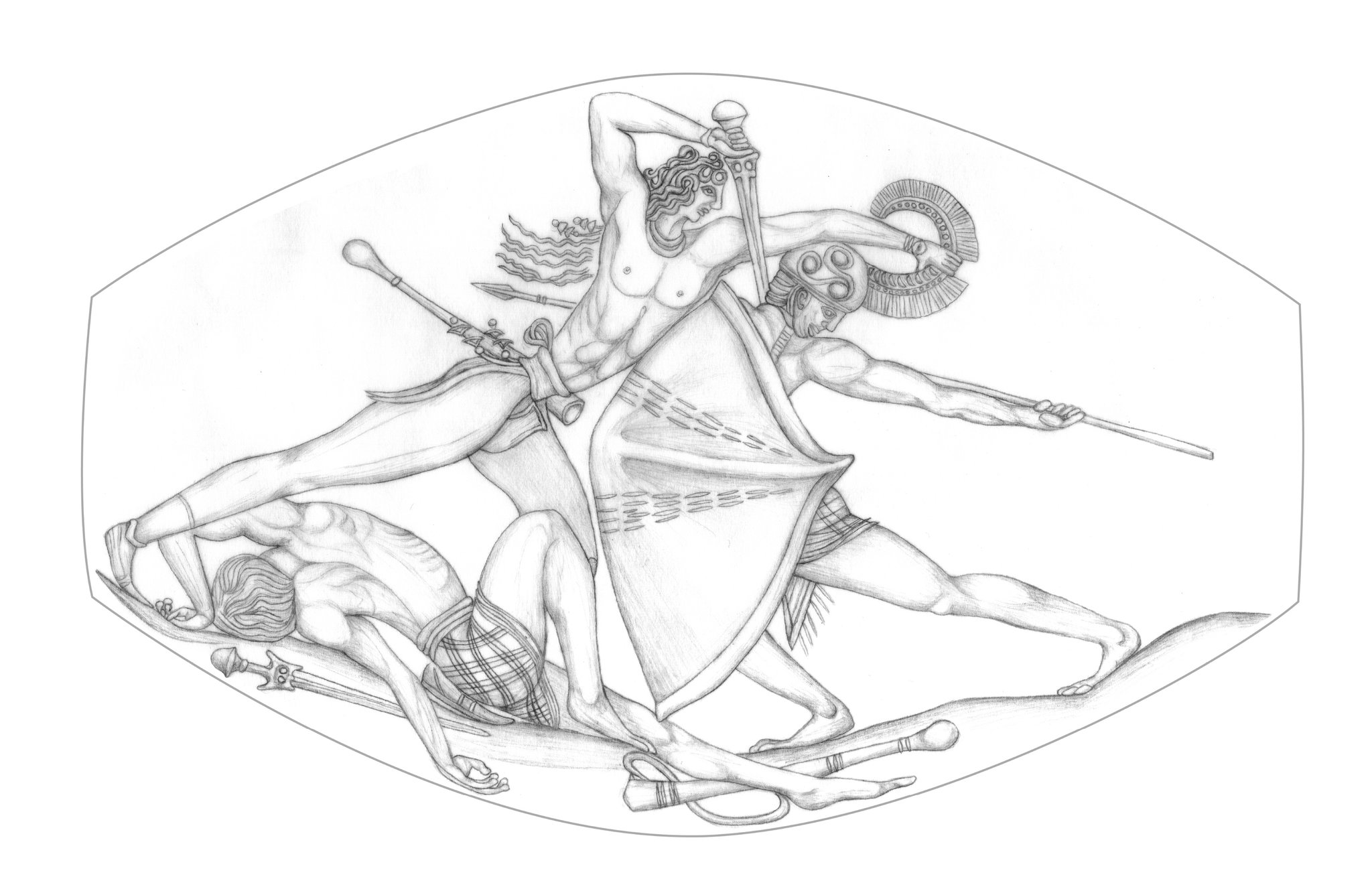
Now the previously inconspicuous pebble went down in history as Pylos Combat Agate. Davis and Stoker call him the most beautiful work in the technique of carving, created in Egeide in the Bronze Age. A similar level of detail in the transfer of the human body was again achieved only in the classical era of Greek art, that is, after a thousand years, Davis believes.
In addition to the discovery of amazing carved agate, the study of other finds from the tomb continues. Professor of physical anthropology Lynne Schepartz from the University of Vincratsrand (South Africa) leads the study of skeletal remains. In particular, person reconstruction experts recreated the appearance of a buried man.
Reconstruction of the appearance of a person from the "Tomb of a warrior with a griffin" on the skull
The Stoker and Davis team created a special site dedicated to the “Tomb of the Warrior with the Griffin”, where you can look at the finds and find out the news about their study. The article by Stoker and Davis about carved agate should be released in the next issue of Hesperia magazine, published by the American school of classical archeology in Athens. Earlier in this edition, an article was already published dedicated to four gold rings found in the “Tomb of the Warrior with the Griffin”.