
Translated material
Limonov, Brexit and “European Regions”
Why Russian television channels seized on the theme of Catalan independence and what a power vertical in the Russian Federation is related to the Russian
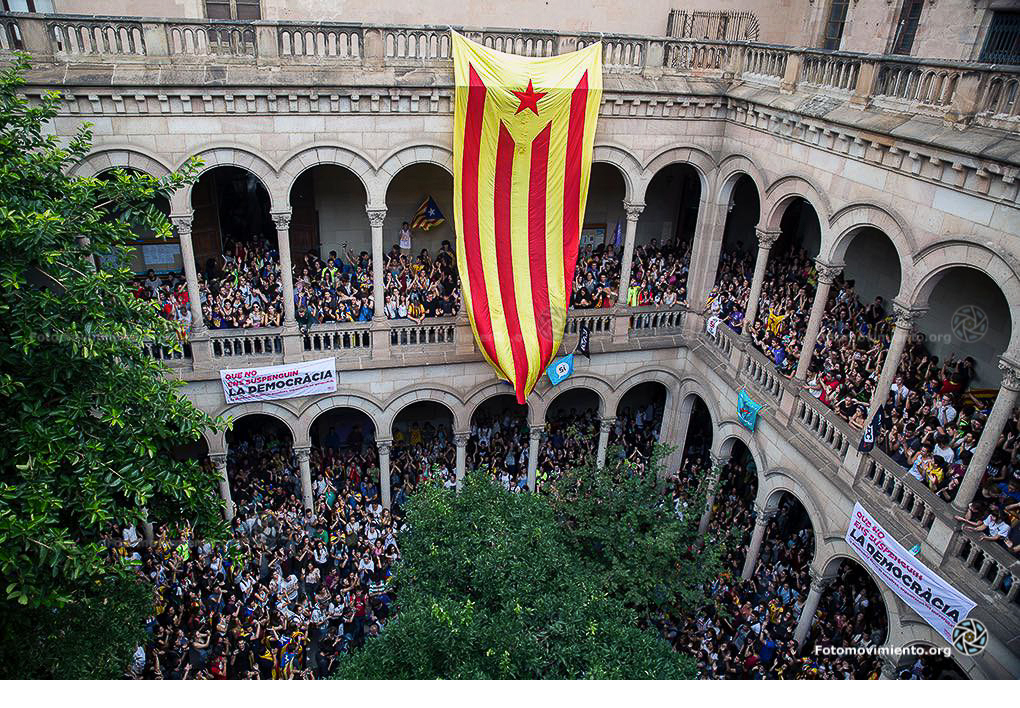
The news of the last weeks from Catalonia - from an attempt to proclaim independence to the dissolution of the parliament, put the direct management from Madrid and the arrest of most of the Catalan government ministers - became one of the mainstream topics in Russia. They were actively commented on television and on social networks, even street pickets with Catalan flags were held in some cities. And although the information wave from the Pyrenee peninsula has calmed down a bit, Catalonia continues to fever: 750 thousand people went to the demonstration in support of the arrested leaders of the Catalan movement for independence in Barcelona last weekend, and people rented buses for a trip to this action throughout autonomy. Undoubtedly, events, in the seemingly distant country, at the other end of Europe, the intrigue itself around Catalan independence, to the real interchange of which is still far away - all this caused and continues to cause a powerful response among Russians.
A hackneyed plate
Immediately after the referendum in Catalonia on October 1, the Russian Foreign Ministry said that he did not recognize him legal and supports the territorial integrity of Spain. However, all other governments stated the same - not a single country in the world recognized the independence of Catalonia.
However, in parallel with this official statement in numerous political talk shows on Russian television channels, the Catalan theme suddenly began to be discussed violently. The Kremlin propagandists (like Sergey Markov) brought their hackneyed record about the "imminent collapse of the European Union." And some even gloatingly stated that Catalonia contributes to this "collapse".
It is difficult to understand an unbiased observer - what could have consisted of interest to the Kremlin if independent Catalonia appeared on the map of Europe? It is unlikely that it could be attached to Russia as Crimea
The method of the “hybrid war” characteristic of Russian propaganda (since the annexation of Crimea and the complication of relations with the West), when the viewer simply gets confused in numerous versions of what is happening and is emotionally suppressed by loud TV presenters. As a result, he has only a general idea that “continuous chaos” reigns in Europe and only Russia is a “island of stability”.
This propaganda forces many, even quite qualified observers, to fall into conspiracyology and suspect that the movement for the independence of Catalonia is not generated by its own internal causes, but organized by the Kremlin. For example, Mikhail Khodorkovsky directly accused the Kremlin of supporting the Catalan separatists. Although it is difficult to understand an unbiased observer - what could have consisted of interest to the Kremlin if independent Catalonia appeared on the map of Europe? It is unlikely that it could be attached to Russia as Crimea.
Only South Ossetia intended to recognize the independence of Catalonia-but the case was limited to the statement of her Foreign Ministry, that they are “ready to consider this issue”. Apparently, the authorities of this republic, entirely dependent on the Kremlin, did not receive the go -ahead from Moscow, which clearly demonstrated the fictitiousness of their “independence”.
The suspicions of the conspiracy therapists in the fact that Catalan independence was “beneficial to the Kremlin”, tried to justify Edward Limonov. He spoke frankly: “The main thing is that our Russia does not crumble with you. And let European states scatter. ”
But here both Limonov and those who adhere to a similar point of view fall into the trap of archaic-imperial ideas about separatism. They consider it a tool for the "collapse" of some world competitors in Russia. Meanwhile, in the case of catalonia, this approach does not work at all. Supporters of Catalan independence, by the way, do not call themselves “separatists” at all - they are emphasized supporters of the unity of the European Union, but they advocate only for its reformatting in the interests of small countries, and not former empires.
And by the way, why can't Catalonia be an independent European country? Its name itself appeared on European maps back in the XII century - 400 years earlier than Spain. The dispute of the Catalans with the castilers (residents of the Central Region of Spain) goes into a distant history - the idea that the movement for Catalan independence is “organized from Moscow”, the absurdities themselves are given to ignorance. The Catalan writer Francesk Series responds to such arguments ironically: "The earth does not spin around Russia!"
On the contrary, it is useful to consider Catalan events not from a conspiracy point of view (whether the Kremlin is the Kremlin or not?), But to compare them with the capabilities and prospects of regionalism in Russia itself. An example of this approach was shown by the veteran of world politics Mikhail Gorbachev. At the October Presentation of his new book, he was asked the actual question about Catalonia, to which Mikhail Sergeyevich answered: “We have a lot of our catalonies” ...
From Ingria to Barcelona
Journalist and sociologist Igor Yakovenko in his article “Russia in the Mirror of Catalonia” drew attention to the contrast between European regionalism and Russian unitaryness: “Regional movements and parties are in almost all countries of Europe. And everywhere they act legally, in many countries they are represented in parliaments and in the executive authorities. And in the Russian Federation (!) The very idea of federalism is declared a crime and is quite officially qualified as extremism. ”
Indeed, there are already more than a dozen examples when Russian courts initiated criminal cases against residents of different regions (Tatarstan, Karelia, Krasnodar Territory) only because they required only an increase in regional self -government. But even this requirement in today's Russia is considered “separatist”, and those who express it may be subjected to judicial persecution.
Regional parties in the Russian Federation are prohibited, they have no right to be elected to local parliaments. Movements for regional self -government are informal. One of them in Russia is Ingermanland.
Ingermanlanders bring closer to the Catalans what they believe: most of the power in modern Europe should not be focused in the capitals of large countries, but in the regions themselves
Ingermanland (Ingria) is a historical region in the region of the current St. Petersburg. By the way, its first name, after Peter the New Capital, was precisely the "Ingermanland province." From the point of view of the current Ingermanland regionalists, the name "Leningrad region" in the absence of a toponym "Leningrad" looks ridiculous and archaic. They offer to return its original name to the region and achieve its republican status in the Russian Federation. In general, it can be noted that the Ingermanland movement unites those Petersburgers who value the specifics of their region above the "general -imperial" patriotism. Ingermanlanders with their flag are actively involved in St. Petersburg opposition shares*.
* On May 27, 2016 in St. Petersburg, the Investigative Committee opened a criminal case for extremism against 36-year-old Artem Chebotarev, administrator of the Free Ingria group on VKontakte-for a single commentary on the social network. The detention of Chebotarev was carried out with exemplary cruelty.
And during the referendum in Catalonia, representatives of this movement arranged a picket near the Spanish consulate with a poster: “From Ingria to Barcelona - Europe of the regions!” The Ingermanlanders bring closer to the Catalans what they believe that most powerful powers in modern Europe should be focused not in the capitals of large countries, but in the regions themselves. Politicians from “large” capitals, for their part, often criticize regionalism - in their opinion, it is fraught with “destabilization”.
The regionalists have an answer to this: various regions and small countries of Europe are not interested in destabilization, but on the contrary - in active cooperation throughout European space. The EU is not destroyed by the regions, but by former empires, as everyone observed in the case of Brexit.
The European Union simply must fulfill its own charts (for example, about local self -government), which give the regions with high powers and thereby bring power closer to citizens, make it more transparent. By the way, Russia also signed this charter back in 1996. However, the subsequent construction of the “vertical of power” practically canceled its execution in the Russian Federation.
Freedom of history
Already after the referendum in Catalonia, the residents of the two regions of Italy - Lombardy and Veneto - spoke out to increase the autonomy of their regions. But if you see not in this the desire of their own citizens, but the “hand of Moscow” - so close to paranoia ...
To reduce all world events and changes to the search for someone’s “secret conspiracies” means to deny the freedom of history. At one time, the fall of the Berlin wall could also be called “destabilization” - but it opened a new page in the history of Europe.
In Russia, despite the fact that it is customary to criticize Europe, you can observe almost the same, mirror, logic: those who require real federalism are also accused of “destabilization” and even “extremism”
In October 2017, Catalonia did not become an independent country. However, very soon, in December, new regional elections will take place there, and quite possibly, proponents of independence will defeat them again. And what will Madrid do? Again send policemen with rubber batons to Barcelona?
Obviously, a reform has come in the EU, which would significantly increase the rights of the regions. And some of these regions could become new independent countries - but within the framework of the same European Union, when there are no borders between them anyway.
However, judging by the reaction to the Catalan events, many “Euroborlars” do not like this prospect - they are scared by a possible increase in the number of political entities in Europe, and they are “destabilized” behind this. Meanwhile, historical development always involves complication. And in general, it would be useful to recall that most modern European states were created by those who were called “separatists” at one time.
It is interesting that in Russia, despite the fact that it is customary to criticize Europe, you can observe almost the same, mirror, logic: those who require real federalism are also accused of “destabilization” and even “extremism”.
It turns out that between the builders of the Russian power vertical and politicians from the "large" European states are much more common than both both of them may seem.
Read also: