
Translated material
The cemetery of outdated technologies
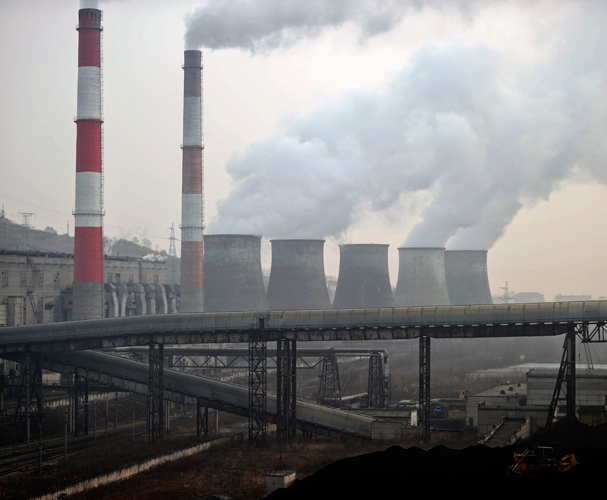
The text continues the project on the Ecology "Variable" .
The Climate Action Tracker rating, published on the eve of the UN Climate Conference in Bonn, evaluates the climate policy of Russia as “extremely insufficient” - here we are in the same group, for example, with the USA, Ukraine and Saudi Arabia. There are every reason for such assessments: Russia declares outwardly ambitious plans, from which it actually follows that we are not even going to reduce the current level of greenhouse gas emissions.
Now the Russian Federation promises to reduce emissions by 25-30% until 2030 compared to 1990, from which the countdown is conducted. But the trick is that after a sharp collapse of industrial production in the early 90s and subsequent changes in the structure of the economy and technology, we did not overcome the threshold of 70% of the level reached at the end of the Soviet era. That is, in fact, this goal, designated several years ago, we have already successfully achieved, or even exceeded this plan.
Russia is one of the few countries of the world that has not yet ratified the Paris Agreement: here we are also in the company of Saudi Arabia, as well as Turkey, Iran and Iraq. Only in December of this year, the special working group of the Ministry of Economic Development should submit a report with an assessment of the influence of the agreement on the Russian economy. Even if the conclusions of this report are favorable (what is the reason to hope for), we must admit: Russia still tries on the reality in which it needs to seriously make efforts to reduce greenhouse gas emissions. We still choose whether it will be convenient for us in this new dress.
The problem, however, is that this choice is apparent. Whether Russia wishes or not, but the Paris Agreement - the rules by which the world will live - has already entered into force. Back in 2015, the capacity of new power plants entered into the system based on renewable energy sources (VIE) twice the power of the generation on fossil fuel launched during the same time. These and other technological changes also demonstrate that the future will come regardless of whether Russia will join the climatic agreement or not.
Plans for the future
What will it be? The authors of a joint report prepared by the Higher School of Economics and the Massachusetts Institute of Technology are trying to answer this question. His presentation took place on November 13 in the Higher School. The report “Russia in the post-Paris world: the new energy landscape shows that with the current energy and climate policy (more precisely, with its absence in at least some consistent form), if we can fit into this landscape, then over time it will occupy an increasingly unsightly place in it.
There will be no immediate unpleasant consequences - in any case, on a noticeably tangible scale. Moreover, under some conditions, Russia will even benefit from the development of events. However, as the calculations of the authors of the report show, such evasion of active choice in the energy strategy will start Russia into an ever -deeper and more hopeless impasse.
Scientists worked with the Emissions Prediction and Policy Analysis (EPPA) , developed at the Massachusetts Technological Institute. This model is designed to calculate the emission of greenhouse gases by the global economy, depending on key development factors. As explained by one of the compilers of the report, Sergei Palov, who presented the American side at the presentation, the compilers laid several scenarios of the alleged future. One of them involves the “everything as usual” model, Business as Usual , that is, the development of the global economy in full ignoring the countries of the world of their Parisian obligations, while others involve a different degree of accounting for these obligations.
The choice is this apparent. Whether Russia wishes or not, but the Paris Agreement - the rules by which the world will live - has already entered into force.
So, in one case it is assumed that countries will follow only those obligations to reduce emissions until 2030, which they have already taken when signing the agreement, are no more. According to the general opinion of experts, with such volumes of a decrease, it is impossible to achieve the official goal of the Paris Agreement (prevent the growth of global average land temperature by more than two degrees compared to the pre -industrial period until 2100). Therefore, another scenario is considered, when countries nevertheless solve the game seriously and take measures to achieve these goals. At the same time, a separate scenario considers the situation in which the goals of holding the temperature at the level of two degrees Celsius are trying to achieve all countries except Russia, which refuses any obligations. And, finally, in another scenario, all countries, including Russia, are taxed by fossil fuel from 1% to 3% and direct the proceeds to the formation and development of the services sector.
According to Sergei Poltsev, almost all of these scenarios are hypothetical and not quite likely. So, taking into account how quickly the Paris Agreement entered into force and how many countries signed it, the Business As Usual script looks like a tribute to the previous fears. Few people think that countries will not increase their obligations. But in the same way, few expect that such an increase will be sufficient to achieve the “goal of two degrees”. The full refusal of Russia from the Paris Agreement is also not quite realistic. But still, working with such scenarios is useful in order to consider how, in various conditions, the emissions of greenhouse gases will grow or decline. In addition, the model shows different options for the formation of demand for fossil fuel from Russia: after all, if the country does not deal closely by reforming its economy, then its export income will still be largely dependent on the oil, gas extracted from the earth and (to a certain degree) coal.
At first glance, calculations conducted are not a reason for completely bitter pessimism. In particular, Russia in almost all development scenarios does not come out in the foreseeable future higher than the ceiling of emissions established by the Paris Agreement (that is, not more than 75% of the 1990 level). Even if the Russian Federation announces that she does not need an agreement, and participation in his preparation and signing was not a binding hobby, then in this case, Russia will break through the emissions ceiling only in the mid-2040s.
However, the demand for export fossil fuel will depend much on the desire or refusal of Russia to comply with the Paris Agreement, which has already entered into force and will begin to operate in 2020. Here, world economic trends will play a role. And, judging by the calculations of the model, they will be quite contradictory for Russia.
In the middle of the flowing gas
First of all, with almost a complete guarantee, Russia may not hope to increase coal exports. Even if the restrictions on emissions under the Paris Agreement will not grow, by 2030 we will find a reduction in coal export almost doubled. And scenarios of more strict obligations are even more significantly limited by export.
However, coal is not the main type of fossil fuel supplied by Russia to the external market. Natural gas, which in this sense is much large, is not in the zone of increased risk. In any case, subject to the current obligations under the Paris Agreement, gas exports from Russia should grow steadily until 2050 (the calculations set their scenarios to this depth). However, if countries still want to achieve the main goal of the agreement, then after the growth of exports of Russian gas until 2030, a noticeable decline will follow - about 25% by 2050.
In other words, in this case, measures to replace coal sources of generation with gas (more “clean” from the point of view of greenhouse gas emissions) will not be enough and the gas TPP will have to prefer installations based on renewable power plants. So even if you take into account that this scenario does not seem too likely, any strengthening of the obligations of the countries undermines, it would seem, the cloudless prospects of Russian gas exports. And the Paris Agreement provides for the mechanism of regular reassessment of obligations - and only towards their tightening.
Our carbon is heavy
Associate Professor of the HSE world Economy Department Igor Makarov, in his part of the report, considered the hypothetical consequences of Russia's complete refusal to fulfill obligations under the Paris Agreement if the rest of the countries of the world continues to comply with it. Even if someone from a major Russian business likes such a scenario, its risks are much higher than the possible relief from the reset of the “burden” of Paris.
This is primarily due to the fact that the main products of Russian exports (even in addition to oil and gas) are extremely carbon -intensive. This means that their production requires large emissions of greenhouse gases, and this situation can not always be corrected even when switching to new technologies. The next most important article of Russian exports after hydrocarbons are metals, the fourth place is occupied by the products of the chemical industry - these production in the foreseeable future will remain associated with large emissions.
It turns out that Russia ignores precisely those technological areas that should become drivers of changing the entire technological landscape of the country.
Makarov cited 2011 data, according to which Russian exports in terms of one dollar of export income to a ton of CO2 , thrown into the atmosphere in the production of goods, are the most carbon in the world. According to this ratio, he is even ahead of China.
If the Russian Federation, at the same time, refuses the obligations under the Paris Agreement, special carbon duties will be introduced against our goods with a high probability (that is, a barrier that prevents the goods from a country that does not comply with the norms to reduce emissions). All these factors together, apparently, will not ruin Russia, will not deprive it of all export income, but with a huge degree of probability they will leave it in yesterday, turning the country, according to Makarov, into a cemetery of obsolete technology.
The conclusions of Makarov and his colleagues look quite justified. Despite our “goals” (which we, as you remember, have already achieved), Russia does not finanize in increasing the energy efficiency of the economy, there is no strategy for the development of production and use of electric vehicles, and the long -standing goals for the development of renewables are already modest, reduced even more (by 2020 only 2.5% of electricity with old landmarks of 4.5% should be obtained).
It turns out that Russia ignores precisely those technological areas that should become drivers of reducing emissions and changing the entire country's technological landscape. Under these conditions, the tips of the authors of the report - to diversify the economy or try to tax the production of hydrocarbons for priority investments in education - look prudent reasoning without any hope for implementing life.