
Translated material
The case of the "revolution" -2017
In Russia, an unprecedented process is being prepared about political terrorism. In the case, comparable to the swamp, more than 15 activists from different regions are already held
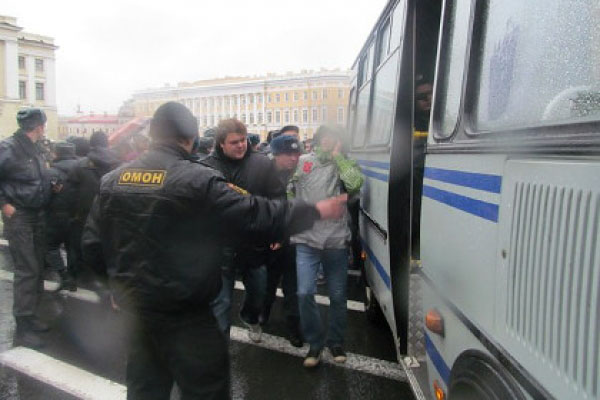
Photo: b-port.com
“Revolution of November 5”, announced by the Saratov oppositionist and video blogger Vyacheslav Maltsev, never took place, but turned into a series of criminal cases and arrests throughout Russia. According to the press service of the Investigative Committee (TFR), in connection with the events of November 5, “a number of criminal cases” under Art. 212 h. 3 of the Criminal Code (calls to riots), Art. 205.2 h. 2 of the Criminal Code (calls for terrorism) and Art. 318 h. 1 of the Criminal Code (the application of violence in relation to a representative of the authorities). As NT found out, under the investigation were not only supporters of political emigrant Maltsev, but also those who have nothing to do with him.
Schoolchildren and "ABC of terrorism"*
According to the agency, on November 5, on the day of the action, more than 350 people were detained in Moscow, including minors. In the TFR, they argue that they all violated public order. However, some, according to the students themselves, were delayed simply because they were on Tverskaya at unnecessary time.
Among the others, participants in the Lectures of Adam Smith, who took place in the Higher School of Economics in Maly Gnezdnikovsky Lane, were detained on Tverskaya. During the break, they went out to eat to the nearest McDonald's, but they could not eat and return to classes. The police detained the entire group (about twenty people) and delivered to the police department.
The SK report says that all the detainees were questioned as witnesses, but it is not specified in which criminal case. As one of the detainees said on his Facebook, the blogger Mikhail Svetov, participants in the “Readings of Adam Smith” on the day of detention were interrogated as witnesses in the case of public calls for terrorism and riots.
Minor listeners were also questioned. On the day of the detention, they were released without drawing up the protocol, but later they were sent a summons demanding that they appear for interrogation in the Khoroshevsky investigative department of the UK as witnesses in the case of calls for mass riots (Article 212 h. 3) and on calls for terrorism or its acquittal with the help of the Internet (Article 20.2 h. 2 of the Criminal Code), the father of a 15-year-old student told NT, said NT, found out among the detainees.
During the interrogation (NT has a copy of the interrogation protocol), in particular, they asked if they use social networks, whether they know the video “Revolutionary/Revolution Memo” (a video with that name was posted on YouTube on November 1) and the Telegram channel “5/11/17”.
At the interrogations of schoolchildren, they asked about “artillery” **, the purposes of its creation, about Maltsev, about the co -chair of the nationalist party Ivan Beletsky and how they understand the revolution for themselves
During the interrogation, the investigator also asked whether they knew something about the public movement “Artillery” **, the purposes of its creation, about Maltsev, about the co-chair of the nationalist party Ivan Beletsky and how they understand the revolution. The investigator was also interested in whether they know the book “Russian cuisine. ABC of home terrorism "*. The day after the interrogation home, where the family of the interlocutor NT lives, they called from the educational institution and said that a request from the ATS received a request from the child’s characteristics.
Hay arsonists
On the Maltsev himself, who emigrated from Russia after the events of November 5 , the FSB started a new criminal case on the organization of the terrorist community (Article 205 of Part 1 of the Criminal Code), the source of the Mediazone, familiar with the course of the investigation, told on November 10.
According to him, still five people - Alexandra Svishchev, Yuri Korny, Andrei Kepty, Nadezhda Petrov and Andrei Tolkachev - have started a case of participation in the terrorist community (Article 205.4 part 2 of the Criminal Code). Tolkachev was also suspected of preparing a terrorist attack by a group of persons (Article 30 of Part 1, Article 205 of Part 2 of P. "A" of the Criminal Code).
According to investigators, the defendants of the case are members of the Art Podbodovka organization ** - organized a community for the purpose of performing terrorist attacks. Petrova and Svishchev Maltsev instructed to plan terrorist attacks, and the rest of the defendants in the case and unidentified persons - they were approved by the FSB.
Maltsev’s lawyer Igor Elifkhanov told NT that he knew nothing about the new case regarding his client. According to him, only the case of calls for extremism was initiated in relation to Maltsev (Article 208 of Part 1 of the Criminal Code). In the summer, after it became known about the initiation of the case, the opposition left Russia.
Ilnur Sharapov, Korny's Lawyer, also told NT that he did not know about the new criminal case against his client. According to him, Korro is a defendant in the case of preparation for a preliminary conspiracy or an organized group (Article 30 of part 1, Article 205, part 2 of paragraph “a” of the Criminal Code).
“He is accused of allegedly going to set fire to the remnants of hay on Manezhnaya Square. He was detained at McDonald's when he led a direct report on his YouTube channel "
Koroni and another activist, Andrei Kepty, was detained on Manezhnaya Square on October 12 - that is, long before the failed “revolution”. The court appointed them an administrative arrest for resistance to the police (Article 19.3 of the Code of Administrative Offenses), but later they had a criminal case. On October 27, the philistine court of Moscow arrested them until December 23.
As NT Sharapov said, his client does not admit his guilt, and also does not consider himself a supporter of Maltsev. “He is accused of allegedly going to set fire to the remnants of hay on Manezhnaya Square. He was detained in McDonald's when he led a direct report. He has his own channel on YouTube, and during this report, he was detained for the channel, ”the lawyer explained.
Fire by headquarters
Elifkhanov also said that he filed an appeal to the Supreme Court for the decision of the Krasnoyarsk Regional Court, which recognized the movement “artillery and training” on October 26 ** an extremist organization and banned its activities in Russia. Elifkhanov writes in the appeal that the “Art -preparation” movement ** does not exist at all. “This is just the name of the YouTube channel, which is leading Maltsev,” Elifkhanov explained NT.
According to the FSB, “artillery” ** is “an unregistered interregional public movement and the Internet project of the same name”, which were created by Maltsev “in order to organize“ revolution ”in Russia. The FSB reported on the activities of the artillery cells “Arthopods” on November 3. According to the special services, its employees, together with the police, stopped the activities of the artillery cells “Art Podgotovka” ** in Krasnoyarsk, Krasnodar, Kazan and Saratov.
Judging by the chronicle of arrests, the courts are still inclined to trust the version of the FSB.
In Kazan on November 1, the court arrested the supporter of Maltsev Oleg Detkin, writes Idel. Ralia. He is suspected of Art. 282 h. 2 p. "B" of the Criminal Code (excitement of hatred or enmity with an organized group).
Elifkhanov’s lawyer writes in the appellation that the “Art -preparation” movement ** does not exist at all. “This is just the name of the YouTube channel, which leads Maltsev,” Elifkhanov explained NT
On October 30, the Railway District Court of Krasnoyarsk arrested the supporter of Maltsev Roman Maryana on suspicion of preparation to participate in the riots (Article 30 of Part 2 of the Criminal Code). As his lawyer Alexei Kostin told Mediazone, Maryan had not yet been charged, but he already pleaded guilty.
On November 3, the same court arrested another supporter of Maltsev, Alexander Zaitsev, on suspicion of tending to organize riots (Article 212 of paragraph 1.1 of the Criminal Code). According to the decision on the initiation of a criminal case, which was published in his Telegram channel, the chairman of the Agora human rights group Pavel Chikov, Zaitsev was the head of the Krasnoyarsk branch of Arthotovka ** and sent a letter to Maryan and another activist, “containing information about the“ artillery ”planned by the supporters of the armed uprising on 11/5/2017. Moscow ”, as well as calls to take part in it.
In Saratov, one of the detainees, Sergey Ryzhov, was arrested on November 3 on suspicion of preparation for a terrorist attack. According to NT by Igor Elifkhanov, Ryzhov’s lawyer, his client “was detained on November 1 by a friend in the apartment. During the examination, they found bottles of benzene and a TNT saber. He claims that he was thrown to him all this. He does not admit his guilt. "
On November 9, the Free News Agency reported that Fedor Martynov, the owner of the apartment in which Ryzhov was detained, was also arrested by the court. He is suspected of illegal production of explosives (Article 223.1 of the Criminal Code).
On November 9, the court in Novosibirsk arrested the applicant of the “Russian march” in the city, 39-year-old Vyacheslav Dobrynin, writes Taiga.info. He is suspected of calling for mass riots and attempted participation in them (Article 212 of Part 3 and Article 30 of Part 1, Article 212 of Part 2 of the Criminal Code). According to investigators, he was a member of the “prohibited movement of the nationalist orientation“ Artillery ”** and published calls for riots in Novosibirsk on November 4–5 in an unnamed messenger.
Calls in Telegram
On November 7, the Central District Court of Kaliningrad arrested the 35-year-old taxi driver Alexander Petrovsky. He was detained on November 5 on suspicion of calling for terrorism (Article 205.2 h. 2 of the Criminal Code). Employees of the Center for Combating Extremism of the Regional Administration of the Ministry of Internal Affairs, as well as employees of the regional department of the FSB, took part in his detention. The case is investigated by the investigative department of the regional department of special services.
According to investigators, Petrovsky posted messages with calls for terrorism in the Chat “Revolution-Kaliningrad” in Telegram. As NT explained by Petrovsky’s lawyer Rostislav Kulikov, we are talking about voice messages with the calls to “advance to the barricades” and the mention of “Molotov cocktails”. At the same time, Kulikov believes, Petrovsky’s quotes were torn from context.
“He is accused of placing voice messages that allegedly contain calls for terrorism. Applying about the arrest, the investigator noted that Petrovsky called for the police to be thrown by the “Molotov cocktails”. I asked the investigator what Molotov’s cocktail was, but he said that he could not answer this question, ”says Kulikov.
The accused himself claims to be posted in the chat of messages, but he did not make any calls for terrorism. “He said that it is necessary to gather peacefully and without weapons. But he wrote that he was afraid of inadequate actions by the authorities and that in this case it is necessary to repulse the police officers, ”the lawyer says. According to Kulikov, his client became a victim of a provocation.
Plus "Free Ingria"
The most high -profile detention in St. Petersburg occurred at about two o’clock in the afternoon - on Kirochny Street, near its car, Mikhail Voitenkov member with activist Ildar (Ilyas) Minikaev, known under the pseudonym Valdis, and activist of the anti -war committee Diana Retinskaya, were detained near its car. All three, according to them, walked peacefully towards Smolny and vice versa, and upon returning, they saw the employees of the EP department in overalls and helmets near the car.
The employees searched the car, did not find anything suspicious in it and demanded to drive with them to the 78th police department to draw up a protocol. We went there, according to Mikhail Voitenkov, on two cars - on his own, in which an employee of the ED department, and at service, rode along with Voitenkov.
The department began to draw up a protocol, but after a while Mikhail was asked to go outside and open the car that he did calmly. In the presence of witnesses, the police searched the car and “unexpectedly discovered” a grenade and a revolver under the driver's seat. All three - Voitenkov, Minikaev and Retinskaya - claim that weapons were thrown by him. Lawyer Valentin Pyshkin, representing the interests of Minikaev, said that a case of weapons by a group of persons was initiated in relation to his client and others (Article 35 of Part 1, Article 222 of Part 2 of the Criminal Code).
According to Mikhail Lebedev, a volunteer of the “Assistance Group for detainees”, these accusations look very strange: “It turns out that the police are charging to a group of persons, but cannot prove the conspiracy. As a result, it is not very clear what this unexpected weapon has to do with all three. ”
After spending two days in the IVS, all three - Voitenkov, Minikaev and Retinskaya - were released home on a recognizance not to leave.
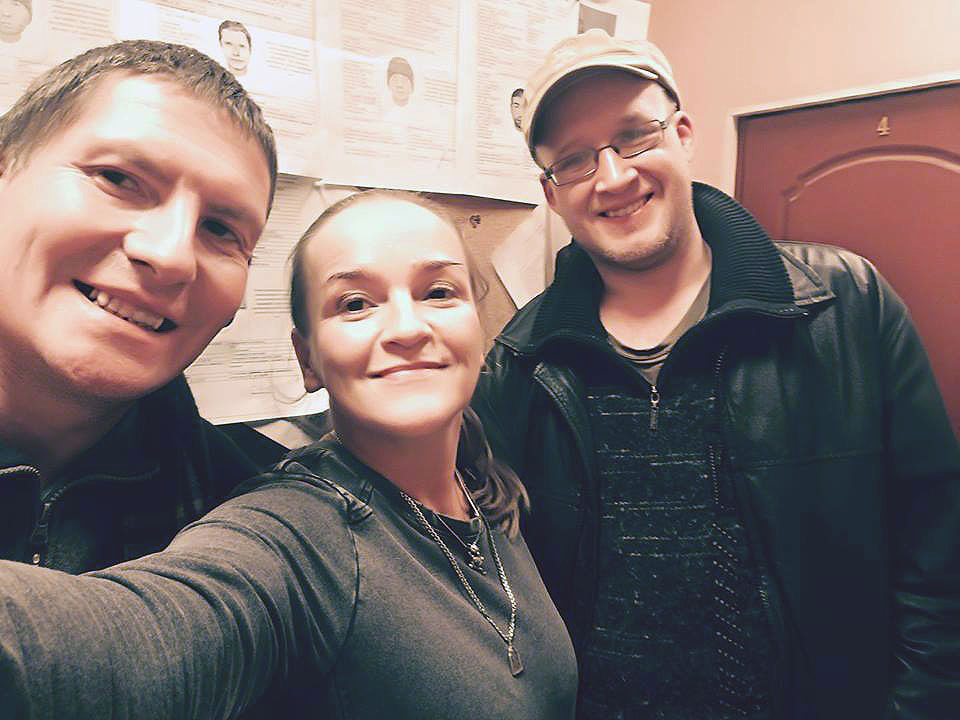
Mikhail Voitenkov, Ildar Minikaev and Diana Retinskaya after leaving the insulator. Photo: Facebook
Romek "Swamp business"
In the SKR report on the progress of the investigation of criminal cases related to the events of November 5, it is noted that "Russian law enforcement agencies are always ready for such criminal manifestations and have experience with opposition to them," and "such criminal cases have already been investigated."
The case, comparable to the current in geographical coverage and the number of people under investigation, was so far only the “swamp”, excited after the protest on Bolotnaya Square in Moscow on May 6, 2012, said Vladimir Zherebenkov, chairman of the Presidium of the Interregional Bar of Law and Man. And it recalls that the demonstration on Bolotnaya ended with clashes of protesters with the police.
May 6 events ended in a criminal case, whose defendants have already become more than 30 people. Within two months after the action, 10 people were arrested on Bolotnaya Square, by the end of October their number increased to 12. In early 2013, a new wave of arrests in the “Swamp case” began, its investigation continues to this day.
The security forces “found a hand” in the suppression of mass inconsistent shares and began to apply more stringent measures. They became more liberated than before
Most of the defendants were accused of participating in the riots (Article 212 of Part 2 of the Criminal Code), some also charged the use of violence against a representative of the authorities (Article 318 of Part 1 of the Criminal Code). None of the defendants in the “swamp business” was justified, the majority received the real terms of imprisonment - from 2.5 to 4.5 years.
According to Gerebenkov, five years after the “swamp business”, the security forces “found a hand” in the suppression of mass inconsistent shares, but they began to use more stringent measures. “They became more liberated than before. If earlier they corded her around the perimeter to disperse, now they simply decide something, take someone away, bring it to administrative or criminal liability, ”says the interlocutor NT.
The director of the Institute of Globalization and Social movements, Boris Kagarlitsky, believes that the security forces act not autonomously, but at the direction of the authorities. “I do not think that the security forces themselves like this whole situation. But some are planted, and completely different people make decisions, ”says Kagarlitsky. According to him, the authorities are now intimidated, but - not opposition and protests: lower -level officials are intimidated by middle -level officials, and those, in turn, were intimidated by higher level officials. “They all intimidate each other and are afraid that they will be punished for a lack of vigilance,” the political scientist suggested. As a result, according to him, "officials themselves plunge into hysteria, retraining these signals, and this trend will increase."
* “Russian cuisine. The alphabet of home terrorism ” - a book about the artisanal production of explosives and incendiary mixtures, is included in the federal list of extremist materials by a court decision in Novokuznetsk in 2009.
** “Artillery” - a movement banned in Russia as an extremist.