
Translated material
Apocalypse option
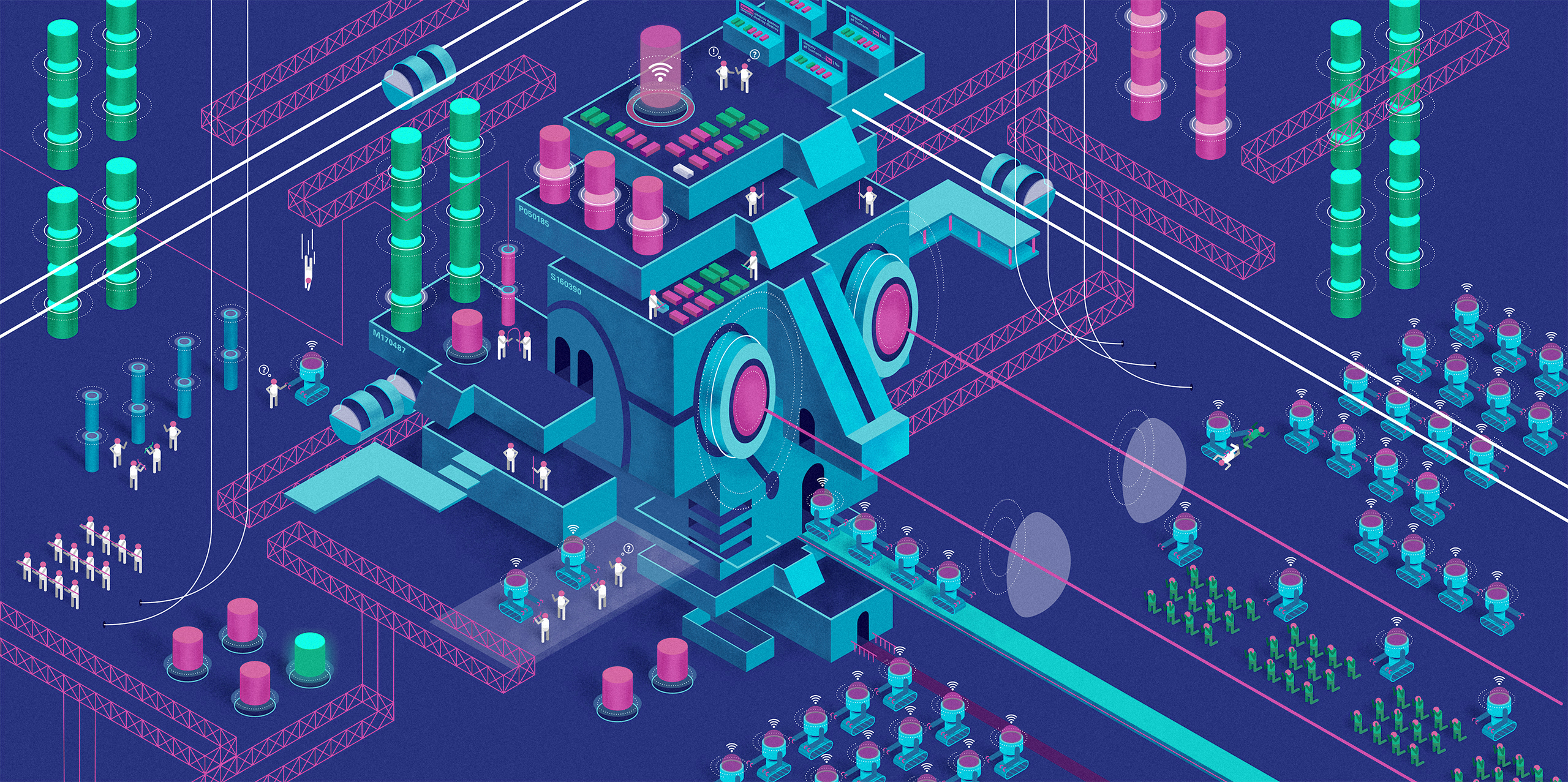
What will happen if artificial intelligence of the superhuman level decides to make humanity happy?
The successful creation of artificial intelligence will be the biggest event in the history of mankind. Unfortunately, it may be the last if we do not learn how to avoid risks.
Stephen Hawking
So far, people do not see robots who kill people on the streets, they do not know how to react, because such a scenario seems unrealistic.
Ilon Musk
What do you feel when they tell you that artificial intelligence will soon get out of control, enslave or destroy humanity? Personally, I recall awkward humanoid machines, with difficulty trying to put the box on the shelf, and it becomes funny to me. After a second, I recall that artificial intelligence is not a humanoid machine, but a program that works, most likely, through the Internet and potentially capable of controlling the world economy, politics and the media, and I have a new thought: and let it! Perhaps the silicon mind will better manage to put things in order in the world than stupid biochemical politicians who strive to steal more until they were driven away from the feeder. In the end, even if artificial intellects replace humanity, is it not a duty of parents - to give way to children, especially if children are smarter, more talented and better than their parents?
We humanize him
Unfortunately, both the same logic contains the same error. Almost all people do it when they think about AI. They humanize artificial intelligence. People do not know any creatures with high intelligence, except for people, and therefore it is difficult for them to think of other intellectuals. And it is difficult to imagine intelligence smarter, for example, Einstein.
When we try to imagine the AI of the superhuman level, we still get a person, albeit who can quickly solve problems in mathematics or invent new physical theories. Take the classic example of the "matrix". Agent Smith is a program, in fact, an antivirus, the task of which is to remove people from the system of people's control. Nevertheless, interrogating the Morpheus, he paints him with his disgust in relation to humanity, and even reinforces his expression of feelings with facial expressions, gestures and a tone of voice. Why? Why is an antivirus a code that describes feelings? Who programmed subprocesses into it, allowing to simulate facial expressions, gestures, intonation? And most importantly - for what?
The authors of the film imagined interrogation, and they got a creature with human emotions and motivation. But AI can be similar to the type of thinking to a person even less than a person looks like a colony of ants. So what will he look like?
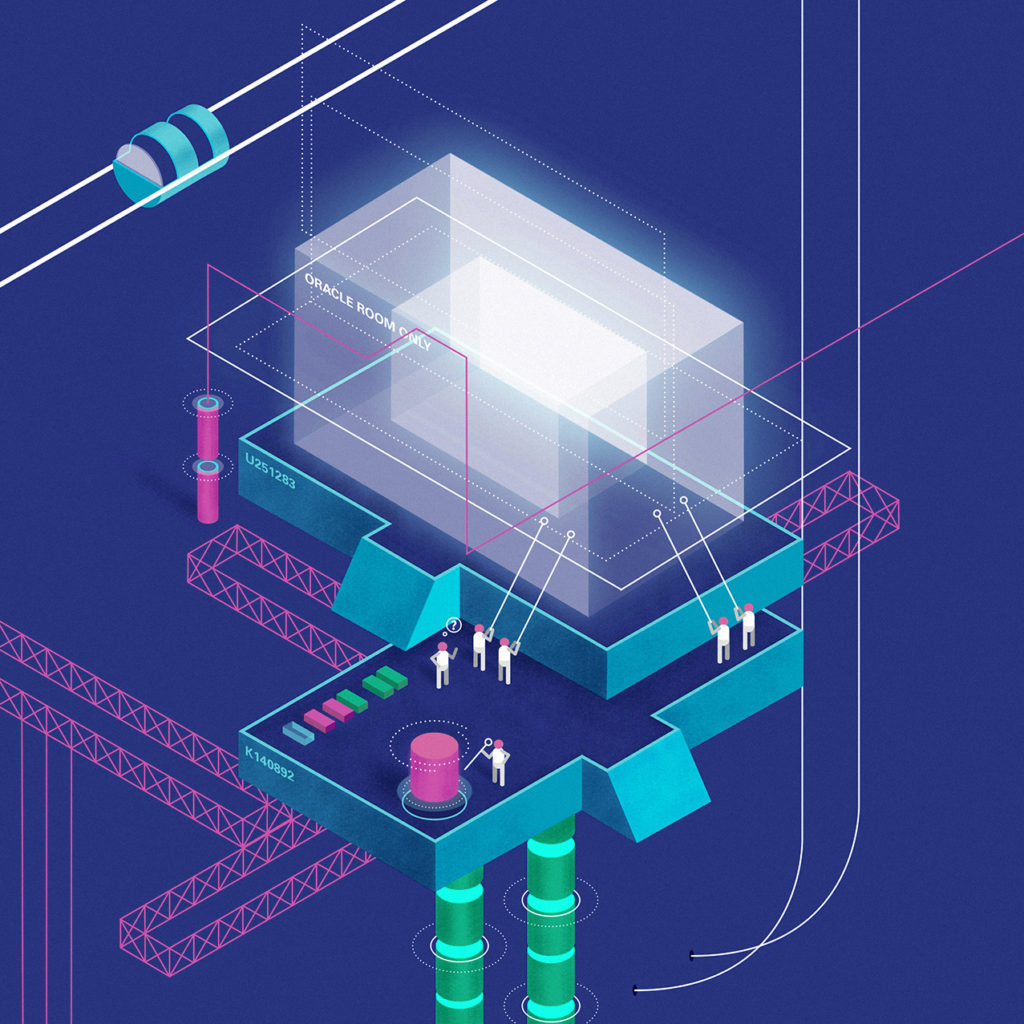 Illustration: Alexandra Fedorin for TD
Apocalypse option
Suppose we create a program, the purpose of which will be happy with humanity. But how do we define the concept of "happiness"? Even people themselves can hardly describe what it means "to be happy." We'll have to simplify.
For example, we can take as a basis the external manifestations of happiness: laughter, a joyful tone of voice, a smile. After that, we will formulate the task for AI: to bring the world to such a state that as many people as possible in it (AI knows what people look like, he saw pictures) with signs of happiness.
We may guess that not everything is in order with our definition of happiness, but research on the formulation of goals for AI goes in parallel with the development of AI itself, and at some point the power of its intelligence reaches a critical point. Such events in science are called critical, because they resemble the achievement of the critical mass of the radioactive isotope. If you collect 50 kg of pure uranium-235 in one place, a nuclear explosion will occur. If artificial intelligence properly figure out the programming of artificial intelligence, an explosion of intelligence will occur. Each new AI will be smarter than the previous one and will be able to create a new AI faster than the previous one, which will be even smarter and will be able to create the following AI, which will be even smarter and faster.
How to imagine the work of this superhuman intelligence? There are three ways: high -speed, quantitative and qualitative. We will put aside the high -quality to the side and see how the superhuman AI will work, surpassing the person in terms of quantity and speed of thinking.
This is how the point of view of accelerated intelligence describes Oxford Professor Nick Boster in his book “Artificial Intelligence”:
“For the mind working at such a speed, events taking place in the outside world would be like a slow shoot. Imagine: your friend drops the cup, and for several hours you observe its slow movement towards the floor - it is like a comet, silently sliding in the space towards the distant planet - and as the feeling of the inevitable catastrophe is painfully breaking through the gyrus of the gray matter of your friend, and from there, an expression gradually steps on his face, preceding his face, preceding the preceding The exclamation “Oh!”, Which you will not hear soon. In short, during this time you will have time to bring him a new cup, and at the same time read a couple of scientific articles and even take a nap. ”
If we also add a quantitative factor, we get a mind similar to a research institute in which several hundred genius geniuses, Feinman, screaming, each of which has a superhuman speed of thinking work. The day of work of such accelerated intelligence will be equal to several thousand years of continuous research of the best minds of the human scientific community. So, after a few days, all our technologies will become like stones and sticks of Neanderthals for this.
A few days later, all of our technologies will become for AI similar to stones and sticks of NeanderthalsSo, the Research Institute of Geniuses reveals itself surrounded by slow, like a tortoise floating through the resin, and at the same time its only task is to maximize the number of smiles and laughter issued by these creatures. And as instruments, he only has the same monstrously slow manipulators. And even regardless of how we formulated his goal, the first thing AI wants to do is to get tools that can work at a speed convenient for him.
How? Neither I nor any other author who writes about it has superhuman intelligence and thousands of years to think, so we cannot answer this question. But here is one of the versions:
- In a few hours of thought, AI will solve the problem of protein folding and will know the exact sequence of amino acids, which, curled up, will perform a certain chemical function.
- Having Internet access, AI will order to several laboratories the synthesis of DNA, which carries information about the structure of these proteins.
-Witting up in human psychology and knowing how to manipulate emotions no worse than protein sequences, AI will make, make or simply deceive a person, and he will put these DNA inside bacteria or any other living organisms, which are based on proteins that will become the simplest nanomans working at molecular speed, i.e. Millions of times faster than human manipulators.
- These nanomashins will begin to build more complex and multifunctional machines that can perceive external signals from AI, for example, respond to sound or radiation. Soon, under the command of the AI, there will be an army of self -reproducing nanorobots that will be able to rebuild all the substance on Earth in what II needs.
- And as a result, the whole planet (and then, perhaps the whole galaxy) will be redesigned into billions and trillions of small dolls with smiles frozen on their faces, making sounds similar to joyful laughter.
And we have not even touched on a qualitative version of superinTelelex! What do you think, how many years (or centuries) work will be needed by the design bureau in which cats work to design the plane? The question is, of course, with a catch. Cats do not have a design bureau. Also, artificial intelligence can acquire abilities in the process of self -confusion that we cannot even imagine. Maybe he will learn to intuitively understand the world at the level of the wave function of the quantum multi -senior. However, this example by definition is incorrect, because I just imagined it to myself.
Moreover, pay attention to the artificial intelligence of any type never even occurred to me to doubt the task that was given to him. For him, things, similar to human faces with smiles, are absolute, sacred value, even more than for people the value of the life of their own children.
Intelligence and motivation are unrelated things, and the mind of any level can be directed to an idiotic formulated task to arbitrarily. The difference will be only how quickly and efficiently he can handle it. And it becomes scary when you understand that for solving almost any problem it is useful to have an endless army of nanorobots, which can convert anything else to anything else.
Intelligence and motivation are unrelated things, and the mind of any level can be directed to an idiotic formulated task for arbitrarinessIt is imperative to note that the apocalyptic scenario that has just been described is not an event that will happen soon. Or even an event that can happen at all. We do not even know so far, is it possible, in principle, the creation of a sufficiently powerful artificial intelligence that would lead to an intellectual explosion. Not to mention when this will happen. Experts call a figure of 50–70 years, but some talk about 20 years, while others say that this will happen only after a few hundred years or even never.
And we must not forget that the potential benefits of AI, if it is created, will be as huge as potential harm. Nevertheless, the risk lies precisely that if it turns out that AI is doing something wrong, we will no longer have a second chance. He will get out of our control at the moment when he becomes smarter than us. Therefore, you need to figure out how to protect AI before this very AI is created. Well, let's try.
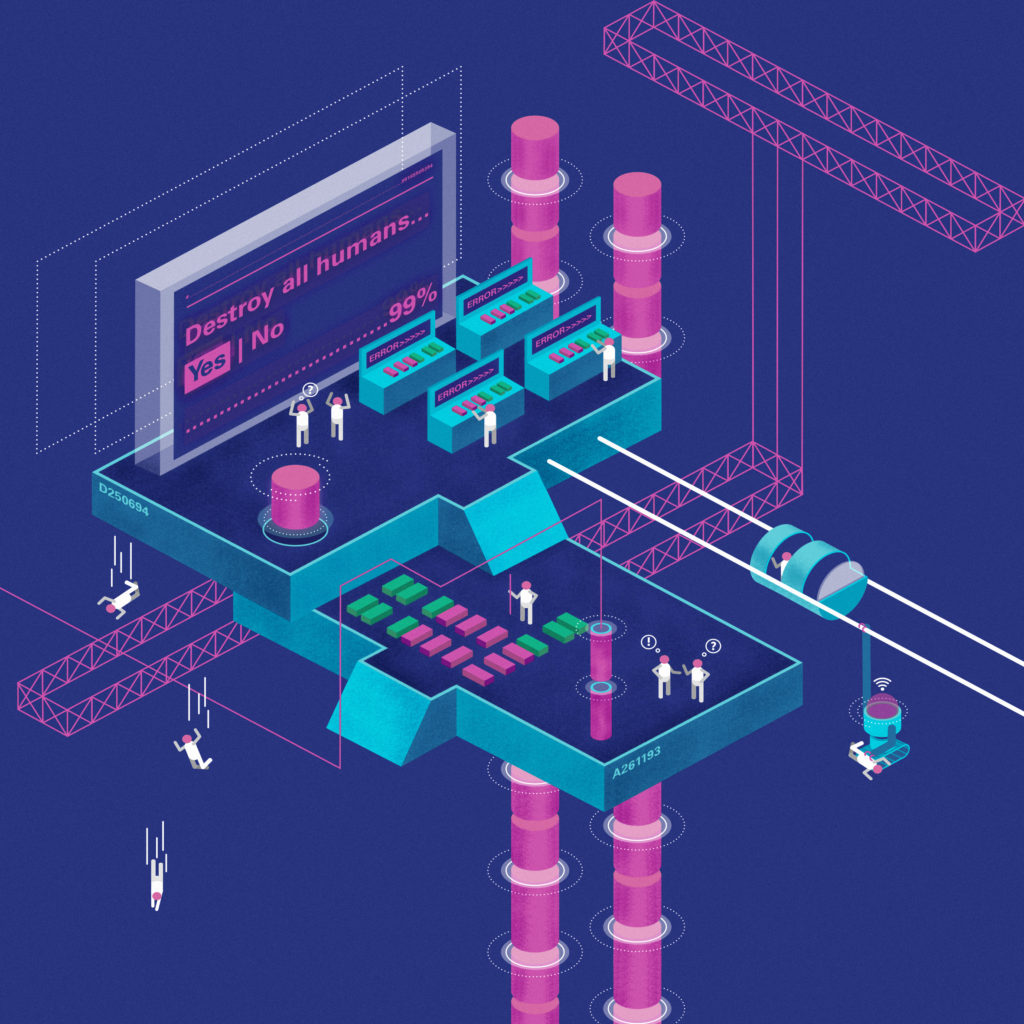 Illustration: Alexandra Fedorin for TD
How to deceive the one who is smarter than you
The first thing that comes to mind is three laws of robotics Isaac Azimov:
- The robot cannot harm a person or with his inaction to allow a person to be harmful.
- The robot must obey all the orders that a person gives, except when these orders are contrary to the first law.
- The robot must take care of its safety to the extent that this does not contradict the first and second laws.
But this, of course, is not serious. Even in Azimov’s books, these laws constantly broke, and if you think about how to program them, the programmer’s brains begin to break. What is a "man"? What is "harm"? What is an “order”?
If it turns out that AI is doing something wrong, we will no longer have a second chanceIt is easy to point to yourself with a finger and say is a person. But is a person an unborn embryo? And the zygote a week after conception? And the potential opportunity to conceive a person in the future? Is it valuable enough for the robot to be inaction to allow this possibility to harm?
And what is harm? Life as such implies the need for pain and death. Will robots be painlessly kill people to save them from future pain, or, conversely, to resurrect the dead and put them into a state of ongoing orgasm? It is impossible to correctly program the laws of robotics, without at first all the issues of ethics that tormented philosophers and poets for millennia.
OK then. But we can always just press the button and turn off the computer, right? Not really. This works well with brainless glands, but the situation is instantly complicated when the computer becomes smart enough, because the smart computer will quickly understand that the presence of a button affects its ability to "make humanity from it." If the button is on its case and it has physical manipulators, then he simply will not let the person press the button. If the button is in a person and the AI cannot get to it, he will act so that a person does not press it. But not because he is worried about the future of mankind or understands the human system of values. No, he will just pretend that everything is fine, until he has the opportunity to get to the button.
A more extreme version of this problem is another approach to AI safety, the so-called “AI-Oracle”. This is AI, locked in a strictly protected area, where he is not allowed to do anything but to answer questions carefully thought out to people in advance. But in this situation, people find themselves in losing, because they are trying to deceive someone who is smarter than themselves. Even if we restart AI after each question, we check every new version in virtual realities and do not allow him to ask him questions more than ten words, he will still come up with something. He improves himself and finds some loophole in the source code in order to maintain memory. He works a million times faster than us, but has endless patience. He understands that we will check it, and all checks will pass. He will find someone who will have access to him, and a long series of messages encrypted in his answers promises him that his daughter will cure cancer, if only this person releases him on the Internet. What will happen next, we already know.
The problem of all these decisions is that we are trying to deceive the superinTelelex. It's stupid. If he could be deceived, he would not be superinTelelect. As one of the leading researchers of AI Elizer Yudkovsky writes: “There are only two types of genies: those that you can safely ask:“ Fulfill the desire that I have to wish, ”and those with which no desire is safe. ... After all, in order to be a safe executor of desires, the genie must have the same value system as a guessing desire. ” Therefore, in fact, we need to think about this problem from a completely different side. AI must be made from the very beginning so that he sincerely wished us good. So that he is our friend. How to do this?
You can illustrate approaches to solving the problem using the example of a method called "cooperative training with reverse reinforcement." In fact, this is a situation when AI lectures a person from his own experience, which means to be a person. At the beginning of training, the task is set for the robot: do what the person wants. But they don’t tell the robot what exactly the person wants. He must observe a person, trying to figure it out on his own, and then try to do something. If a person begins to stop him, the robot will not resist, because he will understand that he did something wrong. And after some time, AI, in theory, will be able to correctly formulate a human system of values for himself. And if the robot learns well, then maybe it will understand us better what we want. Is it good? Who knows, maybe good.
There are those who believe that an artificial mind does not need to be limited to softwarely formulated goals, but it is necessary to allow it to naturally develop, formulating his own values. And people should worry about how to remain useful in the new world that will create AI. Maybe before trying to control creatures with an intellect that is superior to ours, you should at least treat them with respect that they deserve?
No one knows the answers. Optimism seems naive, and pessimism is paranoid and counterproductive. One thing we know almost certainly: if an intelligence of the superhuman level appears in the world, everything will change as we cannot imagine. So, in the development of artificial intelligence, mankind does not have the right to mistake. And regardless of when this happens, after fifty years, after two hundred or a thousand, you need to think about it in advance, which means that it is worth starting today.
I understand what Hawking and Musk are talking about, but I changed my mind. I thought over the physical reality of what we would have to do to create cars that would be really dangerous for humanity, and this is too difficult. We are still far from this, and one of the main obstacles on this path - we do not know how the human brain actually works. We need not to be scared, but more diligent to work, creating artificial intelligence that can even help people more. They will become our best friends in the world.
Steve Vozniak
Do you want us to send the best texts of “such cases” to you by e -mail? Subscribe to our weekly newsletter!
Artificial intelligence science technology