
Translated material
Refraction. Science to see differently
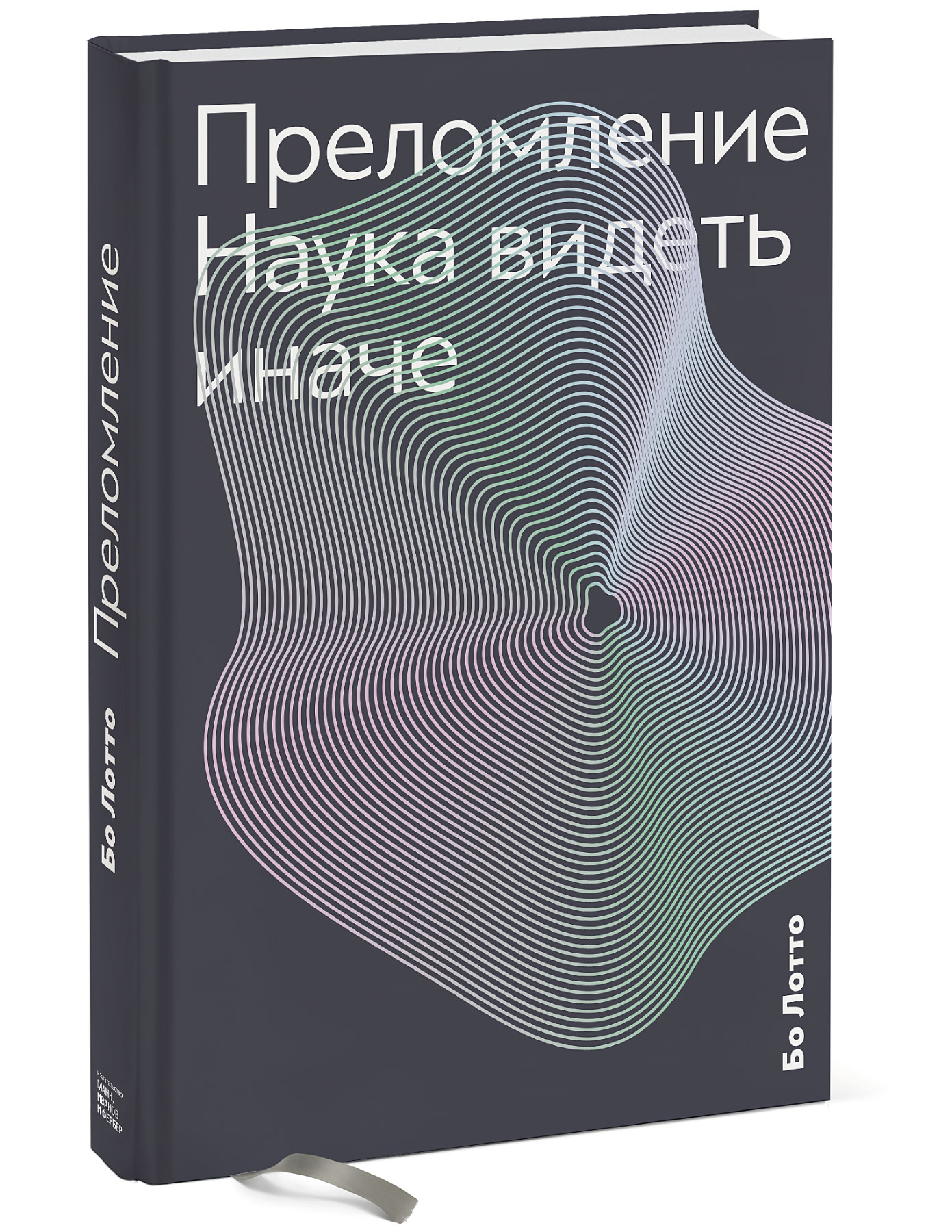
The publishing house "Mann, Ivanov and Ferber" has published a book of neurobiologist Bo Lotto "Refraction. Science to see differently. " The author of the book, a specialist in physiology and psychology of perception, talks about why we do not see a real reality. He will show you how the features of our perception affect the creative potential, work, love, relations with loved ones. We offer to get acquainted with a fragment of the book.
The perception mechanism can be compared with staying in the house on wheels (I agree, not too good comparison, but it will do for our purposes). Our feelings of perception are the windows of the house, there are five of them: vision, smell, hearing, touch and taste. From each window we get different information from the outside world (that is, energy). It is important to note that we are in no way able to leave the house, we can only move with it. But even if you manage to spin and turn inside, the windows are limited to us anyway. So, it is clear: our abilities to perceive the world are very constrained, and we can be surprised to find that the windows of perception are actually less than it seems.
Take, for example, the light is a narrow bunch of electromagnetic radiation, visible to the human eye. It has several characteristics, one of them is the range*. Visible light is only a part of the electromagnetic spectrum, it spreads in the form of waves of a certain length (or, accordingly, frequency), which are perceived by the retina and a section of the cerebral cortex responsible for vision. We see neither ultraviolet (UV), nor infrared (IR) radiation. New technologies, on the basis of which, for example, are made of night vision devices, “expand” the boundaries of feelings, but do not change biology. At the same time, nature gave other species much more advanced “technologies”, allowing them to perceive a much greater range of radiation than a person.
The northern deer are mainly known for the ability to feel smells, but their vision is also very curious. When the northern deer are busy with the main thing-they carry Santa Claus santa in the night sky-they absolutely do not need the skill developed by evolution (which, if they were people, they would call superhuman)-the opportunity to see in the ultraviolet. This ability is due to the cruel laws of survival at the habitat of deer - climatically harsh Arctic tundra. The ability to see in the ultraviolet range allows you to notice the surfaces that reflect UV rays, and, accordingly, understand which objects do not reflect them. The lichen-the main source of food of the northern deer-does not reflect, so if something is put on the card in this game, then this is dinner.
Ultraviolet vision of deer is, in fact, a device that is configured to search for food, like a strongly developed sense of smell. In addition to these paired -chosen ones, there are also insects, birds and fish, in which vision is much better than ours. For example, bumblebees have a very thin color vision, and this allows them to feel UV radiation. It is interesting to note that their ability to distinguish colors appeared in the process of evolution even earlier than the color of the flowers: that is, the flowers have adapted to look like that to become attractive for bees. Contrary to the extremely human center worldview, flowers do not exist for us-not to, say, inspire English romantic poets on the hills of the Lake Territory. Their coloring in all the diversity arose to attract anyone, not people. Birds on the retina are twice as many color receptors than ours. Compared to them, we can say that we do not distinguish colors at all.
The range is not the only characteristic of the light that limits our vision is another - orientation, which is called polarization. Light is an electromagnetic wave. If the fluctuations in the waves emanating from different sources are in the same plane, then the light is called polarized, if in different ones - unimportant. Sunny glasses with polarization lenses pass only vertically oriented light waves and delay horizontally oriented, thereby reducing the effects of glare. But even in such glasses, we are not able to perceive and somehow distinguish the polarized light from the unimportant. This ability is possessed by many animals, such as representatives of the Ratoggy detachment (Cancer-Bogomol).
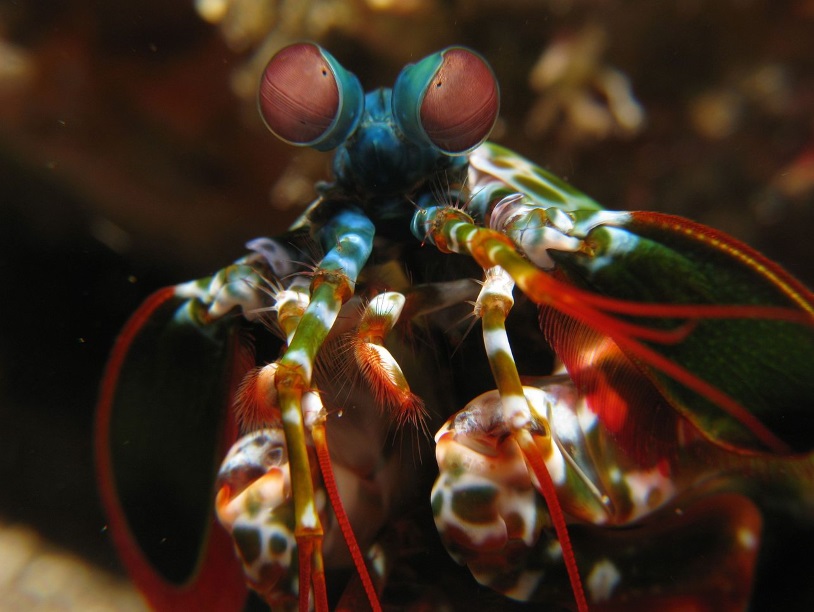
Cancer-Bogomol is a wonderful creature from the crustacean detachment that lives in shallow water. His body looks like a neck of an Omar, and his eyes turn on the stalks **. They are arranged incredibly difficult, science does not know more complicated. Such vision is called stereoscopic, or customizable, although even this term does not convey how amazing their ability to see is. Bogomol cancer has 16 visual pigments-special substances that turn light into electricity for nerve brain receptors. A person has only three of them. Under the water, in a world where the law “either kill or kill you” acts, the appearance can be so deceiving that it can cost life, and highly developed sensitivity gives a cancer-mother’s advantage when it hunts (or for it).
Birds are also able to perceive polarized light, and this allows them to see the electromagnetic structure of the sky, and not just shades of blue. The picture of the structure depends on the corner under which the sun shines, and changes during the shift of the mutual location of our star and feathered. Presumably, birds are able to distinguish between these paintings, and by their changes to navigate in flight. And to determine the further flight route, they need to look up more often, and not down.
So, just imagine ... what is it like to see the world through the eyes of a bird. When we look up on a clear sunny day, we see nothing but evenly blue sky. But for birds and bees, a wonderful cloudless open spaciousness never can be the same color: they study a constantly changing complex pattern, which consists of details of different shapes and structures.
And this drawing determines their position on the ground. What does he look like in their perception? What do they really see? It is impossible to “draw” it in imagination, because this is a completely different reality of perception. With the same success, one can ask a person without eyes to imagine color. It's just incredible!
Returning to our metaphor with a house on wheels, we can say that the window through which we look at the world is a tiny attic eye, and in other species it is a glass wall - like a “French” window from floor to ceiling. And, of course, the same comparison is true for other feelings. In the end, what is a dog whistle ***, if not another level of reality, to which we have no access?
This difference between us and animals does not mean at all that we are less capable of perception. This suggests that the changes that happened to us in the process of evolution are intended for survival in completely different conditions. We, people, have a thumb on the hand - a very useful thing given to us in the process of development, with the help of which we can successfully live and work. And the cancer-Bogomol is happy without fingers at all, because it is in another environment that imposes completely different requirements.
The thing is: we get only those sensations that pass through small windows at the house on wheels, the size of which is programmed by nature. Although the energy itself is real, this cannot be said about objects, distances, etc., even if they are formed from fragments of the real world.
* The sensitivity of the human eye to electromagnetic radiation depends on the wavelength (frequency) of radiation, while the maximum falls on 555 Nm (540 THz), in the green part of the spectrum. The range of visible light is located within the waves of 380–780 nm (790–385 THz).
** That is, they are located on stalks, and cancer can move them, turning back and forth in a horizontal plane. Approx. scientific. Ed.
*** In 1883, the British Francis Galton invented the ultrasonic whistle in 1883 to train circus animals. Modern whistles are also used for training, in particular dogs. Their advantage is that only animals hear the sound made.