
Translated material
Cranes and pigeons
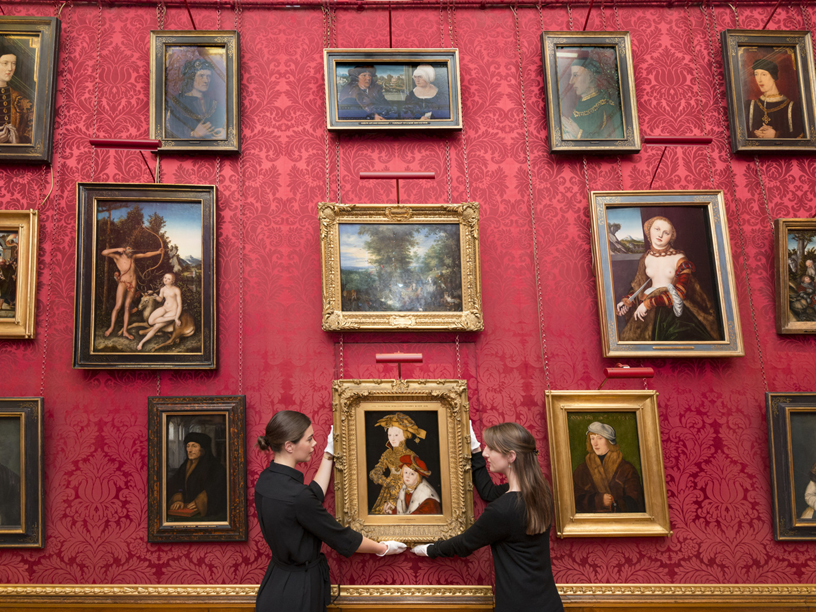
Employees of the British royal collection announced that they managed to confirm the authorship of the painting "Lady with his son." Contrary to the doubts of many skeptics, they came to the conclusion that the picture was written by the really famous German artist of the 16th century Lucas Krana Sr.. And the pigeons helped them to make sure of this, or rather - pigeon tendons.
The painting "Lady with her son" was acquired by Queen Victoria in 1840 as a Christmas gift to her husband - Prince Albert. Albert was a great lover of Cranach and it was thanks to him that in the royal collection there are twelve canvases written either by Kranacha himself, or artists from his workshop. Victoria and Albert had no doubt that the “lady and son” belonged to the Cranach brush.
The picture dates from 1510 - 1540, when Krana the elder worked in Wittenberg at the court of the Saxon Elector. She depicts a woman holding the hand of a chubby boy. The robe of the lady and the child is forced to believe that this is the wife and son of Elector, but researchers cannot accurately establish their personalities. Sometimes they argue that this is Sibille Klevskaya, the wife of Elector Johann-Friedrich Gentic, and the heroine of many paintings by Kranac of the Elder. In this case, the boy is one of her four sons, most likely, the eldest son of Johann-Friedrich II.
Doubts about the belonging of the picture arose among scientists who worked in the royal collection at the beginning of the 20th century. And I must say, for these doubts there were grounds. The reason was the German artist Franz Wolfgang Rorich (1787–1834), who received the dubious glory of the most skilled falsifier of the paintings of the Kranakh (father and son) and Dürer. He managed to sell many such paintings to wealthy collectors. Some of them then settled in museums. In particular, in the collection of the Metro Museum there is a portrait of Sofia Jagellona, the wife of Margraf Brandenburg Frederick I. The Rorich had completely identical to the one that is stored in the British royal collection. Under the name “Portrait of Sibille of Klevskaya”, they are stored in the Louvre and Art Museum of Hecksher in Huntington (USA). They say that in total, Rorich managed to draw and sell more than forty copies of pseudo-Sibill, many of which have not yet been found.
Some of the researchers generally denied the presence of a similar picture in Kranac. They rely on the fact that the obvious demonstration of tender feelings between the mother and son did not correspond to the ordinary style of the artist, whose heroes are usually depicted by detached. The fact that, with all the abundance of fake copies, could not find the work of Kranach, which could serve as a model for the falsifier, also aroused suspicion. Therefore, it was assumed that Rorich combined images in his picture, imitating the heroes of various paintings by Kranacha.
The painting from the royal collection again attracted the attention of the researchers recently, when the keepers decided to send it to the large exhibition “Cranach Der Alterer: Meister Marke Moderne”, which took place in Dusseldorf. Before sending, British experts, together with scientists from the University of Applied Sciences Cologne, were drawn by detailed research, as well as restore.
"Portrait of a lady with her son" before restoration
"Portrait of a lady with her son" after restoration
With the help of infrared reflectography, they looked under a layer of varnish and paints in the picture and found the preliminary sketches of figures typical of Kranacha. The analysis of dyes also spoke in favor of the fact that the picture was painted in XVI, and not in the 19th century.
The final argument in favor of the authenticity of the work was obtained by an X -ray study. On the wooden board on which the portrait was written, a layer of fibrous material that served as a glide was discovered. It was used to prevent possible cracking and curvature of wood. Scientists managed to take DNA sample from this material and found that this DNA belonged to the pigeon. In the 16th century, in the manufacture of glue that paints used, including cranes, the use of pigeon tendons was commonplace. In the 19th century, Rorich, making his fakes, used more modern types of glue.
So experts, led by a Kranah specialist, senior professor Gunnar Heydenreich, came to the conclusion that the picture is genuine and that it was she who served as a model for Rorich.
The guardians of the royal collection made such news, and now the picture took an honorable place in the exposition of the Windsor Castle, next to the other masterpieces of Kranah: “Apollo and Diana” (about 1526), “Lucretia” (1530) and “Court of Paris” (1530 - 1535).