
Translated material
"Brigade" I would not allow the rental "
Interview of Senator Anton Belyakov, who wants to ban the "propaganda of the criminal subculture"
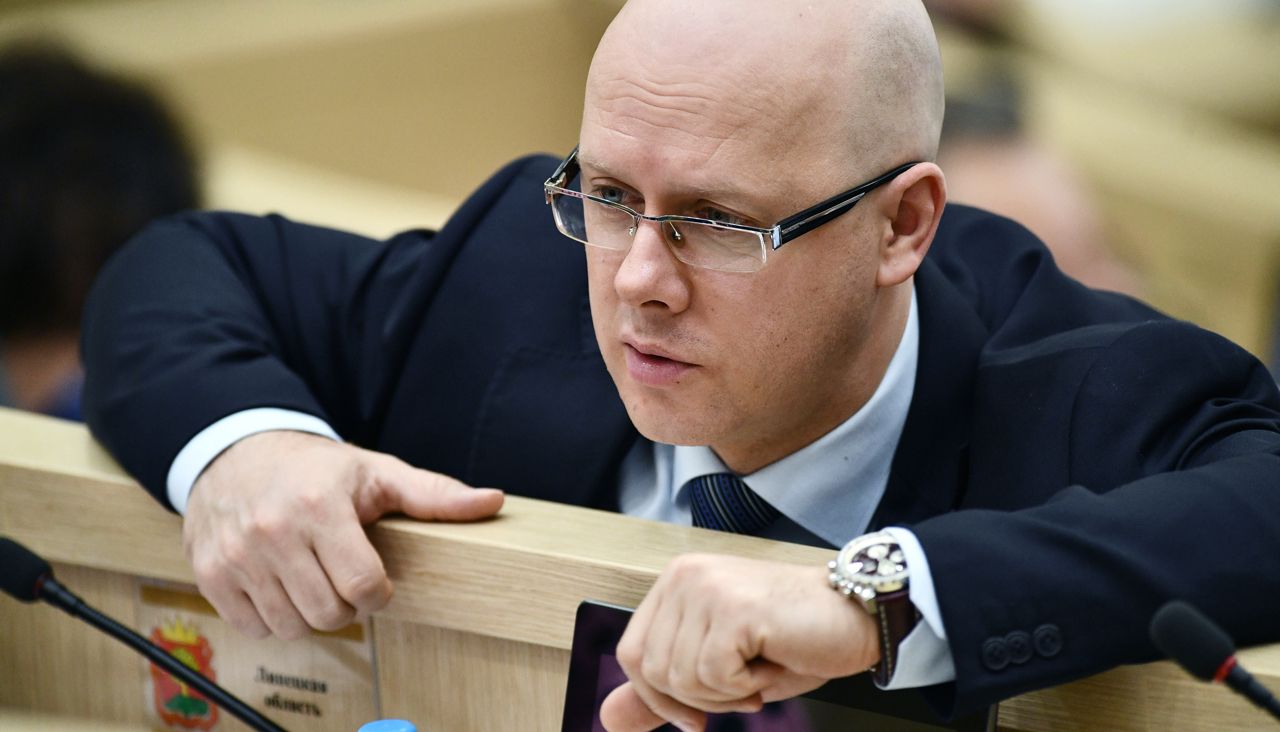
Senator Anton Belyakov introduced a bill to the State Duma prohibiting the "propaganda of the criminal subculture." By “propaganda of the criminal subculture”, Belyakov proposes to understand the spread of “information about the values of the criminal world”, which forms the “attractiveness of the criminal image of behavior”. The bill gives Roskomnadzor the right to block the Internet page with such content on a non-judicial basis. Medusa journalist Pavel Merzlikin spoke with Belyakov.
-Did the bill appear due to the spread of the AUE subculture?
- Not at all. I believe that everything is much stronger and deeper. This has been going on since the 1990s, when there was a heyday of criminal culture and organized criminal groups. There was a moment when even law enforcement agencies openly said that they were worse equipped and were not able to withstand criminal groups. Since then, one could deal with this issue.
Organized criminal groups and youth gangs are quite a distinctive feature of our time. Of course, first of all, not in Russia. There are countries where almost every street has its own youth gang. The only question is whether we can get to the same extent-or we will now take some measures. Today, organized crime, unlike the state, offers understandable social elevators of youth. Well, where will you go in the city where there is no work, where no one knows you and you have no education? Nowhere. But in a criminal group - please. You play sports, become a guard who oversees drug trafficking or prostitution, you immediately get good money. Next, you make a career in a criminal environment. She is understandable, transparent. Here you have a wonderful [criminal] social elevator instead of the state.
- Why did you decide to introduce a bill now?
- A few years ago, the state, including us, lawmakers, began to slowly engage in the theme of ideology. For example, I was a co -author of the bill on blocking content related to suicidal groups. Prior to this, we adopted amendments regarding the sites and groups of extremist content and terrorist orientation. We also adopted the so -called law on insulting the feelings of believers. Adopted amendments to blocks of children's pornography, anti -pedophile amendments, amendments against drug trafficking. In my opinion, these are all links of one chain.
The topic of criminal propaganda is very close to previous bills, because everywhere we are talking about promoting antisocial actions. Is this not identical to extremism? Plus, the tool is already clear. To begin with - blocking this content.
- So against whom is this bill? In a press release about its introduction, the AUE subculture was mentioned many times.
- This is just an illustration. If you go to Yetube, then you will find several thousand thematic videos without any AUE. Moreover, very many are well shot, quite in the style of documentary cinema. They talk about the criminal hierarchy, about building a career in a criminal environment, about thieves' laws. And a little deeper [on the Internet] you can find how better and safer to open a retail outlet with something prohibited and how to take the apartment of your neighbors easier and more correctly. In my opinion, such content needs to be blocked.
- That is, the mechanism of struggle - only blocking pages on the Internet?
- My bill now says only about the powers of Roskomnadzor out of court to block this kind of content.
- How will the propaganda of the criminal subculture be distinguished from artistic works?
- Just as this happens with extremism. In the case of the adoption of the law, the government will determine the body that will develop some criteria for blocking by Roskomnadzor. These decisions can be challenged in court. If they prove that there was no propaganda of antisocial behavior, then the decision will be canceled. If the state for each of the 50 thousand such videos goes to court, this will be a bureaucrat. Therefore, first blocking, and then an appeal.
- Well, then about specific examples. In your opinion, the music in the style of chanson, which glorifies such values, can be blocked?
- Chanson has nothing to do! So we will go far. Any detective plot is Agatha Christie, Erkul Poiro, James Bond, wherever there is a criminal and a policeman or an employee of special services, from your point of view, can be interpreted as propaganda?
The point is the content. In my opinion, in chanson, four fifths of all songs are not thieves romance. These are mournful walls about how someone is sitting, and somewhere on free mother cries. Content that promotes antisocial actions is a completely different matter. No need to confuse.
The same goes for films and series. The point is not to be detained at the end the main hero-criminal. The fact is that this is just a certain criminal story-or does it significantly popularize something? If you ask my personal opinion, the series "Brigade" is, of course, the popularization of criminal values. When the series was already at the box office and there was a wave of negative public opinion about it - that this is the propaganda of the crime of pure water, then, as far as I know, and this finale was born. Allegedly, everything ended poorly with all participants in the "brigade".
- I correctly understood that if the choice of blocking criteria depended only on you, then would you forbid the “brigade”?
- I would not allow the “brigade” to the rental. I would least like that the young people were watching this series now and would get an idea of how to turn from a simple family from a simple family into a thunderstorm of criminal Moscow. Definitely.
- And "gangster Petersburg"?
- I, fortunately for myself, did not look at him.
- Rap?
- We need to consider everything in particular cases. Yesenin has criminal poems, both Vysotsky and Rosenbaum. I'm not talking about a heap of chansonnier like Novikov or Shufutinsky. These are completely different things. This is not a ban on a chanson - it can go about individual works. Poems, songs or a film about some unfortunate person who went to jail is not the same as the unification of young people with a call: “Now we are part of a large whole criminal world, no one will offend you, but there is a oncoming condition-you must collect money from schoolchildren younger than yourself and part of them to the serious guys in the colony.” These are completely different things.
- Can you name the platforms on which such calls are distributed?
- Well, I already talked about YouTube. There are thousands, tens of thousands of videos. In all social networks, there are similar groups. There are low -frequency requests: when you want to create a group of specific people - Ivanov, Petrov, Sidorov, Kukushkin, and Vatrushkin, and Petrov; Then you create a small group, but it is very targeted. Valnaya, softened, with the opportunity to meet everyone. And there is a high -frequency promotion to which Yetub belongs, where a motivational video can gain two million views. And from the point of view of ideology, the second is much more unpleasant, although in the first case the corpus delicti is immediately visible.
- And the struggle against the “propaganda of the criminal subculture” in real life, outside the Internet, will there be?
“Yes, we have initiatives, they will touch it, but I can’t say anything else yet.”
- Okay, then another question. You compared your bill with the struggle against "death groups." Do you think the legislative measures that you took worked?
-Firstly, they worked. Secondly, this does not happen so quickly. We analyzed content in suicidal groups; In particular, the content associated with [one of the symbols of the “death groups” - blue] whales was very high quality. A number of experts called the studios where all this was shot - in Western Europe, most often in Germany. And this is not amateur shooting - this is directing, very professional work. All this was rotated on the network, and these groups have been created for years. And so we blocked this content, but those people who were cooked for a long time in this boiler should immediately forget, or something, about it? No.
Well, you need to understand that the administrator of the group has an e -mail of each of its member. They blocked the group, and people in five minutes can contact and create a new closed public. But now one of the children who just gained access to social networks did not get the opportunity to get acquainted with this content. Here we defended him. There is definitely an effect, but it should not be perceived as instantaneous.
- If you return to your new bill. Do you have a forecast when they can be accepted or rejected?
- I never give a forecast for adoption, but I will tell you that I consider myself a successful lawmaker. I analyzed my work a lot and see that many of my initiatives have become laws. I hope that now this logic will work again.
Pavel Merzlikin