
Translated material
Only gratitude will be heard
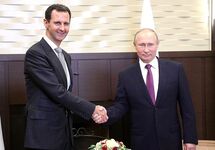
Syrian President Bashar Assad visited Russia on a working visit and negotiated with Vladimir Putin, the Kremlin press service reports . Assad thanked the Russian president for the actions of Russian troops in Syria.
"Over these two years, the successes are obvious, which were achieved thanks to the assistance of the aerospace forces of the Russian Federation and the Syrian army. No one can deny these successes to combat terrorism," Assad said.
“We are counting on to support Russia in ensuring the non -interference of external players in the political process and that the Syrians themselves will be supported by the process from the outside,” the Syria President said.
Putin introduced Assad by the leadership of the Ministry of Defense and the General Staff, which was present in Sochi at the next series of meetings on military construction. At the same time, the Russian president noted that these are "people who played a decisive role in the salvation of Syria."
“Of course, it is still very far from the complete victory over terrorism. But as for our joint work to combat terrorists in Syria, this military operation is really ending,” Putin said.
The Russian military operation in Syria began in October 2015. On October 10, the Russian front-line Su-24 bomber rolled out of the runway at the Syrian airfield Khmeimim, the crew of the aircraft did not manage to eject and died . Thus, the official number of Russian soldiers during the Syrian campaign increased to 41. However, Russians who died in Syria can be much larger , since some of them participated in the Syrian conflict as employees of private military companies. Such losses are not officially reported.
On November 11, Putin and US President Donald Trump published a joint statement about the situation in Syria . At the same time, their full -format meeting at the APEC summit in Vietnam was not composed, the document was agreed by the heads of the foreign policy departments of Russia and the USA. The statement confirms "determination to defeat ISIS in Syria." The document also notes "the importance of de -escalation zones as a temporary measure to reduce violence in Syria, the implementation of agreements on the termination of hostilities, improve the unhindered humanitarian access and create conditions for the final political settlement of the conflict." In addition, the parties agreed to "support the current military channels of communication to ensure the security of the" armed forces of the countries of the countries, "as well as the prevention of dangerous incidents with the participation of partners conducting the fight against ISIS."