
Translated material
Making dashingly
The Kremlin condemned the student’s injury for an anti -war performance in the Bundestag. But the next patriotic bacchanalia is a logical continuation of the official policy of Victory, imposing the Kremlin version of the history of World War II. There is no place for humanity, complexity, uncomfortable historical facts. Protection from "attempts on the Holy" has become the most important topic in foreign policy. In Europe, a new series of scandals around Soviet monuments - these monuments are associated not only with the tragic past, but also with a hybrid Putin aggression.
BULGARIA
"Alyosha"
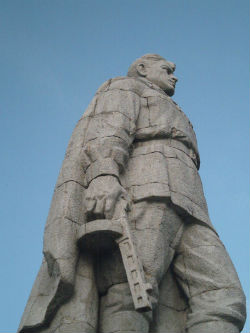
Installed in Plovdiv on the hill of Bunardzhik. Open in November 1954. Sculptors Vasil Radoslavov, Lyubomir Dalchev, Todor Bosilkov and Alexander Kovachev. Architects Boris Markov, Nikolai Marangozov, Peter Tsvetkov. The model for the figure of a soldier became Private Alexei Skurlatov, or rather his photograph.
The authorities of Plovdiv three times - in 1989, 1993 and 1996 - tried to demolish the monument. Each time the public prevented the public. After the third attempt, the Supreme Court of Bulgaria ruled that the monument could not be destroyed.
On the night of November 10, 2017, Alyosha was defiled. Inthe photographs posted on Facebook by the regional council of the Socialist Party of Bulgaria, along with a condemning statement, it is clear that in addition to the swastika, anti -communist and anti -Semitic inscriptions ("communism = Jewry") were painted on the monument, as well as a message that a certain Zakharov is a transvestite.
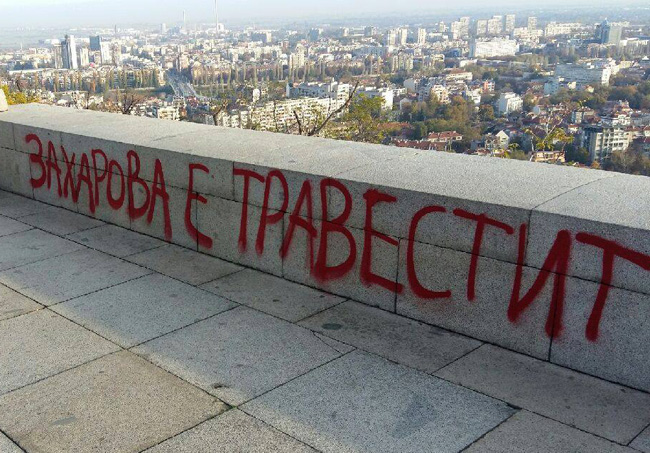
The Bulgarian Foreign Ministry condemned vandals.
*Such manifestations are absolutely unacceptable and contradict the traditional tolerance and tolerance of Bulgarian society, as well as the country's obligations to the EU and international organizations to combat racism, xenophobia and crimes on the basis of hatred.
We hope that the competent authorities will find the perpetrators and bring them accountable.*
Moscow has not commented on the incident.
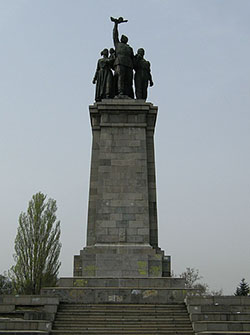
Monument to the Soviet Army
Installed in Sofia on the boulevard of the king-liberator. Open in 1954. Sculptors Ivan Funev, Lyubomir Dalchev, Mara Georgieva, Vaska Emanuilova, Vasil Zidarov, Pyotr Doychinov. Architects Dancho Mitov, Ivan Vasilev, Lyuben Neukov, Boris Kitanov. Graphic artist Boris Angelushev.
Since 1993, the city authorities have repeatedly tried to demolish a monument.
On June 17, 2011, a group of anonymous artists Destructive Creation repainted the figures of the Red Army on one of the two high reliefs of the monument to the heroes of American comics, and the banner in the American flag. “In the leg with the times,” the artists explained their plan. It took three days to remove paint.
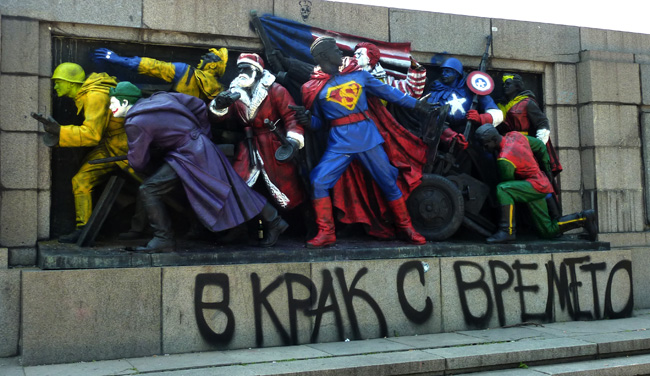
February 1, 2013, on the national day of memory of the victims of communism, the figures of the monument were painted in the colors of the national flag of Bulgaria.
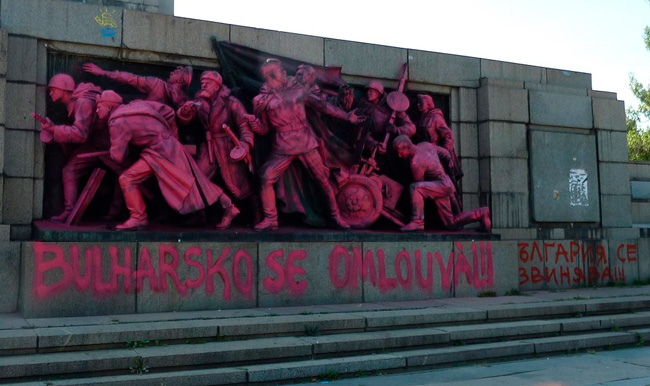
On August 21, 2013, on the occasion of the 45th anniversary of Soviet intervention in Czechoslovakia, the high relief was painted with pink paint. The action was accompanied by the inscription in Czech and Bulgarian: "Bulgaria apologizes." This was an apology for the participation of the Bulgarian troops in the suppression of the Prague Spring.
On February 23, 2014, unknown artists painted the central figure of the high relief in Ukrainian national colors, accompanying this with the inscriptions in the Ukrainian language "Glory to Ukraine" and "Hands off Ukraine."
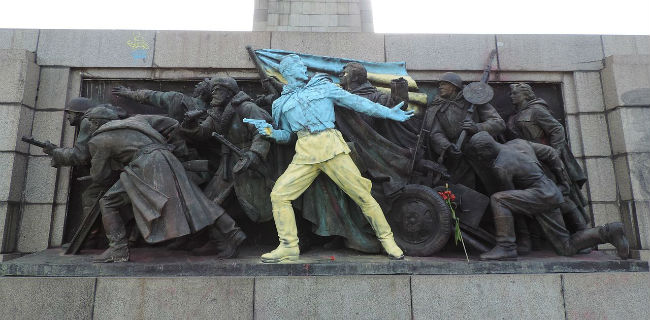
On March 2 of the same year, in protest against the Russian capture of Crimea, the inscription "Hands off Ukraine" again appeared on the monument, and the dedication of the "Red Army, the Liberation of the Bulgarian people" was crossed out.
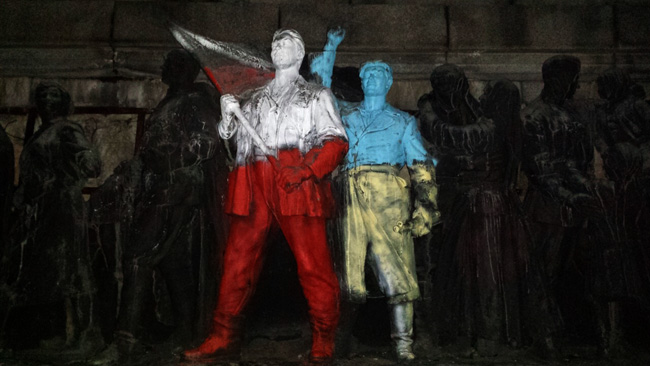
On April 12 of the same year, the central figures of one of the high reliefs were painted in the national colors of Poland and Ukraine. The inscription reminded of the next anniversary of the massacre of Polish prisoners in Katyn.
On the night of October 31, 2017, a new incident occurred, about which the official representative of the Foreign Ministry of the Russian Federation Maria Zakharova made a statement .
The vandals (I can’t call them differently) attacked the monument just a week ago, but now they surpassed themselves, placing an openly anti-Semitic character on the memorial. This trick is especially cynical in the light of the fact that during the Second World War, thanks to our soldiers, our soldiers managed to prevent the deportation of Jews from Bulgaria and thereby save about 50 thousand people from imminent death.
However, this time the Bulgarian Foreign Ministry answered differently than usual.
*When the Bulgarian citizens stood on the railway tracks, interfering with the echelons who went to the Nazi death camps, when representatives of the Bulgarian political, economic and intellectual elite wrote letters in defense of the Bulgarian Jews, and the senior hierarchs of the Bulgarian Orthodox Church joined the Jews gathered for deportation, saying that their compatriots were assigned that their components You can send to the camps only with them, the Red Army was thousands of kilometers from the borders of Bulgaria.
Without belittling the significance and role of the Red Army in the eradication of Nazism in Europe during the Second World War, we would like to emphasize that such attempts to replace historical facts do not contribute to the universal cause of the fight against the revival of anti -Semitism, racism and intolerance, for the categorical condemnation of Nazism and neo -Nazism in its modern manifestations.*
Bulgaria President Rumen Radev said that the commentary of the Russian Foreign Ministry is "either a manifestation of deep historical ignorance, or an attempt to provocate."
Maria Zakharova had to continue the topic at the next briefing. She did not apologize for the mistake and regarded Sofia’s answer as the desire to take the conversation aside.
All this discussion showed that there is an attempt to take the whole conversation from the texture, a real assessment of the situation with monuments in a historical channel. Let historians comment on the historical part. We say that it is necessary to respect for the monuments of those people who gave their lives in order not only to free, but also to protect the lives of peoples, specific people, from fascism and Nazism.
The official representative of the Ministry of Foreign Affairs of the Russian Federation referred to a promptly manufactured note on the website of the Russian Military Historical Society. Its author Mikhail Myagkov insists that the role of the Red Army in the salvation of Bulgarian Jews was decisive.
If there weren’t the Red Army, everything would have gone according to a completely different scenario - the death of Jews from Thrace and Macedonia is confirmation of this. The Nazis would simply “squeeze” the Bulgarian leadership and forced them to participate in the Holocaust now in the actual Bulgarian territory. But after a fracture in the war and approaching the Red Army to the borders of European countries, the Bulgarian authorities were forced to look around, seek contacts with the allies of the Anti-Hitler coalition, think about what would happen when Bulgaria would get out of the wing of Nazi Germany.
Czech Republic
Monument to Marshal Konev
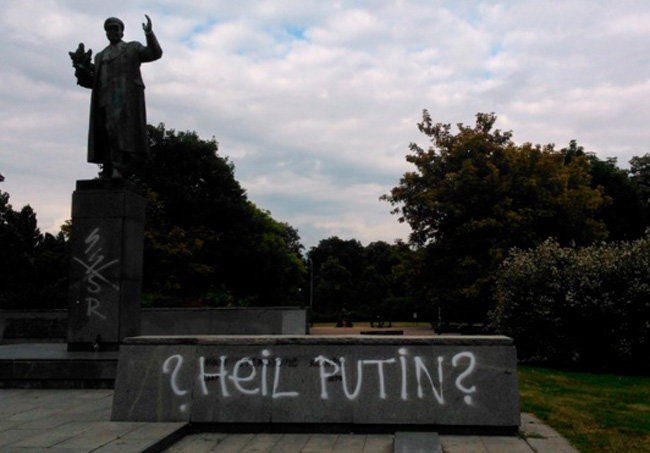
Installed on Interbrida Square in Prague. Open in 1970. Sculptor Z. Cribus. The marshal is depicted with a bouquet of flowers, which was handed to him liberated Prazhan.
In 2008, the authorities of the city district of Prague 6, in which the monument was located, planned to transfer it to another place - the square of Lasaro Cardenas. This was stated by the head of the district administration Tomash Halup.
We intend to ennoble the green area of our area. At the site of the square, there will be a park of figures in which statues of historical personalities from around the world will be placed. In addition to the figures of two Mexican reformers and presidents Benito Huarez and Lasaro Cardenas, the State South American figure Simon Bolivar, monuments to other personalities will be located there. Many states send them as a gift to Prague. Now, for example, we are looking for a place for the monument to Taras Shevchenko, which the Ukrainian government recently gave us. In the park of leaders will be a monument to Marshal Konev.
Russia opposed the transfer, citing an intergovernmental agreement, in which, however, we are talking about the preservation of military graves.
On the night of November 20, 2014, unknown people doused the monument to Konev with pink paint.
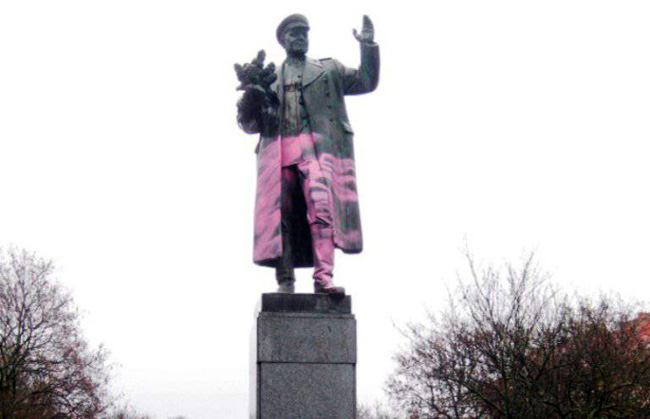
This year, the city authorities have a new plan. On October 4, the head of the Prague Administration 6 of the Aldrzhih Kolarzh sent a letter to the Czech Republic in the Czech Republic of Zmeyevsky, in which he proposed to establish on the pedestal of the statue of a tablet in Czech, Russian and English, explaining who Marshal Konev is and what his merits to the Czechs and history are.
My goal is not to provoke or twist anything, but only to provide people with facts. I admit that they can be unpleasant, but if they are proving, I consider them undeniable. The signs will be installed from a plastic imitation of bronze in order to avoid theft, which, unfortunately, happens in our time. I want to note that Prague 6 annually allocates considerable funds to care for this monument, and the most part of this amount goes precisely to restore stolen bronze letters.
If this option for some reason does not fit Russia, Kolarzh offers the embassy to transfer the monument to its sovereign territory.
This letter was followed by an article in the newspaper Hospodařské Noviny. The embassy published its angry answer along with a letter from Kolarzh on Facebook.
Czech journalists, deftly juggling with pulled phrases, tried to take attention from the essence of O. Kolarzh’s proposals to place a “explanatory plate” on the monument or even remove it into the territory of the Russian embassy closed to the public. The authors of the publication tried to expose in an unsightly form of those who dared to express their civic position and defend the monument, symbolizing the liberation of Czechoslovakia from Nazism in the spring of 1945. Apparently, in the interpretation of journalists, freedom of speech is possible only in terms of Russia's criticism.
AUSTRIA
Monument to the heroes of the Red Army
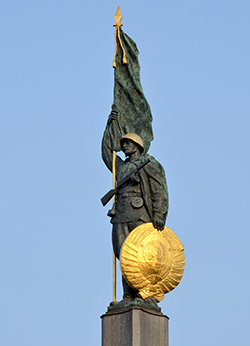
Installed on Schwarzenberg Square in Vienna. Opened on August 19, 1945. The memorial began to be designed before the entry of units of the Red Army to Austria. The Military Council of the 4th Guards Army of the 3rd Ukrainian Front announced a competition for the project of the monument. According to its results, Major S.G. was appointed architect Yakovlev, sculptor - junior lieutenant Michael Intezaryan, later Honored Artist of the RSFSR.
The second verse of the USSR State Anthem in the 1943 edition is placed on the podium of the monument, another work of Sergei Mikhalkov (“Guards! You honestly served the Fatherland, you came to Vienna from the walls of Stalingrad ...”), as well as the order of Stalin on the occasion of Vienna and his phrase from speech due peoples and peace between peoples. "
The obligation to care for the memorial is assigned to Austria by a state agreement signed in 1955 by the Allies and the Austrian government. There is a legend that in 1961, after the visit of Nikita Khrushchev to Austria and an inspection of the monument to them, Moscow invited the Austrians to replace the signature "Stalin" under the order of the commander in chief. But Vienna replied that under the contract she is obliged to maintain the monument unchanged.
Four cases of protest activity were recorded. In April 2012, part of the memorial was filled with red paint. In May 2014 - blue and yellow as a sign of solidarity with Ukraine. In February 2015, unknown people smeared the order of Stalin with black paint. In January 2017, unknown people did the same with red paint.
The Ministry of Foreign Affairs of the Russian Federation protested every time, avoiding mentions of Stalin.
*On the night of February 23, S.G. The memorial is defiled to the Soviet soldiers -liberators on Schwarzenbergplatz Square in the center of Vienna - the facade of the monument is flooded with black paint.
We express the indignation of what happened. We consider the incident as an egregious manifestation of vandalism.*
( Comment on February 24, 2015)
POLAND
In Poland on October 21, amendments to the law "On the prohibition of propaganda of communism or other totalitarian system", briefly called the Law on Decommunization, came into effect. According to amendments, about 500 monuments of the Soviet era should be dismantled in the country during the year. The Polish authorities emphasize that the law does not apply to military burials and architectural monuments - only symbolic images associated with the communist dictatorship are subject to dismantling. Nevertheless, the Russian Foreign Ministry calls these plans a “outrageous provocation” and compares them with the actions of the “Islamic state” in Palmyra, and the Federation Council asks President Putin to impose sanctions against Poland .
*Innovations suggest that in Poland there should not be memorial objects perpetuating the memory of organizations that are objectionable to the current authorities, events and dates. It is not hidden that the main blow will be inflicted on monuments and other memorable objects established in honor of the feat of the Red Army that freed Poland from the Nazi yoke, and the Polish people from total extermination.
With special blasphemy, the Polish authorities timed this decision to the holy and tragic day for us the beginning of Hitler's aggression against the USSR. Otherwise, such actions can not be called such actions with shameful mockery of the memory of the dead.*
( Comment of the Ministry of Foreign Affairs of the Russian Federation of June 27, 2017)
I am convinced that we are observing a deliberate attempt to distract society in Russia and abroad. It is no coincidence that the campaign is unleashed by certain circles in Russia at a time when our cooperation with Ukraine becomes closer, our political dialogue with Belarus is activated, and the international positions of Poland are strengthened. These circles, quite obviously, such a situation is worried ... Poland cares about Soviet and Russian cemeteries, even those that remained from Napoleonic times. Poland respects the blood spilled by the Red Army in the fight against Nazi Germany.
(From an interview with the First Deputy Minister of Foreign Affairs of Poland Bartosh Tsikhotsky on July 22, 2017)
ESTONIA
"Bronze Soldier"
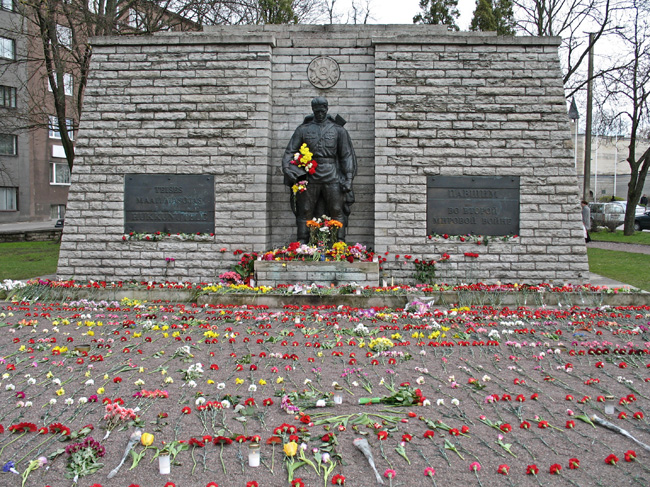
Open on the Tninismmyag hill on September 22, 1947. Sculptor Anne Roos. Architect Arnold Alas. Under the monument in the mass grave, the remains of 13 military personnel rested, from Lieutenant Colonel to the corporal. Their names are known. In 1964, an eternal flame was lit in front of the monument.
An attempt to destroy the monument was made on May 8, 1946 in the center of Tallinn, when the tombstone was still wooden. Two Estonian eighth-graders, 15-year-old Agead Pavel and 14-year-old Aili Jurgenson, laid a homemade explosive device under it.
How much more we had to admire this Red Star, a monument to the Russian looters, while all our statues were destroyed. We just could not come to terms with this. We decided: if these robbers are attended in Estonia, let them see how one of their monuments explodes. We could just pour this wood with gasoline and set fire to, but we wanted to smash it into chips.
( Aili Jurgenson , in the marriage of Aili Yygi)
We took up a dangerous business. What to do with the sentries guarding the monument? They seemed to be not particularly attentive. We had to blow up the monument on the eve of May 9. We hoped that Victory Day would celebrate without a monument. Vello Volt, who was then 13 years old, gathered a bunch of ammunition and weapons for the war. He gave us three sticks of explosives and bicfords cord, long enough to calmly leave.
(Agead Pavel)
Some sources say that the sentry during the laying of the IEV began to flirt with the girl; Apparently, she was not a participant in the operation, this is just a coincidence. Young saboteurs managed to hide unnoticed. The monument was restored by the morning. Aili and Ageed were arrested a few days later. They were given eight years of camps. In the conclusion, Aili Jurgenson met the former fighter of the reconnaissance-sabotage group of Abwehr Erna Yulo Yigi and married him.
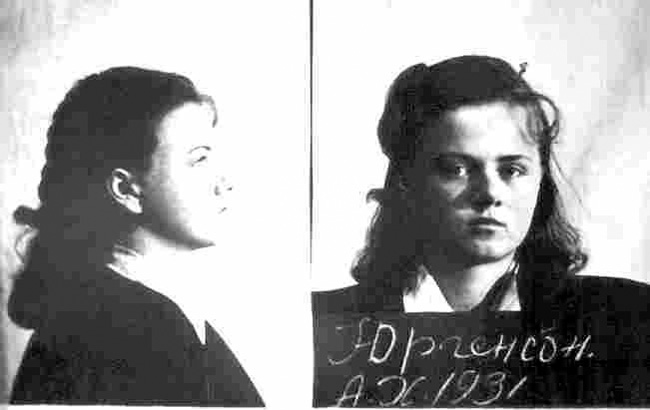
Prison photo by Aili Jurgenson
In 1998, Estonia President Lennart Mary awarded Aili Jurgenson and Agead Pavel the Order of the Orlin Cross for Military Merit.
A bronze statue of a soldier was placed on the site of a wooden obelisk. In the early 90s, an eternal flame was extinguished. In 1994, the signs with the names of the buried were replaced by the inscription "Fallen in the Second World War" in Estonian and Russian.
In May 2006, an acute polemic broke out around the "Bronze Soldier". The Union of the Fatherland party demanded that the monument from the city center be removed as a symbol of the Soviet occupation. A draft law on the dismantling of Soviet monuments was introduced into the Estonian parliament. Russia fiercely protested.
The initiators of the adoption of the law claim that it will positively affect the "international prestige of Estonia." What a perverted logic must be possessed in order to consider the egregious fact of neglect of the memory of the warriors of the anti -Hitler coalition who died on the fronts of World War II, the criterion for the country's authority.
( Application of the Ministry of Foreign Affairs of the Russian Federation of November 10, 2006)
Especially for the protection of the "Bronze Soldier", the organization "Night Watch" was created, whose members were on duty at the monument at night.
In April 2007, the Estonian government, despite the protests of Moscow, decided to transfer the "bronze soldier." The entire set of means of influence was applied to Estonia, from diplomatic notes to an attack on Estonia Ambassador in Russia.
*Question: In the media, with links to Estonian officials, information appeared that the other day in Moscow, an attack on the Ambassador of Estonia in Russia M. Kalyurand was committed using tear gas.
Commentary: On May 2, a group of young people in protest against the dismantling of the monument to the libertist soldier in Tallinn really made an attempt to disrupt the press conference of Estonia Ambassador in the editorial office of the newspaper Arguments and Facts. Однако охране удалось воспрепятствовать этой акции. Какого-либо непосредственного физического нападения на посла зафиксировано не было. Что касается информации о слезоточивом газе, то баллончик с перечным газом использовал как раз охранник эстонского посла против пикетчиков. Этот факт подтвердила сама М. Кальюранд во время беседы в МИД России.*
( Комментарий МИД РФ от 4 мая 2007 года)
Демонтаж монумента в ночь с 26 на 27 апреля сопровождался массовыми беспорядками в Таллине и других городах Эстонии.
*ВОПРОС: Прокомментируйте сегодняшние события в Таллине. Есть сообщения, что там происходят столкновения с полицией тех, кто защищает памятник?
S.V. ЛАВРОВ: Считаю, что все это отвратительно. Я не видел кадров, но слышал, что там происходит. Этому кощунству нет оправданий.*
( Выступление министра иностранных дел России Сергея Лаврова по итогам министерского заседания Совета Россия-НАТО, Осло, 26 апреля 2007 года)
В ту ночь был убит гражданин России Дмитрий Ганин. Российская сторона расценила его смерть как убийство защитника "Бронзового солдата", хотя произошло оно в стороне от центра событий. Но обстоятельства смерти Ганина не столь однозначны . Власти задержали семерых подозреваемых, однако вменить им убийство не удалось . Дело об убийстве Ганина не закрыто.
Четверо активистов "Ночного дозора" обвинялись в организации массовых беспорядков и предстали перед судом.
Такое ощущение, что обвинение просто выискивает улики там, где их нет. Нет сомнений в том, что этот процесс политический. Обвинение основывается не на фактах, а на каких-то домыслах, не имеющих никакой почвы. Мы поражены теми антирусскими настроениями, которые царят в Эстонии.
(Депутат Европарламента от Германии Сара Вагенкнехт в интервью В итоге все четверо были оправданы, им выплачена компенсация за необоснованное содержание под стражей.
Невзирая на протесты, "Бронзовый солдат" был демонтирован и переустановлен на военном кладбище Таллина. Перезахоронили и останки восьми человек из братской могилы. В поминальной церемонии 8 мая 2007 года на Военном кладбище приняли участие члены эстонского правительства во главе с премьер-министром Андрусом Ансипом.
Родственники еще пятерых бойцов пожелали забрать останки. Они похоронены в Ярославле, Кашине, Ростовской области, Полтаве и на Масличной горе в Иерусалиме.
GERMANY
ВОИН-ОСВОБОДИТЕЛЬ
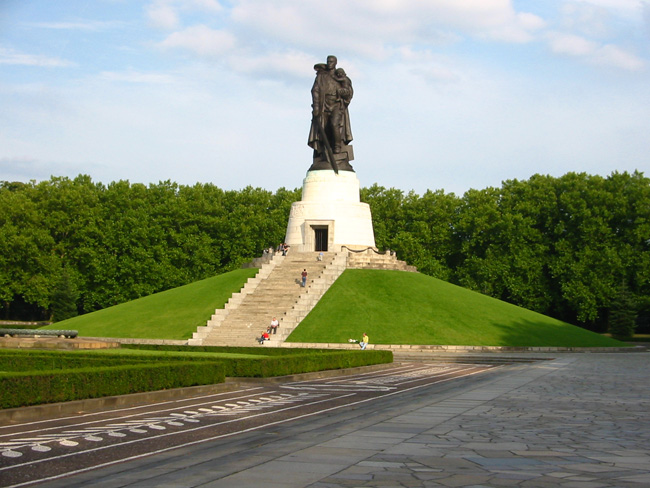
Монумент в Трептов-парке, Берлин. Открыт 9 мая 1949 года. Скульптор Евгений Вучетич. Архитектор Яков Белопольский. Идея дать в руку солдату не автомат, а меч принадлежит Сталину. Камни и гранит, использованные в сооружении, взяты с развалин гитлеровской Рейхсканцелярии. Фигура солдата смонтирована из шести частей, отлитых из бронзы на ленинградском заводе "Монументальная скульптура". Осенью 2003 года статуя была разобрана на составные части и отправлена на реставрацию. 2 мая 2004 года скульптура была установлена заново.
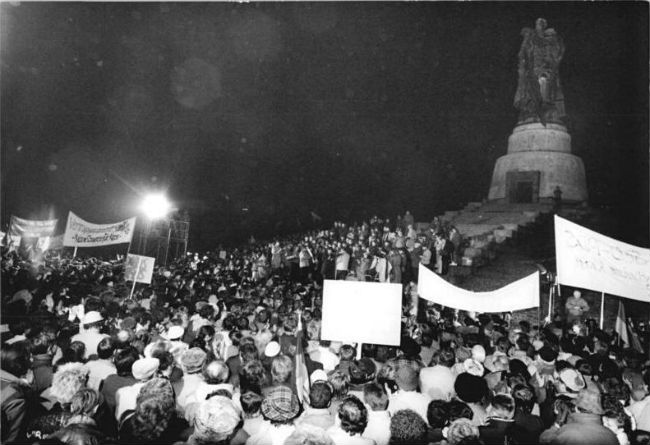
Наиболее значительный инцидент, связанный с памятником, имел место в январе 1990 года. На нем появились антисоветские граффити. Правящая Социалистическая единая партия Германии воспользовалась этим и устроила у подножия монумента "антинацистскую" демонстрацию, собравшую 250 тысяч человек. Есть версия, что написи были сделаны в провокационных целях агентами Штази.
МЕМОРИАЛ ПАВШИМ СОВЕТСКИМ ВОИНАМ
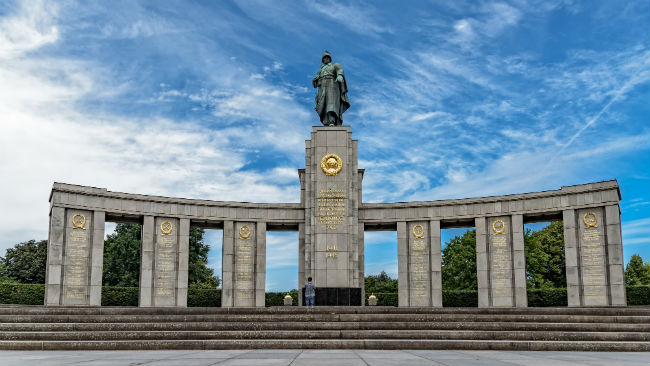
Установлен в берлинском районе Тиргартен решением военного совета 1-го Белорусского фронта. Открыт 11 ноября 1945 года. Скульпторы Лев Кербель. Владимир Цигаль. Архитектор Н.В. Сергиевский.
Территория мемориала была советским анклавом в британском секторе Берлина. До вывода российских войск из объединенной Германии в 1994 году у памятника нес караул 6-й мотострелковой бригады ГСВГ. 7 ноября 1970 года в часового Ивана Щербака стрелял из мелкокалиберной винтовки 21-летний Эккехард Вайль. Щербак получил два ранения. Вайля судили военным судом британскогой зоны Берлина. На суде он говорил , что своими действиями он протестовал против Московского договора между СССР и ФРГ. Вайль получил шесть лет лишения свободы.
В ночь на 9 мая 2010 года неизвестные нарисовали на памятнике красной краской свастику и написали по-немецки "Убийца, насильник, вор". В старшем поколении немцев некоторые называют мемориал "Могилой неизвестного насильника".
КЛАДБИЩЕ-ПАМЯТНИК ВОИНАМ СОВЕТСКОЙ АРМИИ
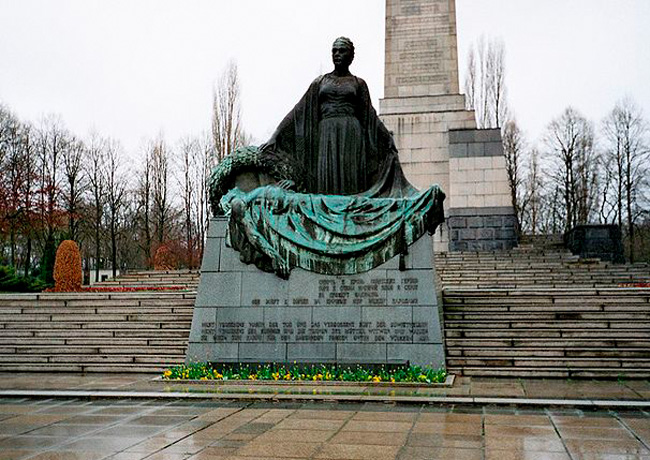
Установлен в берлинском округе Панков. Сооружение мемориала закончено в ноябре 1949 года. Скульптор Иван Першудчев. Архитекторы К. Соловьев, М. Белавенцев, В. Королев. На территории мемориала захоронены останки 13 200 советских солдат. Имена известны только 3180 из них.
В марте 2006 года произошло масштабное осквернение солдатских могил в Панкове. МИД РФ сделал по этому поводу заявление .
В Москве возмущены хулиганской выходкой неизвестных лиц, осквернивших мемориал советских воинов в берлинском районе Панков. Вызывают тревогу беспрецедентные масштабы вандализма. Это варварство, которому нет и не может быть оправдания.
Отдельной статьей Договора об окончательном урегулировании в отношении Германии 1990 года (договор "два плюс четыре") ответственность за сохранность советских воинских мемориалов и захоронений на немецкой территории возложена на правительство Германии. Однако правительство не вправе менять что-либо в этой сфере без консультаций с Москвой.
В апреле 2014 года в связи с событиями в Крыму и на востоке Украины газеты Bild и Berliner Tageszeitung опубликовали и направили в Бундестаг петицию с требованием убрать танки, установленные на мемориале в Тиргартене.
*В то время, когда русские танки угрожают свободной, демократической Европе, мы не хотим больше видеть русские танки у Бранденбургских ворот!..
Мы, подписавшие эту петицию, не хотим, чтобы военное насилие в XXI веке снова стало инструментом политики в Европе.
Мы не хотим отказать российскому народу в уважении к его неизмеримым страданиям и жертвам во время Второй мировой войны. Однако мы считаем, что память о солдатах Красной Армии, погребенных на территории мемориала, никак не связана с неприятием гегемонистской военной политики сегодняшнего кремлевского руководства и путинских танков.*
Однако из этой затеи ничего не вышло. Уже на следующий день федеральное правительство отказало в удовлетворении петиции, сославшись на договор 1990 года.
CNN
В феврале 2014 года телекомпания CNN разместила на своем сайте " галерею самых уродливых в мире памятников". В число экспонатов попали "Слеза" Зураба Церетели, установленная в городе Байон (Нью-Джерси) в память о жертвах терактов 11 сентября 2001 года, а также монумент "Мужество", посвященный защитникам Брестской крепости.
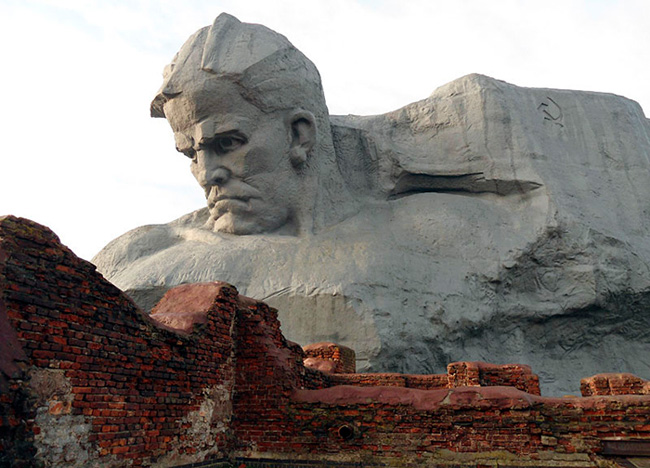
Публикация породила бурю негодования в Москве. Раздались призывы приостановить вещание CNN в России. Телекомпания принесла извинения за "непреднамеренное оскорбление", заявив, что внештатный автор, составивший галерею, "имел в виду лишь юмористический взгляд на мировую архитектуру".
Мы признаем, что монумент "Мужество" несет в себе глубокое символическое значение уважения памяти солдат, отдавших свои жизни ради защиты своей страны. CNN также извиняется перед Зурабом Церетели, создателем монумента, посвященного борьбе с мировым терроризмом.
Монумент "Мужество" был из галереи удален, а "Слеза" осталась.
Уполномоченный МИД РФ по правам человека, демократии и верховенства права Константин Долгов сделал по этому поводу заявление .
*В МИД России приняли к сведению официальные извинения телеканала "Си-Эн-Эн", которые его руководители передали лично в ходе встречи с послом России в США С.И. Кисляком, состоявшейся на днях в российской дипмиссии в Вашингтоне.
Представители "Си-Эн-Эн" заявили, что выражают искренние сожаления по поводу случившегося, а в отношении размещения материала, осквернившего память погибших в войне с нацизмом, проводится "внутреннее расследование".
В свою очередь подтверждаем нашу принципиальную оценку, что попрание памяти героических защитников Брестской крепости, чем бы это ни пытались объяснить, нельзя оправдать и простить. Допускаем, что автор скандального "рейтинга памятников" плохо знаком с историей, а те, кто давал согласие на его публикацию, не имели "злого умысла", как нас теперь пытаются убедить. Но нужно отдавать себе отчет, что подобные безответственные действия нанесли серьезный удар по репутации "Си-Эн-Эн", привели к дальнейшему снижению рейтинга этого телеканала в России.*
Подготовил Владимир Абаринов