
Translated material
Roshydromet recognized the thousand-class excess level of the ruthenium-106 in the Chelyabinsk region. A month ago, they talked about a possible accident in Europe
Roshydromet on November 20 announced the 986-fold exceeding the concentration of the Rutheneniya-106 radioactive isotope in the air of the Chelyabinsk region, which was recorded at the end of September. Despite the reservation contained in the message that even in such a concentration, the isotope is safe, Russian and international media wrote about a serious radioactive leak in the south of the Urals. Journalists and ecologists connected this information with the data of European specialists, who in early October talked about increasing the concentration of ruthenium-106 in Europe. Then Western scientists believed that the isotope source is located in the south of the Urals or in Kazakhstan. The State Corporation Rosatom denies the release of Ruthenenia-106, however, its greatest concentration was recorded near the Chelyabinsk nuclear production association "Mayak".
The first to exceed the level of radiation in Germany on October 6, the Federal Office for Radiation Protection (Bundesamt Für Strahlenschutz (BFS) stated , it suggested that the leak occurred in Russia. It was about a safe increase in the air of the radioactive isotope of Ruthenini-106 in the air-experts recorded it from September 29 to October 3. “The concentration of a radioactive substance is in a very low range, several millibeckers (MBK) per cubic meter,” BFS said then. The discovery of a slight increase in the isotope in the air was also reported in France.
On October 9, BFS specified that radioactive isotopes brought not only from Russia, but from the Southern Urals - the department did not explain what this conclusion was based on. The BFS excluded that the cause of the release of the ruthenium-106 could be an explosion or accident at the nuclear enterprise-in this case, other radioactive isotopes would be discovered. On the same day, the authorities of the Chelyabinsk region stated that the level of ruthenia-106 does not exceed the norm. “The radiation background in the region is within normal limits, its excess was not recorded either near technogenic objects or about any other objects,” said Yevgeny Savchenko, Minister of Public Security of the region. Representatives of the nuclear power plant in the neighboring Sverdlovsk region (this is the only region in the Urals where there is an nuclear power plant) also reported that there were no accidents.
On October 11, the Rosatom State Corporation called the insolvent version about the Russian origin of the Ruthenium trace: “The radiation atmosphere around all objects of the nuclear industry of the Russian Federation within the norm and corresponds to the natural radiation background.” The corporation turned to the Roshydrometing Center with a request to provide air samples from different parts of the country. “On the territory of the Russian Federation, including in the Southern Urals, Rutheneniya-106 was not found, except for the only measurement point in St. Petersburg,” Rosatom said. On October 13, the Russian Emergencies Ministry said that "no radiation cloud over the territory of the Urals was recorded."
The former chairman of the Planet Nadezhda Ecological Foundation in Ozersk in the Chelyabinsk region Nadezhda Kutepova (lives in France, fearing political persecution for his social activities) said that the cause of the leak could be the accident at the Mayak production association. It was at the Mayak chemical plant in Ozersk in 1957 that a large technogenic accident occurred, as a result of which hundreds of thousands of people were injured (there are still no exact data), and the radiation trace of the release still stretches for 300 kilometers.
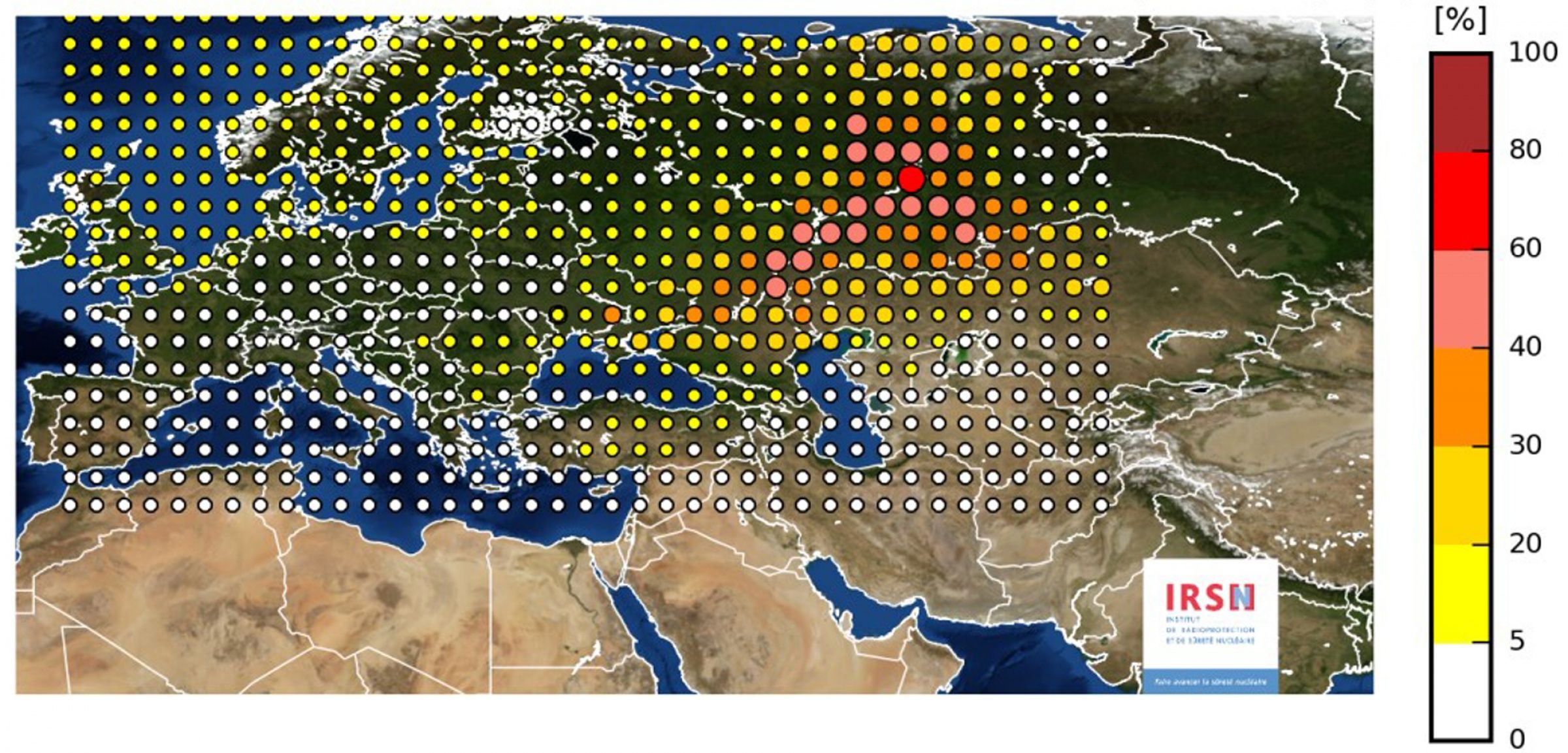
On November 9, the France Nuclear and Radiation Safety Institute (IRSN) published the results of computer modeling based on data about the weather and direction of the wind in late September and early October. According to the release, the source of Ruthenenia-106 was most likely in the Southern Urals or in Kazakhstan, the most likely location is the Chelyabinsk region, including Ozersk. IRSN noted that if the release really occurred in this region, its volumes are estimated at 100-300 terabekkels (Terabekkerel is a million million Beckerels). “This, of course, is a lot; If there really is so much, then this is a very serious accident, ”says Medusa expert in nuclear physics and atomic energy, doctor of technical sciences Igor Ostretsov.
On November 11, the Institute of Radiation Safety and Ecology of Kazakhstan said that the isotope leakage is not related. “We have two reactors-in Alma-Ata and in Kurchatov. If there was something, everyone would know about it, ” said the representative of the institute. Russian departments did not comment on the French institute.
Finally, on November 20, the Roshydrometzenter published a ballot about a radiation atmosphere in Russia in September 2017. In particular, there were data on the state with radioactivity in the Chelyabinsk region. It turned out that the samples taken at the end of September in the village of Argayash (25 kilometers from Ozersk and the Mayak) showed an excess above the background by almost a thousand times (76.1 millibeckerls at a background of 0.07 millibeckel), in the village of Novogorni (10 kilometers from Ozersk) - 500 times. At the same time, the ballot contained total data on all sources of radioactive beta radiation (Rutheneniya-106-only one of the many possible).
On the same day, Roshydromet published a new press release in which he cited data on the content of Ruthenenia-106 in the air of the Chelyabinsk region from October 6 to 13 (October 6-the first public message about increasing radiation in Germany). In Argayash, it was exceeded by 986 times, in Novogorno - 440 times. However, this time the department separately noted that the indicators are still 100 - 10,000 times lower than the permissible (according to the standards of Rospotrebnadzor, the average daily norm is 4400 millibeckels per cubic meter). The table, however, contained the phrase “extremely high pollution” opposite data on samples from settlements. Because of this, the media reported a powerful emission of radiation in the Chelyabinsk region. The same topic on November 21 became one of the main in Western media; They directly connected new information with previous messages about the radioactive cloud in Europe in early October.
On November 21, the Russian Greenpeace said that the organization is going to contact the Prosecutor General of the Russian Federation with a request to find a source of Ruthenenia-106 leakage. The Mayak said that the isotope has nothing to do with the ejection. “In 2017, sources from Ruthenenia-106 were not carried out at the Federal State Unitary Enterprise on Mayak, and the Rutheneniya-106 is allocated from the spent nuclear fuel and the manufacture on its basis of ionizing radiation at our enterprise has not been carried out for many years,” the association said. In the Ministry of Natural Resources of the Russian Federation, as in Roshydromet, they noticed that the recorded indicators of the Ruthenenia-106 content are much lower than the permissible norm.
Roshydromet on November 21 issued a special press release, which stated that "increased attention to monitoring data was created by environmental organizations during the formation of their budgets for the next year in order to" increase "their significance in the eyes of the public."
The press service of the Ozersk administration said that, despite the media reports, there is no panic in the city; Interfax noted that on social networks, residents of the city are ironic about a possible leak and offer no one to worry, because "has passed for a month, no one has grown." Andrei Vazhenin, the chief oncologist of the Chelyabinsk region, also advised not to worry to the residents, who explained that Ruthenius-106 "is not a pure carcinogen." Those who still feel concern for their health, Vazhenin advised "watch football and drink beer."
Evgeny Berg