
Translated material
Asteroid guest ʻoumuamua
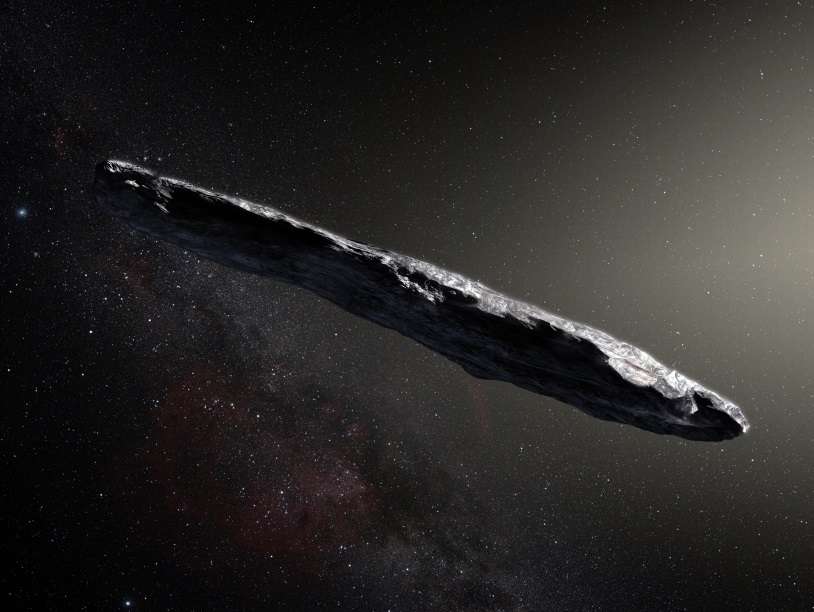
For the first time in history, astronomers discovered an asteroid that came to the solar system from interstellar space. Now he leaves the surroundings of the Sun and will never return, but scientists are sure that such objects often visit us, just before the telescopes could not fix them.
It was discovered on October 19, 2017 by the Pan-Starrs 1 telescope in Hawaii. At this moment, the asteroid was at a distance of 0.2 astronomical units (30 thousand kilometers) from the Earth. At first it was considered an ordinary asteroid, but the calculated orbit parameters showed that the object did not form inside the solar system, but flew into it from the outside. It was considered a comet, therefore, they gave the symbol of C/ 2017 U1 (the element C/ in it indicates the cometary nature of the object). But a little later, the astronomers were convinced that he did not show any signs of cometary activity, although only recently (September 9), the point of his orbit that was closest to the Sun has passed. There was no coma around him (a shell of gas and dust), he did not have a tail extended in the opposite side of the sun. Everyone said that before scientists not a comet, but an asteroid.
As a result, the International Astronomical Union approved a new type of objects - interstellar asteroids. And the asteroid opened on October 19 was the first among them. Now it is denoted by 1I/2017 U1. He also received the official name ʻOumuamua. This word of Hawaiian origin was chosen by Pan-Starrs. According to scientists, the name reflects that an asteroid is similar to a scout or a messenger from the distant past. The word ʻ oh means “stretching your hand for something, getting, striving, achieving”, the word Mua is translated as “first, before”, it is repeated twice to enhance the meaning. The sign at the beginning of the word ʻOumuamua is called in the Hawaiian ʻ ookin and denotes a laryngeal bow-a special sound of the Hawaiian language.
The interstellar asteroid ʻ Oumuamua was observed with the help of a very large telescope of the European Southern Observatory, the Katalinsky heavenly review telescopes (automatic telescopes recorded it even earlier than the Hawaiian astronomers, October 14 and 17, but it was found later), the William Gershel telescope on the Canary Islands.
“I had to act quickly,” says ESO, member of the Olivier Hainut. “ʻOumuamua has already passed the point of the greatest rapprochement with the Sun and was heading back into the interstellar space.” Asteroid became visible and weaker. But astronomers were able to establish its significant characteristics. The orbit has a very great eccentricity equal to 1.196 ± 0.001, this value has never been observed in any object of the solar system. The eccentricity expresses the compression of the orbit. If it is zero, then the orbit of the celestial body is a circle. If it is more than zero, but less than one is an ellipse, and the more eccentricity, the more the ellipses will be extended. With an eccentricity equal to the unit of orbit, it is a parabola, and if it exceeds a unit - hyperbole. Thus, the ʻomuamua moves along hyperbole, and a record gentle. Regarding the sun, its speed is 26.5 kilometers per second. The asteroid was closest to the ground on October 14, when the distance to it was 60 times more than the distance to the moon.
Astronomers found that ʻomuamua has a very elongated form. The ratio of its long and short axes is at least 5.3 to 1, and possibly much more. The length of the asteroid is at least 400 meters. Some researchers believe that it can be a contact double object , that is, consist of two main masses connected to each other. Such types of objects include, for example, the comet Churumov - Gerasimenko.
Its Albedo is about 0.1, which is comparable to Albedo Mars and Mercury. However, combining the images of an asteroid received on VLT with a FORS receiver in four different filters, with images obtained on other large telescopes, a group of astronomers under the leadership of Karen Mich's Institute of Hawaii University discovered that ʻomuumuamua was changing the brilliance ten times, rotating around its axes. With a period of 7.3 hours.
The telescope William Gershel was able to record the spectrum of ʻomuamua. The asteroid turned out to be a dark red body that did not have pronounced parts on the surface. It is unlikely that water or ice can be present. A similar look is characteristic of objects of the Kuiper belt and asteroids of the spectral class D , which probably also come from the Kuiper belt.
It is assumed that the space traveler flew out of one of the star systems of the star association in the constellations of the keel and pigeon (Carina-Columba Association) about 45 million years ago. He approached us from Vega. About 1.3 million years ago, he perhaps passed the TyC4742-1027-1 star at a distance of 0.16 parsec, but it could not come from its system, since its speed is too high. One hundred years ago, he was at a distance of 561 ± 0.6 of the astronomical unit (84 billion km) from the Sun. Its speed, as already mentioned, was 26.5 kilometers per second. As he approached the Sun, he accelerated until he went through the perihelia, where his speed reached a maximum of 87.7 km/s. Then she began to fall again. At the time of detection, the asteroid flew at a speed of 48 km/s. In the end, its speed return to the previous value of 26.5 km/s. Now ʻOumuamoa leaves the solar system so that he will never return here. He goes towards the constellation Pegas.
Astronomers believe that interstellar asteroids fly through the internal region of the solar system about once a year, but since their brilliance is very weak, it has not yet been possible to see them. Only after the rather powerful wide-angle sightseeing telescopes, such as Pan-STARRS, such objects became available for observation. So, perhaps, ʻomuamua will not be the last open interstellar asteroid. “We have long suspected that these objects must exist, because during the formation of planets from planetary systems a lot of material is thrown away,” says Karen Mich,
Research results are published in Nature, briefly reported in the ESO press release , in the news of Science and Nature sites.