
Translated material
We will go for a blue bird with a long string
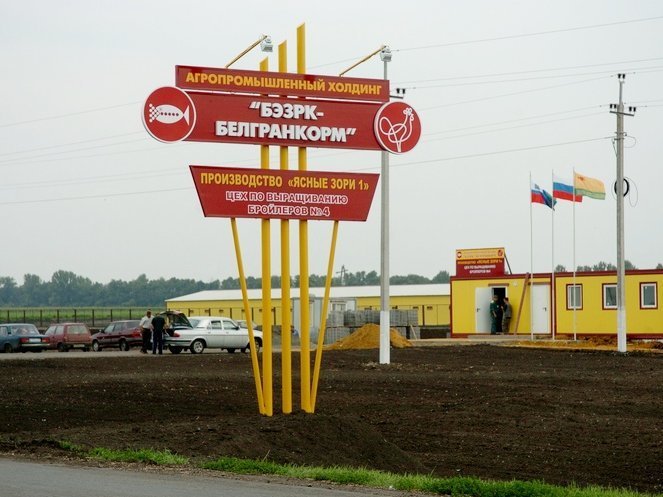
 Photo: Abireg.ru Abireg.ru
A year ago, President Vladimir Putin instructed to create a system of support for non -resource exports. “Already according to the following results, 2017 we must have an effective, effective system for supporting non -resource exports and environmental programs, see the real results of its work,” the head of state said at a meeting of the Council for Strategic Development and Priority Projects. The government was instructed to "pay special attention to the financial support of these initiatives, as well as all other priority projects." One of the strategic areas of exports was announced by the products of the agro -industrial complex.
Russia has long taken a leading position on the supply of grain to the world market. The second most important export product could be a bird, because Russia is already one of the five largest chicken producers in the world. According to the Agrostnik portal, in 2016, the production of poultry in the country exceeded 4.6 million tons in slaughterhouses. As experts expect, according to the results of 2017, it will reach 4.9 million tons and if in the early 2000s there were 50% chicken, now the poultry farms provide the domestic market by 98%.
The production increase slows down, and it is simply necessary to increase supplies abroad. This is facilitated by an attractive ruble exchange rate towards the dollar and the demand for chicken from a number of countries. Currently, the chicken in Russia is cheaper than in China and the USA (although much more than in Brazil).
Great hopes
According to the Agrostnik portal, in 2016, Russian poultry farmers sold more than 100 thousand tons of products abroad. It is expected that by the end of this year exports will reach 152 thousand tons (165 million dollars). But back in 2007, only 0.8 thousand tons were sold abroad. Basically, domestic agricultural holdings supply their chicken in close abroad. You can become a serious exporter only by mastering new sales channels.
The countries of Asia, Africa and the Middle East, which are ready to purchase significant volumes of Russian chicken, could become the leading area of exports. Large poultry complexes have already begun to sell chicken in Egypt, Iraq, the United Arab Emirates (UAE), Vietnam (mainly offal there). However, there is no need to talk about any large-scale export.
The manufacturers themselves, representatives of the Rosselkhoznadzor, officials of other departments are constantly talking about the successes in establishing the export of chicken. Regularly in the media there is information about how one or the other enterprise has concluded a contract for the sale of chicken. In fact, there are no serious bird exporters in the country. Work for export involves strict compliance with production standards, and work with Muslim countries imposes additional obligations. In addition to the high quality of the meat itself, it is necessary to ensure the conditions of production according to Muslim canons. However, the problem is that even large manufacturers are not ready to work in the foreign market.
So, the attempt by Belgrand Kormam LLC enter the markets of the Arab countries turned into a failure. The Belgorod company is one of the leading chicken manufacturers in Russia. According to independent experts, it takes fourth place in terms of production. True, Belgrand Kormam itself puts itself on the third line. According to the company's website, last year Belgrand Kormam produced 282 thousand tons of broilers, the company sells its products under the current year. The company sells its products under the stamps of “clear dawns”, “halal”, “rural traditions”, “chicken king”, which are represented in almost all retail chains of the country.
It seemed that Belgrand Kornma had everything in order to become a serious exporter: modern equipment, capacities capable of providing production growth, the ability to adapt the product to the requirements of new markets and, most importantly, the halal certificate. In March 2016, Belgrand Kormam concluded an agent agreement on promoting chicken with Agroimpex. Agroimpex became an exclusive representative of export issues to the countries of the Middle East and North Africa (the UAE, Iran, Iraq, Kuwait, Saudi Arabia, Yemen, Oman), pledged to analyze the market in the agreed territories, to look for customers, to conduct pre -contractual negotiations, to coordinate the conditions of supply ... By the beginning of September, the agent received proposals from the UAE, the agent received proposals from the UAE, Iraq, Egypt for supply from 100 to 2000 tons per month of frozen carcasses of halal chicken. It soon became clear that the company has no permission to sell chicken to Arab countries.
On the website of the Rosselkhoznadzor, Belgrand Kormam was listed in the list of enterprises that passed veterinary and sanitary survey for compliance with the requirements of the UAE. At the same time, back in February 2016, the company received letters from the Rosselkhoznadzor and the Russian Embassy in the UAE with information on changing the procedure for accreditation and certification of chicken. A commission of the importer country should come to the enterprise, check production and draw conclusions about its compliance with national quality standards and halal standards. Moreover, the expenses for the arrival and acceptance of the commission should be incurred by the enterprise itself. With a positive decision, the manufacturer will receive accreditation and will be included in the register of the UAE exporters.
It is worth noting that every Muslim country has its own rules for admission of products. For example, supplies to Egypt do not require accreditation, the presence of a local Halal certificate is enough. But Egyptian inspectors check each batch export exported. It happens that accreditation of one Muslim country can be recognized by others. For example, if there is an UAE certificate, you can sell a bird, for example, in Kuwait or Bahrain.
Belgrand Korkram provided its agent with the entire list of the existing sanitary and technical documentation for chicken, including the Halal certificates for production and massacre issued by the International Center for Certification and Standardization of the Halal under the Council of Muftis of Russia for the first stage of accreditation. Agroimpex translated documents at its own expense, posted them on the website of the Ministry of Climate and the Environment of the UAE, paying the fee for the manufacturer (which is paragraph two of the dawn of hystration). And Belgrand Kormam sent a guarantee letter to the agent, taking on obligations to reimburse all expenses.
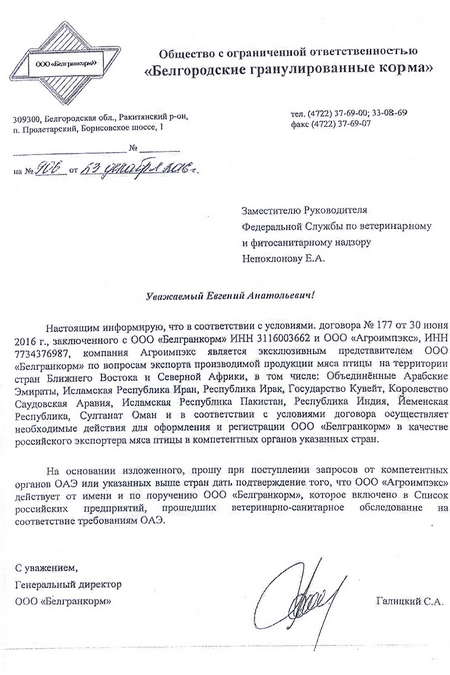
While the procedure for registering and preparing the arrival of inspectors was underway, the agent continued to analyze possible sales markets, trying to receive intelligible offers from the manufacturer about how many products and how long they are ready to supply. Representatives of Belgrand Kornma replied that they would provide information on request.
An unleaser bird
In January, a commission of the Ministry of Climate Changes and the Environment came to the Belgrand Kormam factory. And she issued a verdict: production does not correspond to Muslim canons. Claims are described in detail in the acceptance certificate in five points. For example: the commission was surprised that in the presence of individual halal and non -cherry shops, both types of products are spent on the same warehouse.
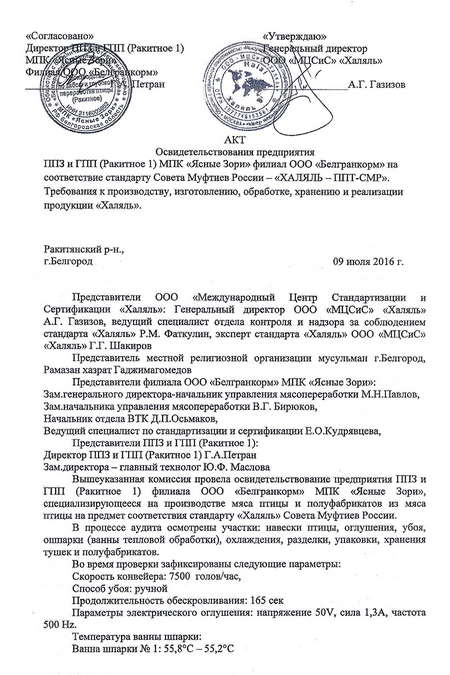
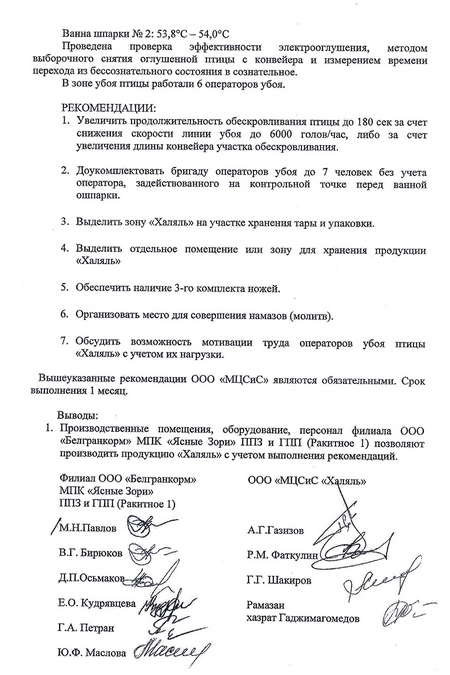
The situation is very strange, because in 2015 Belgrand Kornma was issued a certificate of the International Center for Certification and Standardization of the Halal under the Council of Muftis of Russia. In July 2016, the enterprise was checked by the Commission of the Center and representatives of the local religious community. An act was drawn up with recommendations to eliminate the identified violations. A separate line spells out: production, equipment and personnel allow producing “halal” taking into account the implementation of recommendations.
A number of questions arise. What did the manufacturer count on, who had enough time to rebuild production to the necessary standards? What kind of product under the Halal brand was sold to Russian Muslims all this time? And finally, what chicken is offered to consumers of non -cherry products? After all, the claims of the Arabs were not limited only to the religious component.
In the act of acceptance by a separate item, it is noted that Belgrand Kornma products do not meet the requirements for confrontation between falsification and giving false information during trade and commercial operations in terms of providing information about the content of all additives and solutions in cheese meat. Simply put, an unknown, not indicated on the marking and label, fluid is injected into the chicken to increase weight.
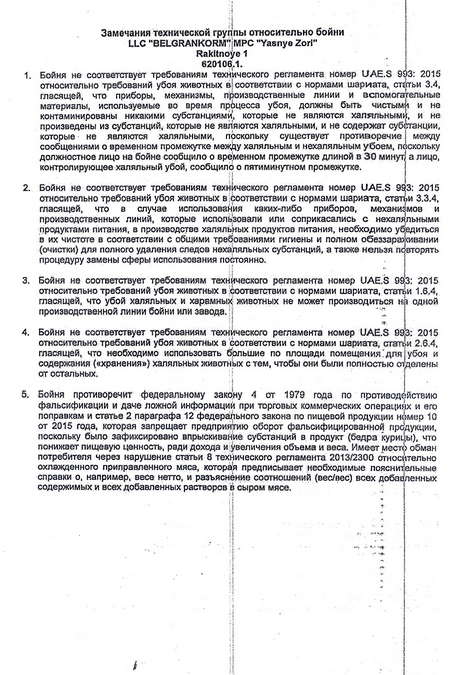
According to representatives of Agroimpex, automated equipment for pumping carcasses of Arabs saw with their own eyes. Factory workers tried to convince the inspectors that the liquid was injected only into carcasses intended for a local buyer, and no one was going to “pump up” export chicken. But, probably, it is difficult for the Arabs to understand the psychology of the domestic manufacturer, and they rightly believe that there is an apparatus, and he can work in both markets. As a result, the commission refused to allow Belgrand Koram in the UAE. Earlier, Belgrand Kormam tried to receive a certificate for the export of chicken in the EU. However, the European Commission revealed the inconsistency of products to European quality and safety standards.
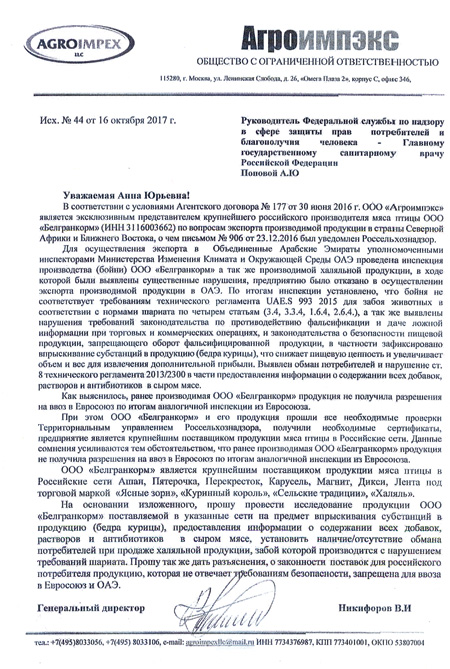
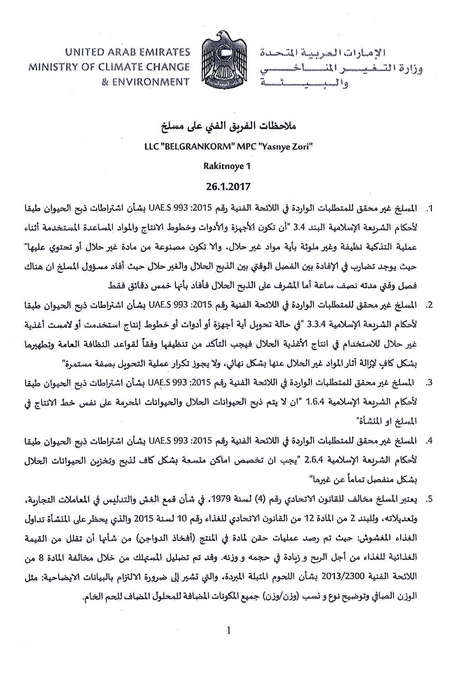 Conclusion of the Commission of the Ministry of Climate Changes and the Environment of the UAE
It is worth noting that Belgrand Korma already fell into scandalous stories in the domestic market. For example, in March, Rosselkhoznadzor, as reported by RBC (05/25/17), discovered an antibiotic Furazolidon in Kargill's chicken nuggets, which supplies products in McDonald's. Then the cutlets were studied by the central scientific and methodological veterinary laboratory. Also, an antibiotic was found in a frozen chicken fillet, in addition, the chicken was teeming with salmonella. It was Belgrand Kormamm that supplied the chicken for processing at Kargill. The head of the Kargill representative office in Russia, Elena Zasimova, then sent a letter addressed to the head of Rosselkhoznadzor Sergey Dankvert, in which she said: “Belgrand Kormam” did not declare the use of antibiotics in its production, therefore, control of the contents of Furazolidon in each batch of raw materials from this supplier was not carried out.
I'll leave you
After the refusal of Arab inspectors to certify production, the agent repeatedly sent letters to the Belogorodsky poultry people with a request to eliminate the shortcomings for the re -commissioned commission, as well as provide a competitive price and information about possible supply volumes. In response, the manufacturer sent assurances in the interest of exports. The agent repeatedly registered Belgrand Korm on the website of the Arab Ministry, once again paying a fee.
From the very beginning, Agroimpex informed the manufacturer about the price requested by the importer: $ 1.35–1.4 per kilogram (for example, Cherkizovo and Resource, at the same period, sold the chicken in these countries at the same price). The vacation price of Belgrand Kornma for the domestic market was about 80 rubles. per kilogram, including VAT (when exporting VAT is returned). At the same time, the cost of carcasses at the time preceding the signing of the agreement was 50-60 rubles. per kilogram (at a dollar exchange rate 76–79 rubles). Probably, Belgrand Korkram hoped for a further fall in the ruble and the ability to earn much more than in the domestic market.
The company began to persistently offer its delivery price: 140 rubles, that is, about $ 2.35. Representatives of Agroimpex tried to explain to the households that a constant market price was formed in each country, that when exporting, VAT is returned in the amount of 10% and even, trading in cost, it can be benefit that they earn not on high margins, but on the volume. shipped products and stability of supplies.
As a result, Belgrandorsm refused not only to work on export, but also to reimburse expenses to his agent. The manufacturer filed a lawsuit in the Arbitration Court of the Belgorod Region on the recognition of an agency agreement invalid. Probably in this way the manufacturer demonstrates its inability to provide quality products for export. After all, it is much easier to work on an internal buyer.
Meanwhile, the lawyers of the Agroimpex indicate paragraph 1 of Art. 1005 Civil Code. It says: under an agency agreement, one party undertakes to commit legal and other actions at the expense of the principal on behalf of the other party (fundamental) on behalf of the other party. In total, Agroimpex spent about 20 million rubles on the fulfillment of obligations under an agency agreement. At its expense, the company studied potential sales markets (for which I had to equip the staff with specialized specialists, remove the office), registered with three foreign electronic specialized trading floors, negotiated with the leadership of the Rosselkhoznadzor, the Ministry of Economy of the UAE, participated in international exhibitions, translated materials to Arabic and English, and made up the analysis of logistics routes Exports, registered the company on the website of the Ministry of Climate and the environment of the UAE, paid for the flight and accommodation of inspectors, the services of translators-synchronists.
Stabilizers, antibiotics, plague
The story with Belgrand Kormrom makes us once again think about the quality of the products sold in our stores. Constantly the consumer market shake various kinds of scandals. Independent laboratories and official inspection bodies often find harmful substances in food. In pursuit of profit, unscrupulous manufacturers use any tricks, just to increase the weight of the goods. At the same time, current mandatory standards in Russia prohibit the content of stabilizers, emulsifiers, fillers and thickeners in poultry meat. Including this applies to phosphates and polyphosphates - polymers of phosphoric acid, which perform the functions of a moisture -holding agent. It is not clear how these extra ingredients affect our body.
In the chicken, traces of antibiotics are periodically found, which causes the concern of doctors. Of course, the use of various drugs when growing a bird is a necessary step. Chicken disease is a terrible thing, because one day the whole bird can fall. Previously, feed antibiotics were used in industrial poultry farming, including on the basis of tetracycline. Today their use, as well as stimulants and anabolics, is prohibited in Russia. However, in fact, it is impossible to determine what medicines, in what quantities the bird was fed and how long it lasted-all his life or it stopped a while before slaughter so that the drug leaves the body.
Animals can feed the same drugs that give a person. Doctors limit the use of antibiotics in the hospital, prescribe them strictly according to the prescription in the clinic, but together with the chicken, a person receives the same medication, only blindly. With a real disease, a medicine that regularly enters with food into the human body will no longer act. You can only guess about the scale of the problem.
In mid -November, the State Duma adopted a law according to which the Rosselkhoznadzor receives the right to consider cases of administrative offenses in the field of circulation of medicines for veterinary use. Then the State Duma speaker Vyacheslav Volodin instructed the relevant committees of the lower house of the parliament to develop a position on the introduction of the necessary measures when using antibiotics in animal husbandry. According to the market participants, it is necessary to create a single electronic system for controlling antibiotics in animal husbandry: what kind of antibiotics this or that manufacturer uses in which volumes purchases drugs, where the finished product prepared from meat or milk, it may be worth indicating on the label the name of the antibiotic that was treated by the animal.
Two organizations are engaged in the quality control of products in our country: Rosselkhoznadzor and Rospotrebnadzor. The first checks and certifies directly production, the second - checks the finished product at retail outlets. In addition to scheduled inspections, Rospotrebnadzor reacts to consumer complaints. Officials constantly say that in Russia quality standards are no worse than in Europe (in particular, some antibiotics, growth stimulants, anabolics are not allowed, and a ban on the use of chlorine for disinfecting the bird is introduced).
Why do manufacturers create what they want? Because the quality of the product in our country is poorly controlled. Today, each large enterprise has acquired its laboratory, there are many independent laboratories in the country where you can check the products. At the same time, as noted by market participants, only in the head structure of the Rosselkhoznadzor in Moscow there are certified laboratories that can conduct serious tests. It is not only about a detailed test for antibiotics, but also about genetic analysis (allows us to establish the fact of cannibalism, when the birds are filling their own brothers). For example, the use of bone flour (produced from animal bones) when feeding animals is prohibited not only in Europe, but also in Russia. But our manufacturers violate the established standards. And it is almost impossible to check them.
Сложилась весьма странная ситуация – пищевые предприятия контролируют сами себя, а ведомство, которое должно строго следить за качеством продуктов, не только не имеет необходимых ресурсов, но и, вероятно, закрывает глаза на серьезные нарушения. Никто толком не знает, что творится в регионах. Информация просачивается в прессу только тогда, когда скрывать ее становится невозможно.
Например, неделю назад произошел очередной крупный скандал. Руководитель Россельхознадзора Сергей Данкверт обвинил ветеринарную службу Тюменской области в сокрытии факта вспышки африканской чумы свиней (АЧС) в регионе, а также ее распространения за пределы области. Ранее власти Тюменской области сообщили о выявлении очага АЧС в Исетском районе и уничтожении около 16 тыс. свиней на ООО «Комплекс» в селе Шорохово и поголовья свиней в личных хозяйствах в радиусе 5 км. Появились сообщения и о вспышках АЧС в Курганской области и Ямало-Ненецком автономном округе, которые покупали продукцию у «Комплекса».
«По нашим данным, ветеринарная служба Тюменской области скрывала развитие африканской чумы. Мы думаем, что болезнь начала распространяться в области в 20-х числах октября. Ситуация усугубляется тем, что «Комплекс» две недели работал и отправлял продукцию сотням потребителей, например на изготовление пельменей, – сказал Сергей Данкверт. – Мы, со своей стороны, подключили к работе региональное управление Роспотребнадзора, так как уже речь идет о готовой продукции. Все органы исполнительной власти должны заниматься выявлением, изъятием и уничтожением этой продукции. Мы пишем письмо в Следственный комитет и Генеральную прокуратуру о возбуждении уголовного дела по факту сокрытия и распространения африканской чумы. Люди умышленно отправляли в другие регионы зараженное мясосырье, и непонятно, как ветеринарные врачи это допустили».
Пока надзорные органы всячески скрывали проблему, зараженная продукция могла разойтись сотням мелких предприятий. Для человека болезнь опасности не представляет. Но ведь кто-то мог накормить чумными пельменями домашних свиней, которые разнесут заразу по округе, и она вполне может перекинуться на промышленные свинофермы.
Вернемся к «Белгранкорму». Производитель рассчитывал хорощо заработать на экспорте, рассчитывая на то, что в арабских странах не особо заморачиваются качеством и безопасностью продуктов. Между тем выход даже на арабский рынок чреват серьезными издержками, которые отечественный производитель нести не желает. Издержки несет внутренний потребитель. Ценой собственного здоровья.
Примечательно, что предприниматель В.Никифоров, к примеру, сам – не благодаря Минсельхозу – а за собственные средства на собственной энергии и авторитете создал контракт, совершив невозможное – потеснил на рынке традиционных поставщиков-бразильцев .