
Translated material
Putin's order to the defense industry
Russia returns to the mobilization economy of the Stalin type
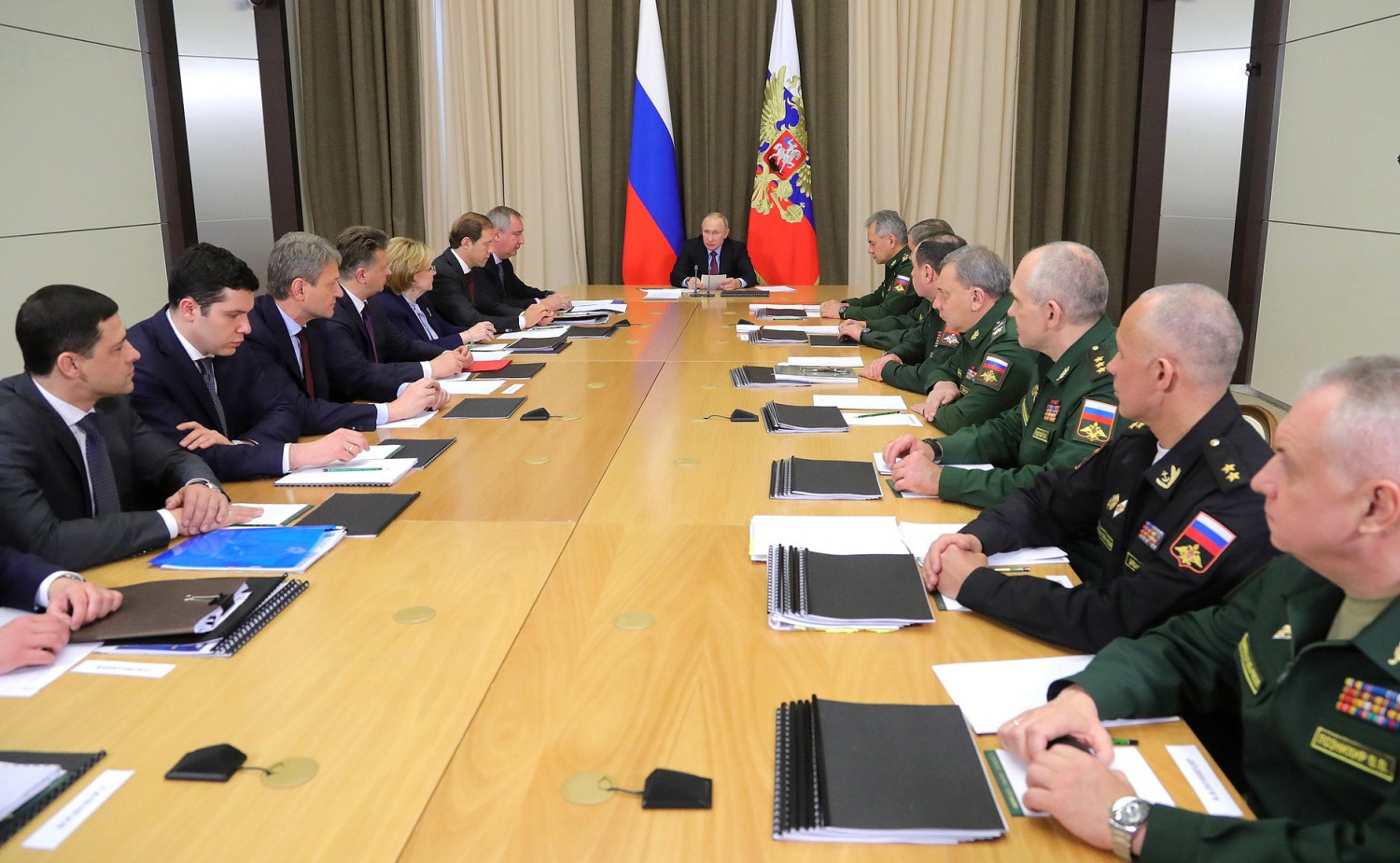
A meeting with the leadership of the Ministry of Defense, the military-industrial complex, the heads of ministries and regions, Sochi, November 22, 2017. Photo: kremlin.ru
On November 22, it has every reason to become the black day for Russian business. Meeting with the leaders of the Ministry of Defense and the military-industrial complex, Vladimir Putin said: “The ability of the economy to quickly increase the volume of defense products and services at the right time is one of the most important conditions for ensuring the military security of the state. All strategic and simply large enterprises should be prepared for this, regardless of ownership. ” If the head of state seriously spoke and, most importantly, understood what he was saying, this actually means the beginning of the end of the market economy in our country. This means that Russia is returning to the mobilization economy of the Stalinist type.
It is appropriate to recall that the goal of the Stalinist industrialization was not at all the desire to bring the country to the “advanced borders” or, God forbid, increase the well -being of the subordinate population. The goal was to provide the armed forces with the necessary amount of military equipment. Factories and factories were created as if for the production of civilian products, but in the so -called “threatened period”, on the eve of the war, they had to very quickly switch to the production of cartridges and shells, tanks and aircraft. It should be recognized that this concept justified itself during the Great Patriotic War, allowed to deploy military production in the shortest possible time and, by the beginning-mid-1942, bypass Germany to issue the main types of weapons.
However, following this concept was one of the main reasons for the collapse of the Soviet economy in the 1980s. After all, enterprises were doomed to create parallel backup line lines, to contain not only them, but also an excessive number of personnel. The industry was supposed to unify the main components and nodes in such a way that they were good for both military and civilian products. Roughly speaking, the details from the Minsk refrigerator were supposed to be suitable for different nodes of atomic submarines, and the details of the Muscovite for infantry fighting vehicles. Moreover, gigantic reserves of strategic materials were created in advance to ensure the operation of industry during the war. But some production, such as aluminum, is continuous, they cannot be stopped. As a result, the USSR received a huge amount of unnecessary metal, which was forced to use for the manufacture of dishes.
In the 1980s, industry regularly issued thousands of tanks, aircraft and missiles, and the state could no longer pay. The civilian production market was too small, and the cost of export oil and gas fell catastrophically
The implementation of the concept of industrial mobilization turned into gigantic imbalances in the economy. Indeed, one way or another, the cost of military production “for future wars” was introduced into the cost of already produced civil goods, not to mention the fact that unification of the units had a catastrophic influence on the consumer properties of these goods. One of the most important functions of the state plan was artificial balancing prices in order to achieve at least the likeness of the profitability of production, weighed down by “mobilization tasks”. At the same time, the director of the plant knew very well that for a civilian production failure he would only scold him, but for disrupting the production of military products you can put a “party card”. In the 1980s, industry regularly issued thousands of tanks, aircraft and missiles, and the state could no longer pay. The civilian production market was too small, and the cost of export oil and gas fell catastrophically.
This system was doomed to collapse in a market economy after the collapse of the USSR. Private owners could not pay for the content of mobiles. As a result, a complex chain of production cooperation (for example, the production of the Su-30 fighter required one and a half thousand components that were made in “civilian industries”) also collapsed safely. That is why in the 2000s, when, as a result of an increase in oil and gas prices, the state had money for the production of weapons, industry was torn by the defense order year after year. Private manufacturers, as features from incense, fled from extremely unprofitable defense production. Indeed, in order to make several hundred components, they needed to contain separate workshops and stream lines for their money. The way out was in the creation of specialized military production, when all components would be made at the final assembly factories, which repeatedly increased the cost of products. It is in the way as you can understand that the manufacturer of the Almaz-Antei air defense systems and the main manufacturer of military aviation, the unification of KNAPO in Komsomolsk-on-on-Amur went. It is clear that such an approach made their "products" literally gold. Only foreign contracts allowed them to stay afloat.
However, in the context of the economic crisis and reduction of foreign orders, this scheme has ceased to work. And then, if Putin’s words are seriously accepting, they decided to return to the model of the mobilization economy again. That is, to ensure that, with the help of non -economic measures (relatively recently, the Duma has already acted with initiatives to introduce criminal punishments in relations of those businessmen who refuse to fulfill the defense order) to force industry to ensure military production. It is not difficult to predict the consequences. If new mobzations are distributed with all proletarian determination, then at first this will increase corruption costs many times. Private entrepreneurs will try to pay off the Ministry of Defense officials. And since after a short time it turns out that the production of military products for some reason is not growing, proposals for the nationalization of “strategically important” industries will follow (if you wish, all industry can be subjected to them) and the reconstruction of the state plan. Another step will take to turn the country into a single military camp, surrounded by evil enemies.
If new mobzations are distributed with all proletarian determination, then at first this will increase corruption costs many times. Private entrepreneurs will try to pay off the Ministry of Defense officials
With this approach, it is more pointless to discuss that the inclusion of the entire industry in the system of the military-industrial complex matters only in the presence of armed forces based on the concept of mass mobilization. When millions of reservists who have received military training during the call service are called under the “threatened period” under the gun. But more recently, Vladimir Putin stated that one of the Kremlin’s goals is the transition to a professional army. Which, we note, is primarily caused by a bad demographic situation-the age of 18, annually reaches no more than 650 thousand young men, and this will last at least until 2030. This means that the draft resource in Russia is very small - to serve, there is simply no one. For whom, one wonders, to conduct mass production of military equipment. Moreover, the experience of the latest wars says that the conflicts of the future will be fleeting: no one will have time to call back reservists, nor to make weapons for them.
Most likely, explaining their failures, the OPC captains complained to Putin about private manufacturers, and someone recommended that he recall the Stalinist recipes ...