
Translated material
Memory. Alexander Sumarokov
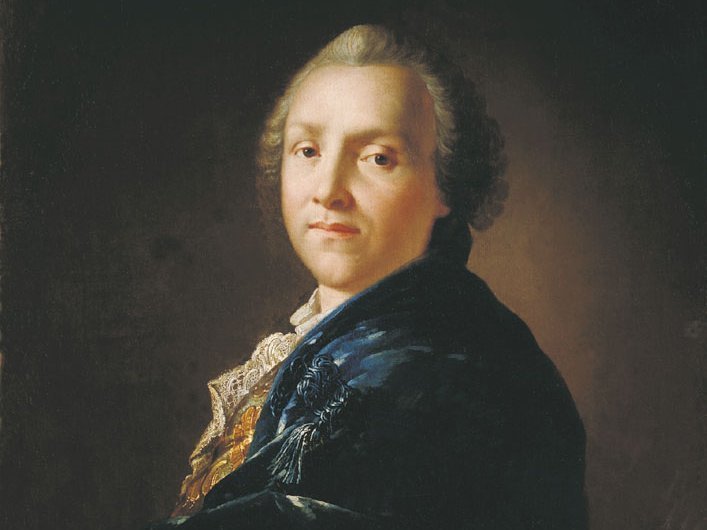
On November 25, 1717, the poet and playwright Alexander Sumarokov was born.
Personal business
Alexander Petrovich Sumarokov (1717 - 1777) was born in the Finnish city of Wilmansstrand (now Lappeenrant), where his father, officer of the Vologda Dragoon Regiment served at that time. He received a thorough home education, then he was sent to study in a land gentry cadet corps. After graduating from the corps in 1740, with the rank of lieutenant, he was enrolled in the service in the Military Council of Count Minikh, then he was promoted to captains and became the adjutant of Count Alexei Razumovsky. At the end of 1745, already in the rank of Major Sumarokov, he was appointed head of the Life Company’s office-a privileged grenadier company of the Preobrazhensky regiment, where the participants of the Palace Revolution of 1741 served, when Elizaveta Petrovna came to power. The company was engaged in the protection of the empress and members of the imperial family. As a result of their special situation, the Life-Companials were distinguished by "extreme licentiousness and almost a complete lack of discipline." Sumarokov’s efforts to strengthen discipline led to numerous conflicts.
Already studying in the Cadet Corps, Alexander Sumarokov began composing poetry. He read the work of Tredyakovsky “a new and brief way to compare Russian poems” and became a supporter of the new system of Russian versification-Sillabo-Tonic. He shifted the poems of the psalms, wrote songs, imitating Tredyakovsky and French poets, composed two congratulatory odes to the release of the Empress Anna Ioannovna to release. In the future, he combined active literary activity with the service.
In 1751 he received the rank of colonel, in 1755 - a foreman. Since December next year, simultaneously with the military service, he begins to fulfill the post of director of the Russian theater in St. Petersburg, created shortly before that on the basis of the Yaroslavl troupe Fedor Volkov. In 1759, Sumarokov began publishing the first Russian private magazine "Hardworking Bee". The magazine was published once a month. The feuilletons and satirical articles published in the “hardworking bee” Sumarokov caused discontent in the literary environment and the nobleman. The supervision of the magazine intensified and, releasing twelve numbers, Sumarokov stopped the publication.
In 1761, Sumarokov resigned to engage in exclusively literary and theatrical activities. In 1769 he moved to Moscow. He returned to St. Petersburg in August 1773 for the troubles of publishing his works and the production of plays at the court theater. The last years of Sumarokov’s life were overshadowed by the disease (he gradually began to blind) and financial troubles. Quite at the beginning of his life, he was too wasteful and did not treat the housekeeping with due attention. To pay off debts, he sell the library. In 1774, the creditors did not allow him to leave Petersburg, Sumarokov was able to return to Moscow only in January 1775. On September 29, 1777, his house was sold in Moscow. Three days later, Alexander Sumarokov died.
What is famous
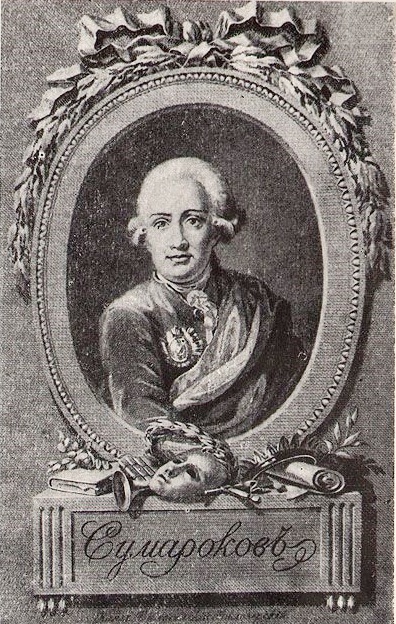
The literary heritage of Alexander Sumarokov is vast. In addition to many poems in a variety of genres, he composed nine tragedies, twelve comedies, two operas, arrangements of all biblical psalms (some in two versions). He perceived his literary work as the enlightenment of his readers - nobles, who were supposed to learn good morals by literary examples. It was the enlightened nobility that he considered the basis of the ideal society.
Sumarokov also acted as a conductor of the ideas of European culture in Russia. He sought to create samples of works of all genres, as well as introduce readers to the cultural achievements of Europe. To solve the last problem, he, in particular, published an abbreviated translation of the Boailo treatise “Poetic Art” under the name “Epistol about poetry”, where he spoke about more than twenty classics of world poetry in the notes (“Shekespir, Aglian tragic and comedian, in which there are very thin and extremely good. 23 days of April, in 1616, for the 53th centuries, for the 53th centuries, for the 53rd centuries, for the 53rd centuries. his "). He translated the works of Voltaire, Cornell and Racine into Russian.
The exemplary poet-classicist, Sumarokov was inferior in the perception of contemporaries Lomonosov in works of high style, but he owns many successful discoveries in verses of medium and low genres: songs, fables. Sumarokov’s experiments in a simple syllable, which were much closer to the everyday speech of the nobles of his time than similar works of Lomonosov and Tredyakovsky, were the harbingers of the stylistic reform of Karamzin and his followers.
What you need to know about
Alexander Sumarokov easily made his enemies. Not only in character, he was very proud and hot -tempered, prone to outbreaks of anger. Also, being a noble nobleman, he despised people of lower origin, although those, by virtue of his rank, had power. Such views only worsened his relationship with censors and theatrical authorities. It would seem that his position was to intend after the reign of Catherine II, which he sang in the “labor bee” even before she became the empress. But Catherine did not like Sumarokov’s satirical poems too critical for the authorities. Later, Catherine's attitude towards the poet completely deteriorated because of his reviews about the “penalty” of Catherine II. Sumarokov managed to quarrel with his relatives, he was almost deprived of the right to manage his property in court.
Direct speech
In height
I am insolent my spirit lifted;
Where arrows cannot fly,
I am looking for myself in the edges of heaven.
I hear the angels asking
And this is the time for the realization:
“The ruler of nature! Sour
Exhaust the scepter of the Ottoman!
Worthy of such a dignity
Catherine on the Earth. "
A.P. Sumarokov “Oda Sovereign Empress Catherine II to capture Khotin and conquest of Moldova”
If the lines with rhymes are called verses.
Poems according to the rules of the wise muses are floating.
The syllable of the songs should be pleasant, simple and clear,
Vitism is not necessary; He is beautiful by itself;
So that the mind in it is hidden and spoke to passion;
He is not a big over him - he has a heart.
Do not make an example from the goddesses
And do not nibble in passion: “I'm sorry, my Venus,
At least to collect the goddesses, you are not more beautiful ",
Tell me, saying goodbye: “Sorry now, my light!
It will not be a day so that I, not the eyes of my dear,
He did not exude from the eyes of his streams of tearful.
Places witnesses of past sweet days,
They will be incorporated in my memory.
I began to torment Luta's thoughts,
And the pleasant minutes ended.
Sorry for the last time and remember how you loved. ”
A.P. Sumarokov "Epistol II"
Sorry, my amiable, my light, I'm sorry,
I was told more well as a hike;
I don’t know if I can see you,
In you, though for the last time, stay with me.
Leave the longing, or mortal rock carried me away?
Do not cry for me, beautiful, do not waste you.
Have a thought to the habit of yourself,
That I will come to you with a victory.
When I die, I will die there with a gun in my hands,
Linge and defending, not knowing that fear;
You will hear that I was not timid in the field,
Fighted with such ardor with which he loved.
Here is a tube, let it get it to you!
Here is my glass, filled with wine;
For all your beauties, you drink from it,
And if you were the heiress only you.
And if I will deserve the halberd there,
With what joy to your eyes I will come to!
As a gift, I will bring shoes sews,
Cuffs, scaled, dandy stockings.
A.P. Sumarokov "Sorry, my dear ..."
My tongue should conquer pretense;
Feel another, to say otherwise,
And I am like abominable Lukavtsy.
Here is the tread, if the king is unrighteous and vicious.
A.P. Sumarokov Fragment from the tragedy "Dmitry Impostan"
I notified that I was sent for the signing of Lomonosov to the State Contractor to Hold my salary of Promemia in order to return the detained treasury for printing my tragedies; And in the afternoon, although I entrust the salaries from the civil lawsuit, however, under the department of the office I don’t, for the sake of this office, to keep my salary of Lomonosov’s sending, I hope, does not favors. And that is Lomonosov, as a person whom I have suspicions on, by the petition of my decrees, as a villain known to me, will be detached from my affairs. This is Lomonosov, perhaps, he accepted the boldness to make such attacks on me because he often goes crazy from drunkenness, that the whole city is known, and (as well), he signed that promotory in his ordinary madness; For the Academy of Reasons does not have to recover money from me with such a manner, even more from state debts, but I have never unlocked from any. I am asking the State Contractor to the Contractor, so that she is not a person who is under his department, for the only one that he receives a salary from her, did not favor; For if the Academy wanted to recover money from me, insulting me so sensitively and me, an honest person, then she would have to write to the wrong place from which I get a salary, but where I am under the department; For always and often crazy Lomonosov can not keep a single half from my salary with his command, even if he was in the whole mind; Because I get my salary according to the capture of her imperial majesty by decree and serve from the beginning of my service immaculately. And he, Lomonosov, did such in the drunkenness of boldness repeatedly, for which he contained a few time under the guard and was detached from the presence of the conference. And that he is not in full mind, in that I am indicated by the rhetoric and grammar composed by him.
Representation to the State Contractor from the foreman Alexander Sumarokov
Sumarokov probably read himself by the Russian Volter and, following the example of his model, attempted to rejuvenate his talent. But if he was deceived in the calculations of author’s vanity, then at least he had something Voltaire, namely his irritability, several of his satirical ardor, which are not at all edifying, but often funny and fascinating. The lawsuit between him and Lomonosov has long been decided, and, with the exception of several witty remarks [from Sumarokov] about our language, there is nothing to learn from the facts of this forgotten lawsuit; But it’s still curious to read them, because Sumarokov’s personality affects them. The same can be said about his war with Tredyakovsky, adding that here the lawsuit was decided by oblivion, forcibly world transaction, with a baptized offspring, which abandoned Sumarokov and Tredyakovsky; But appeals exist. His pamphlets are especially funny against his clerks; Although they are also alien to us in their content, they are precious and now in truth and strength of feeling and in patriotism that is animating them. They no longer tremble with interest, but still awe of anger, but the author’s heat still preserved in them.
P. A. Vyazemsky
8 facts about Alexander Sumarokov
- The only genre that did not succumb to Sumarokov was an epic poem. After his death in Sumarokov’s papers, a draft of the poem “Demitriad” was found, but the poet stopped, writing only one page.
- In 1766, Sumarokov divorced his wife, with whom he had lived in marriage for twenty years. His actual wife was Vera Prokhorova, the daughter of his coachman. In 1774 they got married. Sumarokov had two daughters from his first wife and daughter and son from the second. Vera died five months before Sumarokov’s death, and he, by his own admission, “cried for a constantly twelve weeks.”
- Sumarokov belongs to one of the options for the Azopov fable about the Vorona and the fox.
- Sumarokov composed the play “Hamlet” based on Shakespeare, remaking his tragedy into the play, built according to the canons of classicism. He wrote: ““ Hamlet ”mine, in addition to the monologue in the end of the third action and Klavdiev on the knees of the fall, is hardly like a tragedy on Shekespirov.” The shadow of Hamlet’s father turned into a dream, Claudius, along with Polonia, planned to kill Gertrud and forcibly pass off Ophelia for Claudius, Hamlet turned out to be a man of decisive will and decisive actions, in the final of Gertrud is tonsured in the nuns, Polonium committed suicide, and Hamlet is going to engage in offerent.
- Sumarokov signed the “epistol to Russian warriors” by A. S., which is why many readers suspected that Alexander Suvorov wrote this work.
- According to legend, Sumarokov’s funeral was paid by Moscow theater actors.
- The grave of Sumarokov in the Donskoy cemetery in Moscow was lost already at the beginning of the 19th century. The current monument was erected only in 1951.
- Pushkin called Sumarokov the main merit that “Sumarokov demanded respect for poems” at the time of a neglect of literature.
Materials about Alexander Sumarokov
Article about Alexander Sumarokov on Russian Wikipedia
An article about Alexander Sumarokov in the Encyclopedia "Circumspices"
Works in the library of Maxim Moshkov
Alexander Sumarokov in the IM Werden library
Article of N.V. Zakharov and B. N. Gaidin about Sumarokovsky "Gamlet"